

KUROKABUTO Non-filter Junmai-Ginjo Yamadanishiki
Black kōji, bright citric acidity and a fuller rice core.
Thailand · Product information
Product information from Bacchus Global Co., Ltd., based in Bangkok, Thailand. About Bacchus Global

Black kōji in a sake brew
KUROKABUTO is made with black kōji, an approach more familiar in shochu than in sake. It is bottled without filtration, preserving a generous texture while the kōji’s citric acidity keeps the profile defined.
How it tastes
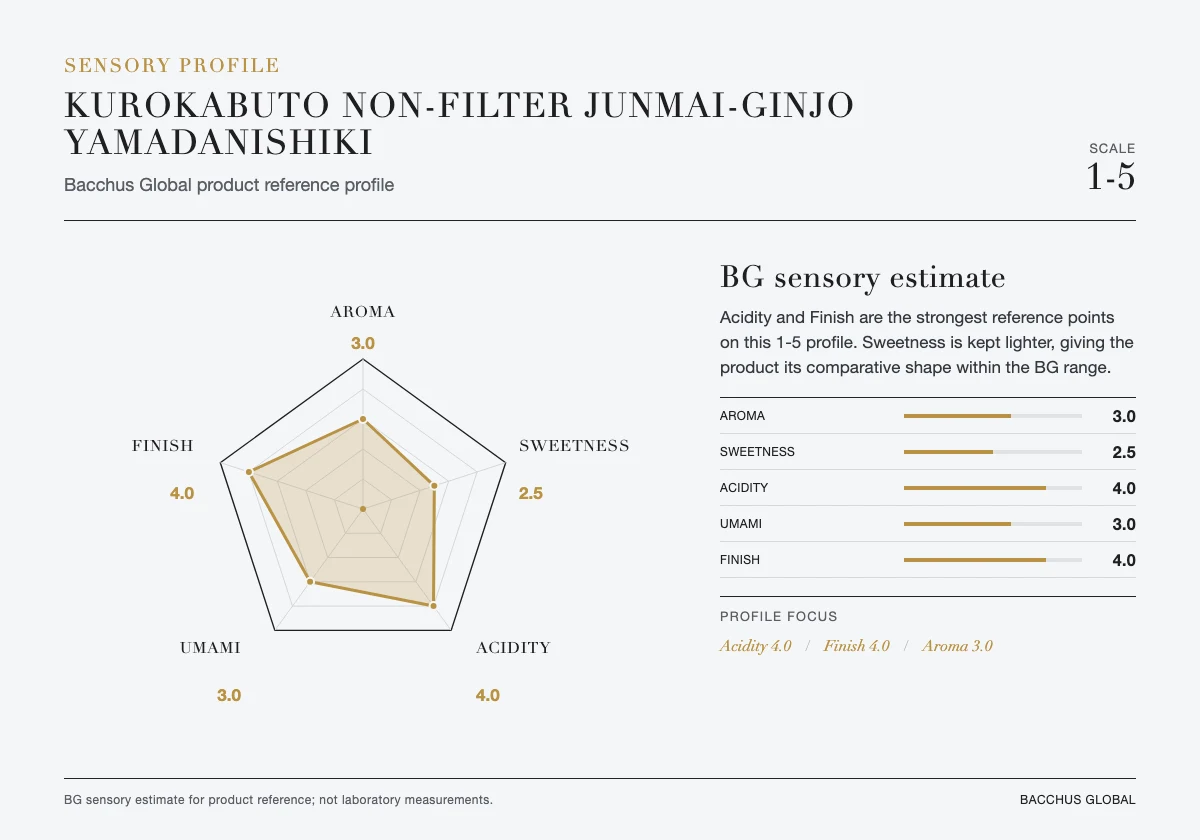
Ripe strawberry and pear sit over a soft, rich rice texture. A lemon-like acidity draws the character through to a lightly savoury, clean finish.
Beneath the black kōji’s citric edge, the rice’s natural richness stays well defined throughout.
Kurume, Fukuoka — since 1875
Ikegame Shuzo was founded in Kurume, Fukuoka in 1875. KUROKABUTO applies black kōji, more familiar in shochu making, to sake brewing for a distinctly citric line of acidity.
Verified for this bottling
Only distinctions attributable to this exact label are shown. Awards for a pasteurised or otherwise different version are not transferred here.
Question 1
Which koji is used in brewing this sake?
- Black koji
- White wine yeast
- Olive yeast
Read the answer and explanation
Correct answer: A — Black koji
Answer: Black koji. The linked section gives the source detail.
Question 2
Which acid is associated with that koji?
- Only lactic acid
- Citric acid
- Only acetic acid
Read the answer and explanation
Correct answer: B — Citric acid
Answer: Citric acid. The linked section gives the source detail.
Question 3
What happens after pressing?
- Ten years in cask
- Immediate distillation
- Bottling without filtration
Read the answer and explanation
Correct answer: C — Bottling without filtration
Answer: Bottling without filtration. The linked section gives the source detail.
At the table
- Fried chicken or tempura
- Grilled meat
- Mushroom dishes
- Thai dishes with moderate spice
Interested in listing KUROKABUTO Non-filter Junmai-Ginjo Yamadanishiki at your restaurant or retail venue? Our team can provide information on availability, storage requirements and trade terms.

