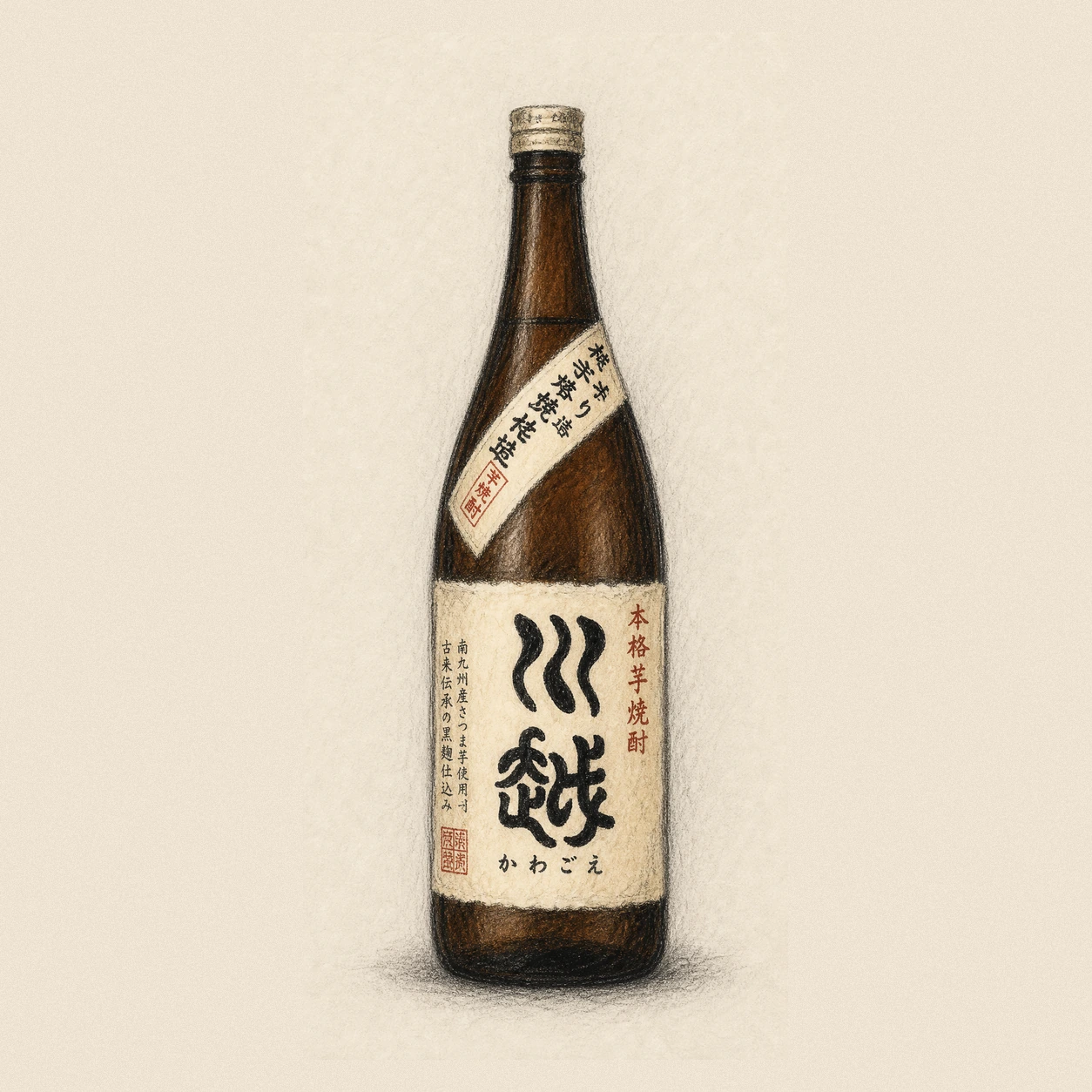
KAWAGOE
Thai rice comes home as Miyazaki shochu. At a 19-generation family brewery, freshly lifted Koganesengan meets Thai rice koji and Taisho-era Bizen ceramic jars — a quietly distinctive connection between Kunitomi and Thailand.
Thai rice, used as koji
Kawagoe Shuzo uses Thai rice for its koji. The 19th-generation master brewer describes the choice simply: shochu’s roots are in Thailand, and Thai rice suits shochu. In Bangkok, that material connection turns a familiar grain into a new conversation — not an embellishment, but part of the making itself.
Harvested in the morning, prepared the same day
Miyazaki-grown Koganesengan sweet potatoes are dug in the morning and prepared on the same day. The first mash is made in Bizen ceramic jars installed in the Taisho era, before atmospheric distillation. The method joins a fleeting raw-material moment with vessels that have remained in the brewery for more than a century.
A family brewery that chooses focus over scale
In an unconditioned brewery, the team manages fermentation with attention to the surrounding air and their own senses. Bottling, inspection, label application and even the cutting of the washi labels are handled by hand. The house limits itself to a small number of labels, treating volume as a boundary rather than the goal.
Four directions connecting Thailand and Miyazaki
What the Kawagoe product page records is not tasting language but the record of how it is made — Thai rice koji, same-day-mashed golden sweet potato, first fermentation in a Bizen-ware jar dating to the Taisho era, atmospheric distillation, and handwork that favors quality over volume. This reads four directions of affinity with food from those four process-level characteristics. This is not a pairing the brewery has officially presented, but a reading drawn from the recorded characteristics.
This pairing rationale draws on the following reference book: Logical Pairing’s idea that flavor can be designed through “harmony” (aromas in a similar direction) or “combination” (different aromas layered together), and on the low iron content of shochu described in Sushi & Washoku Pairing Principles — a trait that lets it sit alongside food without accelerating fishy notes. The Thai-herb direction is a deliberate bridge drawn from a recorded process fact, not a definitive sensory claim.
Kunitomi, Miyazaki — a 19-generation family house
Kawagoe Shuzo is a family-run brewery in Kunitomi, Miyazaki, with roots in the late Edo period. Its 19th-generation brewer, Masahiro Kawagoe, has continued a deliberately small, craft-led way of working. The Kawagoe name was selected for ANA international First Class in 2002, a notable chapter in the producer’s history.
For current-lot specifications, availability, storage requirements and trade terms, please contact Bacchus Global.