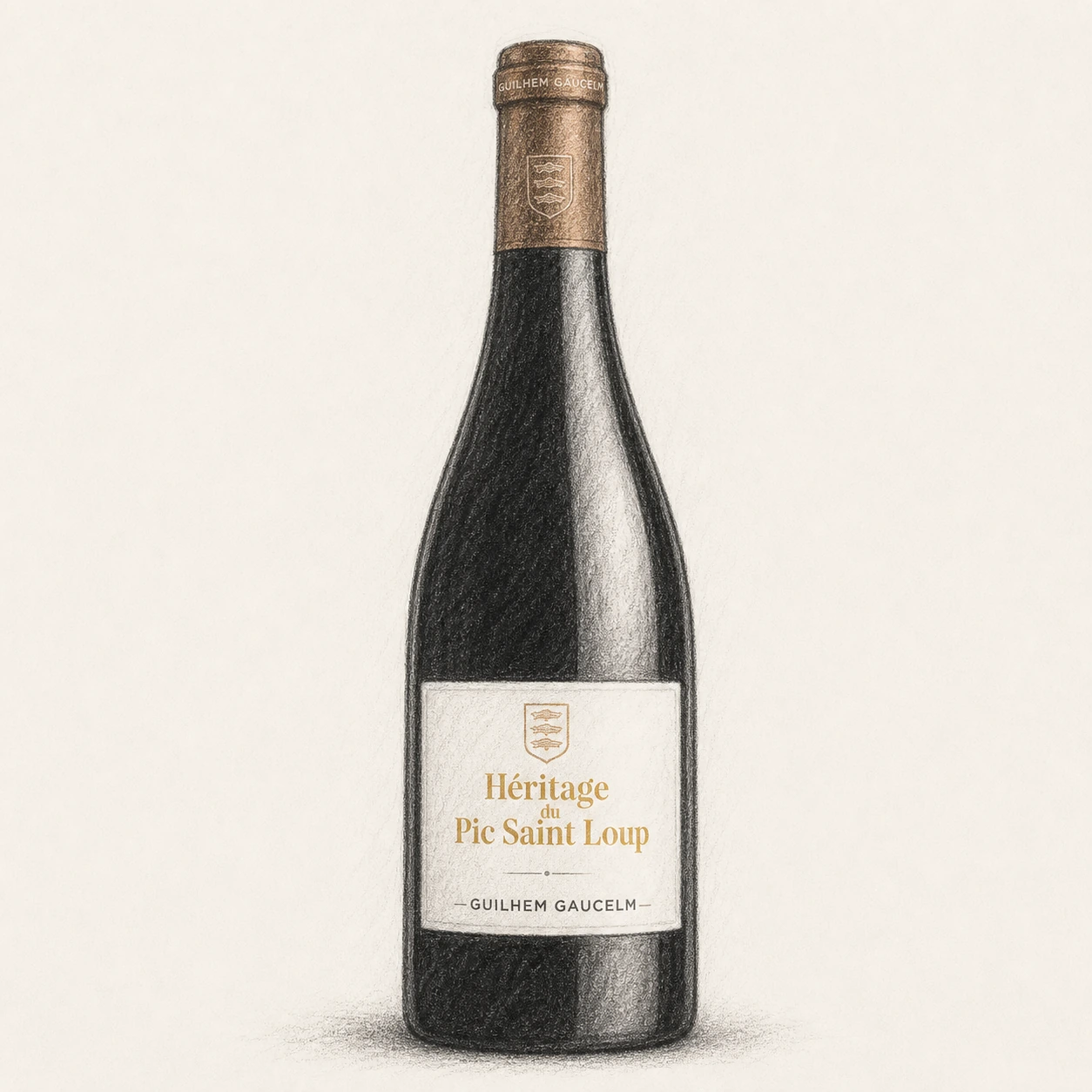
Original bottle illustration — Bacchus Global
AOP Pic Saint-Loup · Languedoc, France
HÉRITAGE DU PIC SAINT LOUPGuilhem Gaucelm 2020
Guilhem Gaucelm takes its name from a steward recorded in 13th-century archives of the Pic Saint-Loup hills, where the Ravaille family has tended vines for generations. Grown on ancient, low-trained vines in a valley cradled between two limestone peaks, this cuvée is still made by hand, parcel by parcel.
- Wine type
- Red still wine
- Grape
- Syrah 50%, Grenache 50%
- Appellation
- AOP Pic Saint-Loup
- Origin
- Languedoc, France
- Drinking window
- Can age up to 20 years from vintage
- Recommended temperature
- 16–19°C
- Alcohol
- —
- Bottle size
- 750 ml (also available in 1.5 L magnum)
A Thousand-Year Heritage
The Ravaille family has cultivated this land in the Pic Saint-Loup hills since at least the 13th century, and the estate itself was founded in 1992 by three brothers — Jean-Marc, Pierre and Xavier — who bottle their own wines. Guilhem Gaucelm takes its name from a steward documented in medieval archives as one of the area's earliest recorded custodians, linking the cuvée to more than eight centuries of local history.
The vineyard lies in a valley between the Pic Saint-Loup peak and the Hortus plateau, where a mosaic of marl, limestone, clay and rounded river stones shapes each parcel. Farming follows biodynamic principles, and vine material for several parcels traces to massal selections drawn from historic estates including Château de Beaucastel, Domaine Gauby, Domaine Tempier and Thierry Allemand.
Taste profile
In the glass
GUILHEM GAUCELM 2020
Scale1–5
BG wine structure estimate
Comparative profile within the Bacchus Global wine range.
Aromas of graphite and wild laurel open into blond tobacco, cocoa bean and plum jam, layered with garrigue scrubland herbs (thyme, rosemary), eucalyptus, cinnamon and sweet spice notes.
Full-bodied and rich, with cardamom, clove and cinnamon spice framing concentrated blackberry, blueberry and plum fruit, closing on very fine-grained tannins and a long finish with a caramel nuance.
Clear, deep-hued robe.
Before it reaches the glass
Temperature
16–19°C
Timing
Has structure to develop over up to two decades from the vintage, while also showing character in its youth.
Glassware
—
At the table
The wine's spice, dark fruit and fine tannin structure lend themselves to a range of dishes across different culinary traditions.
Its warm spice notes and firm but fine tannins create natural bridges to grilled, braised and spice-forward dishes, whether rooted in Japanese, Thai or Western cooking.
Japanese
- Kamo nabe (duck hot pot)
- Yakiniku with tare glaze
- Simmered shiitake and root vegetables
Why it worksThe wine's fine tannins and dark spice notes echo the umami and char of grilled or simmered duck and beef preparations, while its concentrated fruit balances rich, slow-cooked vegetables.
Thai
- Massaman beef curry
- Grilled marinated pork neck (kor moo yang)
- Panang curry with beef
Why it worksCardamom, clove and cinnamon notes in the wine mirror the warm spice base of Thai curries, while its structured tannins stand up to grilled and slow-braised meats.
Western
- Rosemary-roasted lamb
- Duck roasted with wild mushrooms
- Slow-braised beef daube
Why it worksClassic Languedoc pairings of roasted lamb, duck and braised beef find a natural match in the wine's full body, spice and fine-grained tannin structure.
From cellar to bottle
Winemaking
Grapes are hand-harvested in the cool early morning and fermented separately by parcel using only wild yeast, with punching-down during maceration; the wine settles naturally without fining or filtration before ageing 24 to 30 months in large wooden foudres, with a minimal addition of sulphur only at bottling.
Product detail
The blend of equal parts Syrah and Grenache comes from a plot of about 2 hectares planted with vines over 100 years old, trained in traditional gobelet form and yielding 10 to 20 hectoliters per hectare; vine material for several parcels traces to massal selections from Château de Beaucastel, Domaine Gauby, Domaine Tempier and Thierry Allemand.
Origin & Terroir
The estate was formerly known as Ermitage du Pic Saint Loup and adopted its current name, Héritage du Pic Saint Loup, following a 2023 legal agreement resolving a naming dispute with the AOC Hermitage appellation. Bottles of the 2020 vintage were released under the former Ermitage du Pic Saint Loup label.
Official producer website→Recognition
La Revue du Vin de France (RVF), Guide 2024
The Guide 2024 edition of La Revue du Vin de France described the 2020 as a dense, garrigue-driven wine marked by graphite and wild laurel, naming it a Coup de Cœur (editors' pick) selection.
Trade information
Contact Bacchus Global for product documentation, availability and trade enquiries.