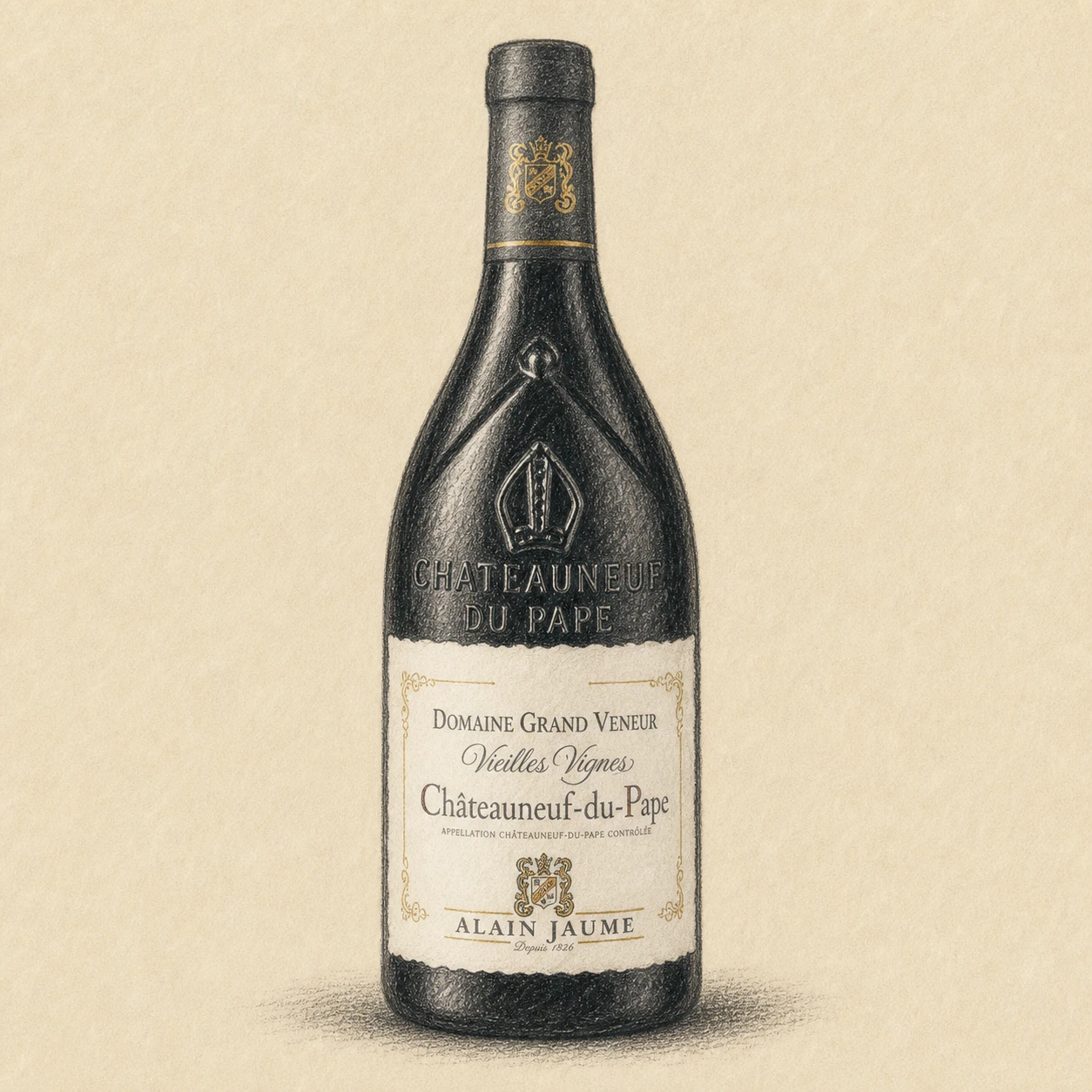
Original bottle illustration — Bacchus Global
Domaine Grand Veneur
DOMAINE GRAND VENEURChâteauneuf-du-Pape Vieilles Vignes 2021
In a corner of Châteauneuf-du-Pape where sun-warmed stones release their heat through the night, old Grenache and Mourvèdre vines settle into an unusually even partnership, giving this cuvée a structure that sets it apart within the appellation.
- Wine type
- Red wine
- Grape
- Grenache ~45%, Mourvèdre ~45%, Syrah 10%
- Appellation
- Châteauneuf-du-Pape AOP
- Origin
- Southern Rhône, France
- Drinking window
- 2026–2035 and beyond
- Recommended temperature
- 15.5–16°C (60°F)
- Alcohol
- 15%
- Bottle size
- 750 ml / 1500 ml (Magnum)
About the Wine
Domaine Grand Veneur is the estate-bottled arm of the Jaume family, whose roots in Châteauneuf-du-Pape trace to the nineteenth century, now run by the sixth generation of the family.
This Vieilles Vignes cuvée draws on parcels of Grenache, Mourvèdre and Syrah planted between fifty and over a hundred years ago, blended in an unusually even split between Grenache and Mourvèdre for the appellation.
Taste profile
In the glass
CHÂTEAUNEUF-DU-PAPE VIEILLES VIGNES 2021
Scale1–5
BG wine structure estimate
Comparative profile within the Bacchus Global wine range.
Crushed stone, charcoal and graphite minerality opens onto jammy blackberry, cassis and plum, layered with truffle, bark and roasted meat, then violet, licorice and garrigue spice.
Full-bodied with striking concentration and unusual mid-palate density; a creamy edge touched by mocha gives way to firm, building tannins and a long finish carrying mint and dark fruit.
Inky, dense purple color that signals a substantial concentration of pigment.
Before it reaches the glass
Temperature
15.5–16°C (60°F)
Timing
Best from 2026 through 2035 and beyond; decanting for an hour or two is recommended, and especially advisable if opening before 2028.
Glassware
—
At the table
Grenache-Mourvèdre concentration and firm tannins call for dishes with weight, umami and a touch of char.
Across cuisines, the pairing logic follows the wine's structure: rich proteins and slow-cooked, savory preparations stand up to its density, while herbal or spiced notes echo its garrigue and licorice character.
Japanese
- Kamo nabe (duck hot pot)
- Wagyu sukiyaki
- Yakitori with tare glaze
Why it worksDuck hot pot and glazed skewers bring the same savory, slightly caramelized notes as the wine's roasted-meat character, while the richness of wagyu sukiyaki matches its density.
Thai
- Massaman beef curry
- Grilled beef neua yang
- Panang beef curry
Why it worksMassaman and panang curries bring warm spice and slow-cooked beef richness that mirror the wine's licorice and garrigue notes, while grilled beef echoes its roasted-meat character.
Western
- Braised lamb
- Cassoulet
- Oven-roasted beef short ribs
Why it worksSlow-braised lamb, cassoulet and roasted beef ribs share the same rustic, savory register as the wine's tannin structure and dark fruit.
From cellar to bottle
Winemaking
Grapes are hand-harvested and fully destemmed, then fermented at a controlled 30°C with roughly 25 days of maceration and punch-downs. The wine then ages 16 months, with the Grenache portion resting in concrete tank and the Mourvèdre and Syrah in a mix of new and one-year oak barrels.
Product detail
Bottled at 750 ml and 1500 ml (Magnum), the wine draws on vines aged 50 to over 100 years planted in the appellation's northern sector near Orange.
Origin & Terroir
These vineyard and founding details describe the estate as a whole rather than this specific bottling.
Official producer website→Critical Recognition
Wine Advocate (Joe Czerwinski, May 2024)
Noted that the elevated Mourvèdre share brings out truffle and bark character, with concentration carrying from start to finish.
Jeb Dunnuck (bottled review, October 2023)
Noted for bringing more richness than most other wines of the vintage, with mid-palate depth and aromas of licorice, pepper and roasted meat.
James Suckling (May 2023)
Described with forest-berry, licorice and savory bark-like character, with firm tannins pointing to 2026 as an ideal starting point.
Wine Spectator (2021 vintage)
Rated 92 points by Wine Spectator for the 2021 vintage of this cuvée.
Trade information
Contact Bacchus Global for product documentation, availability and trade enquiries.