Drink
When Koji Returns
What “Reverse Import” Asks of the Future of Fermentation
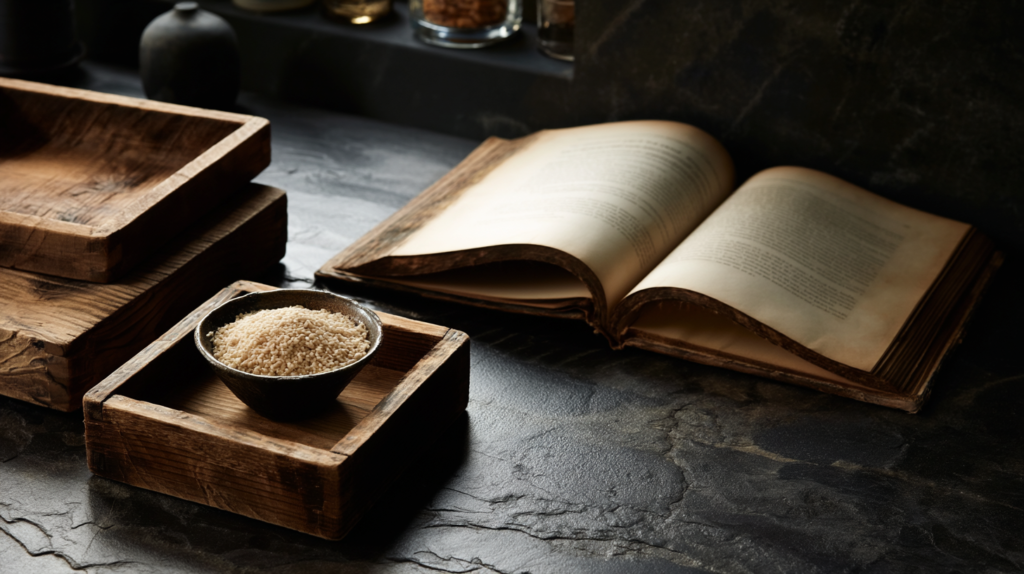
In the commentary of chefs abroad and the pages of international culinary journals, a persistent refrain emerges: “I learned about koji through noma, or through fermentation books published in English.” Learning about Japanese koji through Western literature—I found myself dwelling for some time on the paradox this fact reveals.
Koji mold—Aspergillus oryzae—is a microorganism Japan has quietly nurtured for over a millennium. It is the invisible hand behind many of Japan’s iconic fermented foods, including miso, soy sauce, sake, and shochu. Sometimes called Japan’s national fungus, koji forms the silent bedrock of the country’s culinary heritage.
Yet today, a striking reversal is unfolding: young Japanese chefs are rediscovering the applications of koji through Western texts. Koji quietly made its way from Japan out into the world, only to return home by way of the West. Thus began an unexpected journey: koji as a “reverse import.”
The Spark Came from Copenhagen
The catalyst was noma in Copenhagen. The restaurant’s fermentation lab applied traditional techniques using Japanese koji mold to local grains and seasonal ingredients, crafting expressions such as “Nordic miso” and locally rooted garum. This attempt to transpose a traditional Japanese technique into an entirely different cultural context ignited the imaginations of chefs worldwide.
In 2020, American chef Jeremy Umansky and his contemporaries published Koji Alchemy. Systematically covering everything from the scientific principles of the mold to practical, borderless recipes, the book became the definitive primer for the English-speaking culinary world, sparking a global movement in modern kitchens.
Then something curious happened. Rather than a text from Japan—the historical home of koji—this English-language volume became the definitive reference circulated among contemporary culinary practitioners.
What Japan Let Go
Why did this reversal happen?
In Japan, koji was simply taken for granted. For centuries, brewers and fermentation artisans had little need to explain koji to the outside world. When a craft is woven into the fabric of everyday life, there is less incentive to translate it into prose. Japan’s practitioners possessed more than a thousand years of lived experience, yet they postponed the work of shaping that experience into a language for the world beyond.
By contrast, chefs who encountered koji from the outside spoke of it with pure astonishment. “What is this organism?” “Why does it produce such profound depth of umami?” “How far can its boundaries be pushed?” Language is born where there is wonder. And because those words were shared in English—a language that travels effortlessly across borders—they spread with remarkable velocity.
The technique had always resided in Japan. But the language required to articulate that technique to the wider world was cultivated elsewhere. This, perhaps, is the true nature of what Japan let go.
What Reverse Import Brought Back
Yet this paradox is not merely a story of loss.
The language for discussing koji that passed through the West has brought vital new questions back to Japan. It asks how the koji used in sake, the koji used in traditional seasonings, and the koji used to age meat can reveal such vastly different dimensions while relying on the same microscopic foundation. The concept of “terroir fermentation” championed by noma—pairing local ingredients with local microorganisms—is something Japan’s traditional breweries have practiced for generations, but it had rarely been articulated in such evocative terms.
For Japanese makers, this reverse import has become an opportunity to rediscover the nuances of their own culture through an external gaze.
Bangkok as a Third Point
Where, then, does Bangkok stand within this shifting landscape?
Is it merely at the receiving end of this reverse-import route? Or can it become a vital third point of connection, bridging Japan’s foundational heritage with the reimagined language of fermentation developed in the West?
There is no longer a single narrative to define what koji is. The vocabulary of Japanese master brewers, the insights of Western fermentation researchers, and a rising consciousness that views koji through the rich culinary tapestry of Southeast Asia are beginning to converge. That point of convergence may well be Bangkok. To reclaim koji is not to possess it, but to tell its story anew in a fresh cultural context. That retelling—and the subtle work of translation—has only just begun. (Mr. Bacchus)
This article is intended solely to explore the cultural and historical context of koji fermentation and its global evolution, and does not aim to promote or encourage the consumption of alcohol. / บทความนี้จัดทำขึ้นเพื่อนำเสนอข้อมูลเกี่ยวกับบริบททางวัฒนธรรมและประวัติศาสตร์ของการหมักโคจิและวิวัฒนาการระดับโลกเท่านั้น มิได้มีเจตนาเพื่อส่งเสริมหรือโฆษณาเครื่องดื่มแอลกอฮอล์ สำหรับผู้มีอายุ 20 ปีขึ้นไป โปรดดื่มอย่างรับผิดชอบ
Discover the culture behind every bottle
We share brewery stories, tasting notes and the craft of koji & fermentation — for educational and cultural purposes only.
เราถ่ายทอดเรื่องราวจากผู้ผลิต บันทึกรสชาติ และศาสตร์แห่งโคจิและการหมัก — เพื่อการศึกษาและวัฒนธรรมเท่านั้น
Follow on Instagram FacebookRelated Articles
“Dissolving the Boundaries of a Sake Maker” / “Fermentation in 2026” / “When the Five Senses and Data Meet in the Same Brewery”