Drink
The Silent Synergy of Fermentation
Why Sake and Thai Cuisine Share a Common Ground
The Silent Synergy of Fermentation: Why Sake and Thai Cuisine Share a Common Ground
In recent years, bars and restaurants that place sake at the center of their offerings have been gently multiplying across Bangkok. Some have even begun to curate their concepts not around traditional Japanese cuisine, but around thoughtful pairings with Thai food. Treating sake with the same reverence usually reserved for wine, these establishments are exploring a fascinating culinary intersection. Behind this movement lies a compelling truth anchored in a single, ancient process: fermentation.
The Hidden Structure of Thai Cuisine
While Thai cuisine is celebrated globally for its vibrant interplay of sweet, sour, spicy, and salty notes, a quiet undercurrent of umami anchors these expressive flavors from beneath. This foundational depth belongs to the craft of artisan fermented seasonings.
Nam pla (fish sauce), aged patiently with sea salt over long months, and kapi (shrimp paste), derived from fermented krill, are both rich in naturally occurring amino acids—most notably glutamic acid. This invisible framework gives tom yum goong its profound resonance and lends green curry its enduring depth. Beneath the lively, aromatic surface, Thai cuisine carries a soulful complexity born of time and microorganisms.
The Alchemy of Koji and Time
Sake brewing, by contrast, is a masterclass in the transformation of grain.
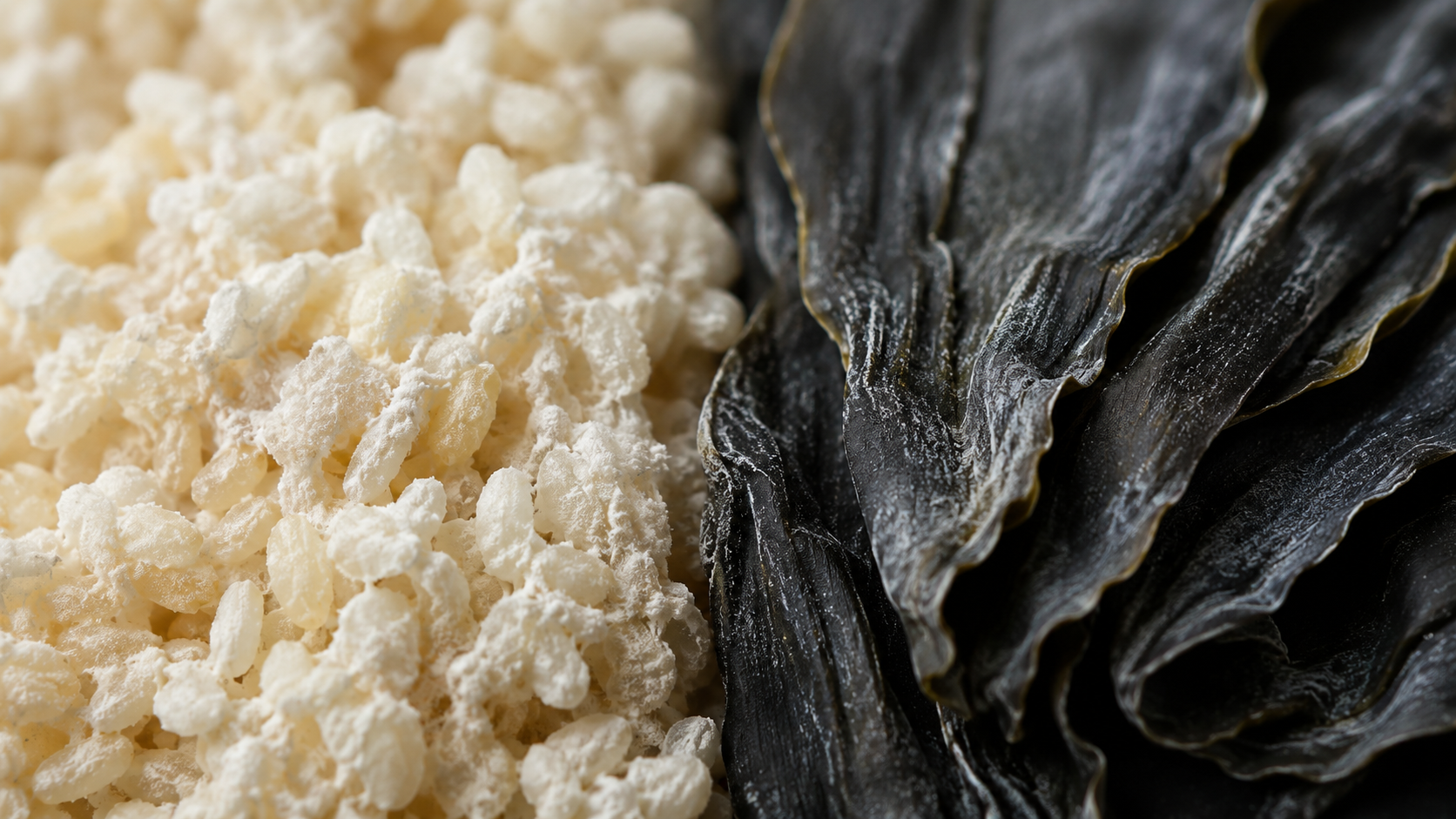
To transmute the starch of rice into alcohol, the grain must first be persuaded into sugar—a delicate task entrusted to koji. As the koji mold blankets the steamed rice, its enzymes slowly dissolve starches into sugars, while simultaneously breaking down rice proteins into rich amino acids.
Among these, glutamic acid emerges as the signature of sake’s umami. While its presence varies, junmai sakes—especially those crafted through historical, labor-intensive methods like kimoto or yamahai—possess a remarkably deep amino acid profile. When a brewer steps back and allows wild microorganisms to dictate the rhythm over weeks and months, the rice yields a more profound, texturized complexity.
The Shared Foundation of Umami
At this intersection, two distinct culinary lineages converge.
The glutamic acid born of the sea in nam pla meets the glutamic acid born of the soil in sake. Though their origins and methods are worlds apart, both are sculpted by fermentation to share the exact same molecular core of savory depth. It is this shared structural DNA that allows their flavor profiles to harmonize so naturally.
Long before Tokyo Imperial University chemist Kikunae Ikeda scientifically identified glutamic acid in kombu dashi in 1908—coining the term “umami”—both Thailand and Japan had already mastered its usage. Through fish sauce and koji, these cultures instinctively wove the flavor into their daily lives. Science merely named what intuition had long revered.
Of course, shared chemistry is not a guarantee of an effortless pairing. The lively dance of heat, acidity, sweetness, and serving temperatures requires thoughtful curation; compatibility shifts with every plate. Umami is not a simplistic answer, but rather the opening conversation. Yet, it is precisely this common starting point that has inspired contemporary chefs in Bangkok to look past convention.
Transcending Borders on the Modern Table
Viewed through this lens, the notion that sake belongs exclusively to Japanese dining feels unnecessarily restrictive.
Umami is a universal language. The lineage of fermented fish sauce travels through Vietnam’s nước mắm and reaches the salt-cured anchovies of the Mediterranean. Fermentation-driven umami is a global heritage. If sake can find common ground with the complex layers of Thai cuisine, its potential extends far past conventional boundaries.
Bangkok—a metropolis defined by its culinary fluidity—is the ideal stage for this evolution. As visionary dining rooms offer sake uncoupled from traditional Japanese settings, we begin to appreciate the beverage not as a cultural artifact, but as a versatile culinary companion. Guided by the ancient wisdom of fermentation, food and sake are quietly finding their place on a reimagined global table.
This article is intended solely to explore the cultural and fermentation science behind the affinity between Japanese sake and Thai cuisine, and does not aim to promote or encourage the consumption of alcohol. / บทความนี้จัดทำขึ้นเพื่อนำเสนอข้อมูลเกี่ยวกับวัฒนธรรมและวิทยาศาสตร์การหมักที่อยู่เบื้องหลังความเข้ากันระหว่างสาเกญี่ปุ่นกับอาหารไทยเท่านั้น มิได้มีเจตนาเพื่อส่งเสริมหรือโฆษณาเครื่องดื่มแอลกอฮอล์ สำหรับผู้มีอายุ 20 ปีขึ้นไป โปรดดื่มอย่างรับผิดชอบ
Discover the culture behind every bottle
We share brewery stories, tasting notes and the craft of koji & fermentation — for educational and cultural purposes only.
เราถ่ายทอดเรื่องราวจากผู้ผลิต บันทึกรสชาติ และศาสตร์แห่งโคจิและการหมัก — เพื่อการศึกษาและวัฒนธรรมเท่านั้น
Follow on Instagram FacebookRelated Articles
“The Molecular Harmony of Sake and Foie Gras” / “Beyond the Sushi Counter” / “The Umami Evolution” / “Rice as a Common Language Brewed by Thailand and Japan”