
The beef broth carried from one day to the next in EkkamaiWattana Panich
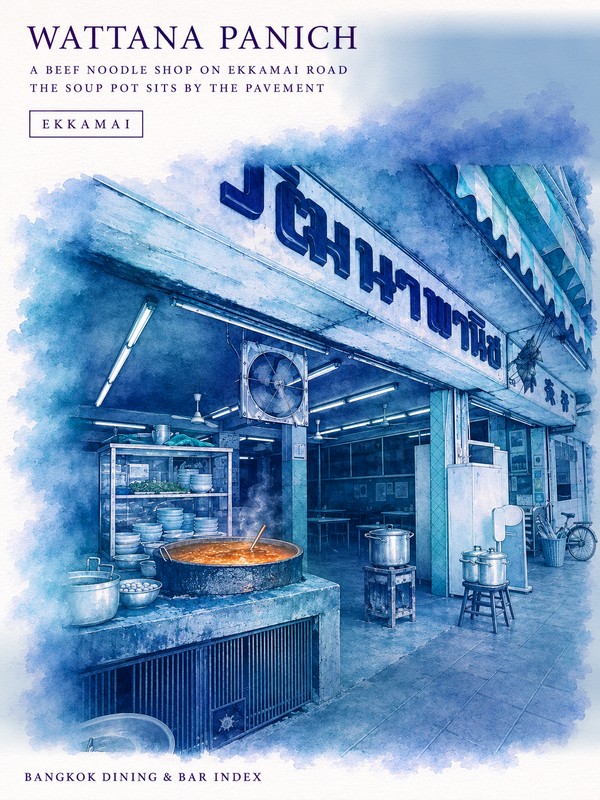
NPR and Eating Thai Food describe a large pot of beef stewing at the front of Wattana Panich in Ekkamai. We traced the family business through its practice of saving a little of each day’s broth to start the next batch.
- Location
- 336–338 Ekkamai Road
- Cuisine
- Thai beef noodles
From a shop near the river to Ekkamai
In 2019, we find that NPR reported that the grandfather of the shop’s third-generation owner had begun making the family’s soup at a shop near the Chao Phraya River. At the time of the interview, the Ekkamai restaurant occupied two floors of a shophouse the family had bought earlier. The report gives no exact date for the move to Ekkamai or opening year for the current shop.
Washing the pot and saving a little broth
We focused on what happens to the broth set aside and how the pot is emptied and cleaned. The owner told NPR that the family empties and washes the pot every evening after closing. They keep a small portion of the broth at a gentle simmer overnight. It forms the base of the next day’s soup.
Tasting before seasoning
We read that the owner told NPR that, since his grandfather’s day, the family had worked without fixed quantities for the ingredients. Whoever makes the soup tastes it and decides what to add. NPR mentions Chinese herbs and spices along with garlic, cinnamon, black pepper and coriander root. The third-generation owner said he learned the taste of the shop’s soup by sampling the broth his father made when he first started working there.
Simmering large cuts of beef before slicing
In the 2019 interview we consulted, the owner described starting with large pieces of beef. After about three hours, the meat was taken out, cut into smaller pieces and returned to the pot for about another four hours. He said cooking the beef in large pieces first let it absorb the flavour of the broth. The timings are the estimates he gave at the time.
Rice noodles, plain rice and braised goat
A visit reported by Eating Thai Food, whose account we read, describes three kinds of rice noodles: broad sen yai, narrower sen lek and finer sen mee. The account also describes gao lao, a bowl of beef and broth served without noodles, with plain rice on the side. Another dish in the same account pairs noodles with Chinese-style braised goat.
The restaurant today
Every night, the pot is washed. Only a small amount of soup is left overnight on low heat.
The pot is a large one, about 5 feet (about 1.5 meters) across, set near the pavement by the entrance of a beef noodle shop. The shop is on Ekkamai Road in Bangkok. We list this shop as a beef noodle shop. The building is a two-story shophouse that the family bought.
The soup that is kept becomes the base of the next day's soup. The soup contains about 12 kinds of Chinese herbs, along with cinnamon, black pepper, and coriander roots. There is no fixed recipe; the person making it tastes the soup and decides what to add.
The meat is simmered as a whole piece for about 3 hours. After it is cut, it is simmered for about 4 more hours. Thin and wide noodles are among the choices.
On the signboard, red three-dimensional Thai letters are lined up. Under the roof there are long tube lights and a square exhaust fan. On the shelf beside the pot, many bowls are stacked.
The shop is listed in OAD (Opinionated About Dining) and Shell Chuan Chim. We list this shop as Thai cuisine in the Ekkamai area. It is categorized as an à la carte-focused restaurant.
Sources: BDI venue card, articles from NPR, Tasting Table and Time Out, a photo of the shopfront