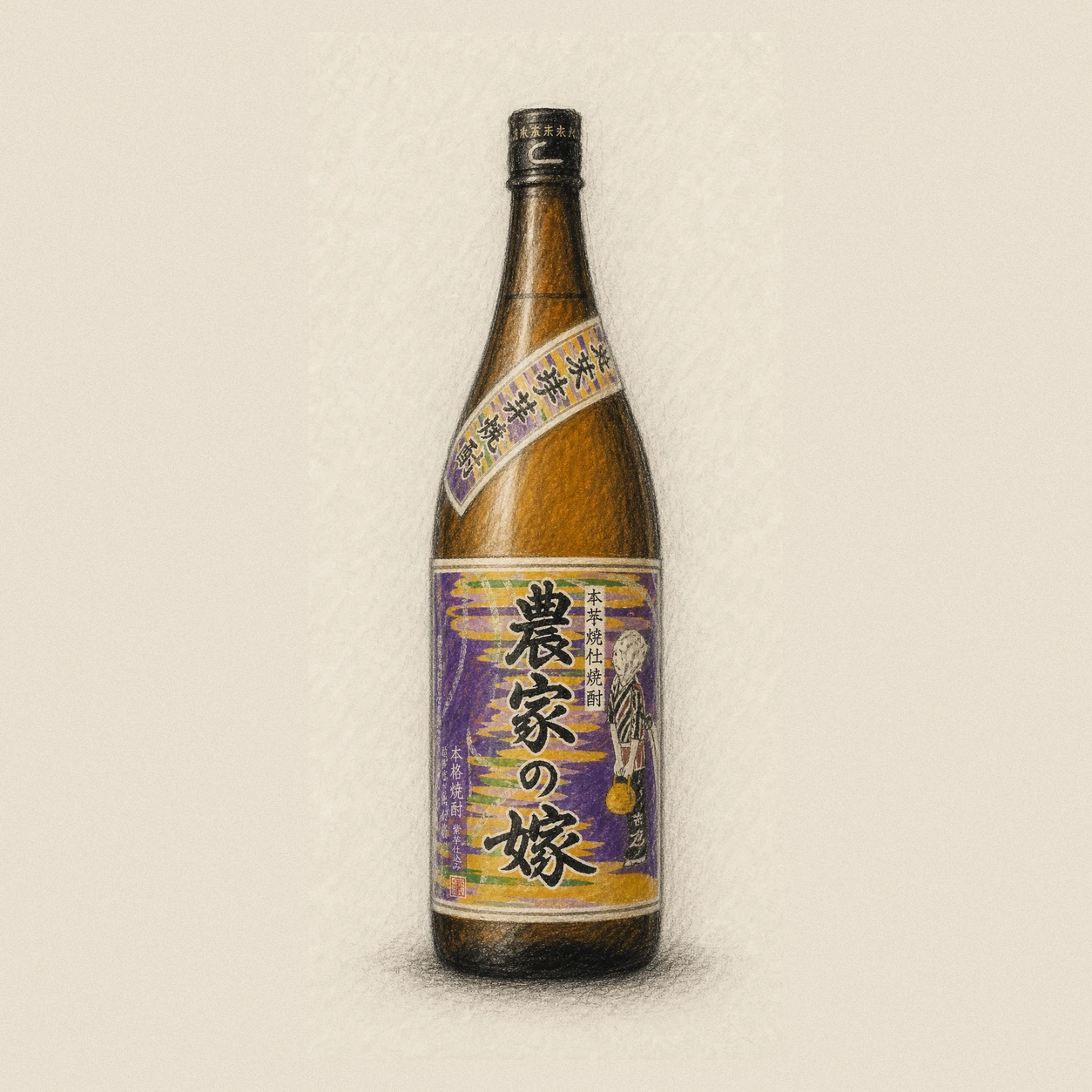
NOUKA no YOME
Murasaki Yaki-imo
Kagoshima-grown purple sweet potatoes, roasted through on a lava-plate kiln over Tanegashima Satsuma-shii charcoal, then fermented in traditional clay pots with natural Kirishima water — a shochu shaped by fire, earth and water.
Thailand · Product information
Product information from Bacchus Global Co., Ltd., based in Bangkok, Thailand. About Bacchus Global
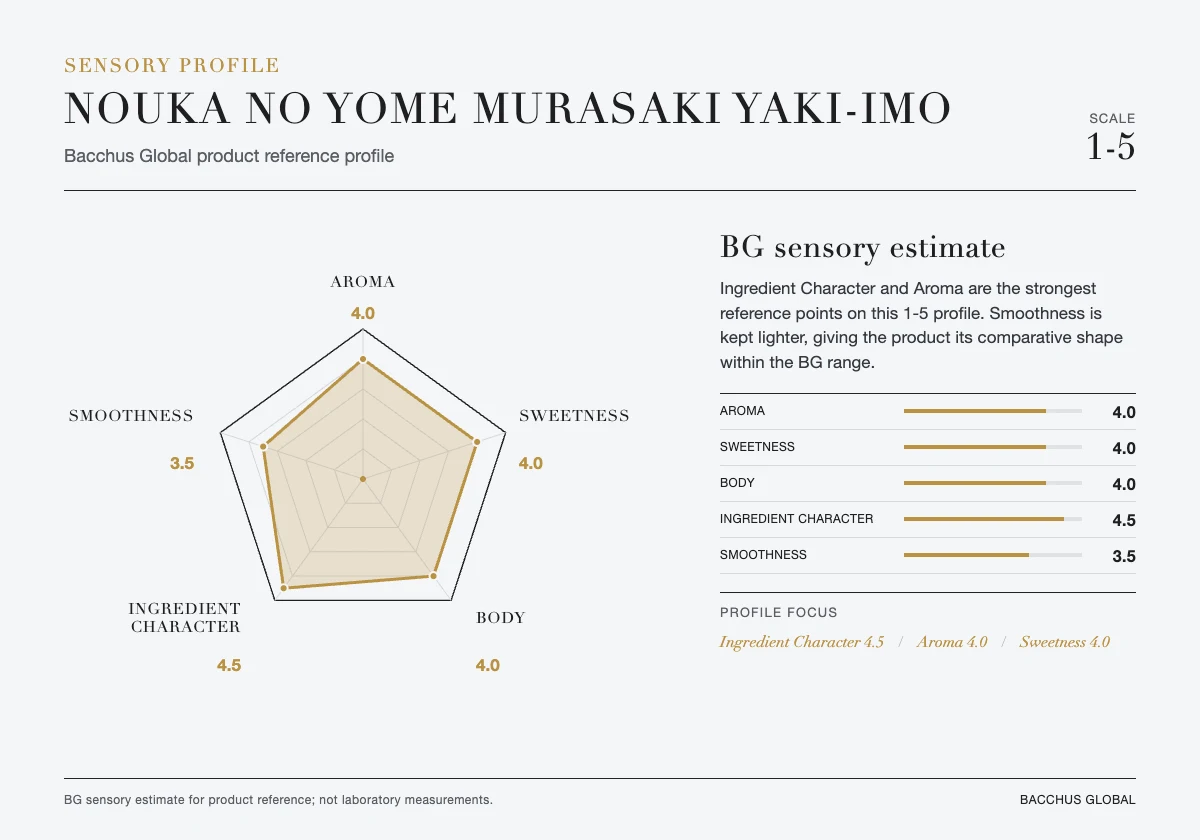
Sensory profile
Purple sweet potato, lava plate and charcoal
Rather than steaming the sweet potatoes, Kirishimacho Distillery roasts Kagoshima-grown purple sweet potatoes until cooked through on a lava-plate kiln, using charcoal made from Satsuma-shii wood from Tanegashima. Fire is not a finishing touch here; it shapes the ingredient before fermentation begins. The resulting mash retains a vivid purple colour.
A one-to-six ratio, worked in traditional earthenware
Rice koji and roasted purple sweet potato are brought together at a ratio of one part rice to six parts sweet potato. Because roasted sweet potato produces a thicker, more resistant mash, stirring requires greater physical care. Fermentation takes place in Japanese earthenware pots whose use reaches back to the Meiji era.
Natural water from the Kirishima mountains
The roasted sweet potatoes and rice koji are joined by natural groundwater from the Kirishima mountain range. At the foot of those mountains, water, volcanic land and the heat of charcoal meet in one process without obscuring the identity of the purple sweet potato.
Fruit first, with a measured roasted depth
The distillery describes a fruit-like aroma and a pleasingly smooth mouthfeel. Specialist sake and shochu retailers also record roasted sweet-potato skin, concentrated sweetness and a faint acidity. Because the maker does not publish a formal finish descriptor, the profile is presented without imposing one.
On the rocks or with water
The distillery recommends serving Nouka no Yome on the rocks or with water. Both approaches keep the fruit-led aroma and smooth passage at the centre of the glass without adding an unverified serving claim.
Question 1
How is the purple sweet potato handled before mashing?
- It is roasted into roasted sweet potato
- It is frozen and made into juice
- It is aged in barrels for a long period
Read the answer and explanation
Correct answer: A — It is roasted into roasted sweet potato
The raw material is roasted sweet potato, not steamed sweet potato.
Question 2
What role does the page indicate for rice koji?
- An ingredient mashed together with the roasted sweet potato
- A material for coloring the bottle
- Only a metaphor for aroma
Read the answer and explanation
Correct answer: A — An ingredient mashed together with the roasted sweet potato
It is listed in the ingredients field and in the description of the mashing.
Question 3
What vessel holds the fermentation?
- Wagame (Japanese earthenware jars)
- Only stainless-steel beer kegs
- Bottles for in-bottle secondary fermentation
Read the answer and explanation
Correct answer: A — Wagame (Japanese earthenware jars)
The page describes them as wagame jars handed down since the Meiji era.
In the same direction as food cooked over fire
The distillery does not publish official food pairings. What follows are four directions read from the aromas and taste structure that can be confirmed. Two threads run through them. The roasted character that comes from the baked sweet potato sits in the same direction as the aromas of open flame and searing. And shochu, as a distilled spirit, carries fewer taste elements than brewed drinks, so it rarely meets heavily spiced or herb-driven dishes head-on.
Food-pairing literature records that the sweet aroma of cooked sweet potato links readily with the fat of pork and fish. Purple varieties are described as carrying rose, citrus and herbal notes, which meet the fruit-like impression of this shochu.
At the gate of Kirishima Jingu, since 1911
Kirishimacho Distillery was founded in 1911 in Kirishima, Kagoshima. At the gate of Kirishima Jingu and the foot of the Kirishima mountains, it continues honkaku shochu making with natural groundwater and Japanese earthenware pots.
The distillery is ISO 9001 certified and supports the Most Beautiful Villages in Japan association, connecting quality management with the landscape and community that surround its work.
Created to overturn the old image of imo shochu
The distillery explains that its roasted-sweet-potato approach began with a wish to overturn the old perception that imo shochu left a strong potato smell on clothes and hair. Roasting the ingredient opened another route to aroma while preserving the character of sweet potato.
Nouka no Yome—“the farmer’s wife”—is named as the presence that sustains Akarui Nouson, the distillery’s flagship brand. Soil, farming, village life and the people who support them are joined in a single brand philosophy.
Good shochu is born from good soil. Good soil is found in a bright farming village. And a bright village is made by the farmer’s wife.
Kirishimacho Distillery — translated from the official brand philosophy
Interested in listing Nouka no Yome at your restaurant or retail venue? Our team can provide information on availability, storage requirements and trade terms.