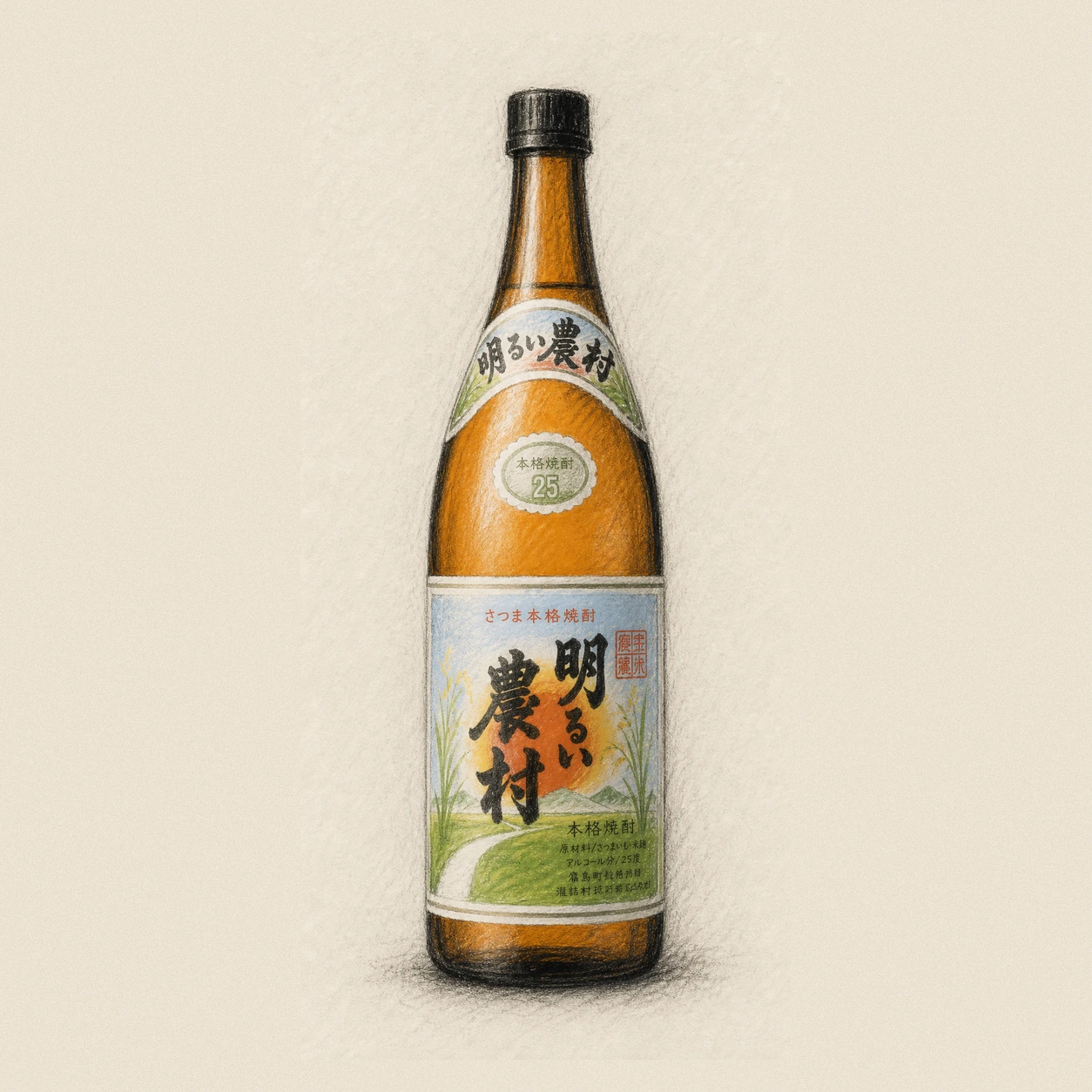
AKARUI NOSON
Kagoshima-grown Koganesengan sweet potatoes, natural water from the Kirishima mountains and fermentation in traditional Japanese clay pots. Kirishimacho Distillery brings land, farming and village life together in its flagship honkaku imo shochu.
Thailand · Product information
Product information from Bacchus Global Co., Ltd., based in Bangkok, Thailand. About Bacchus Global
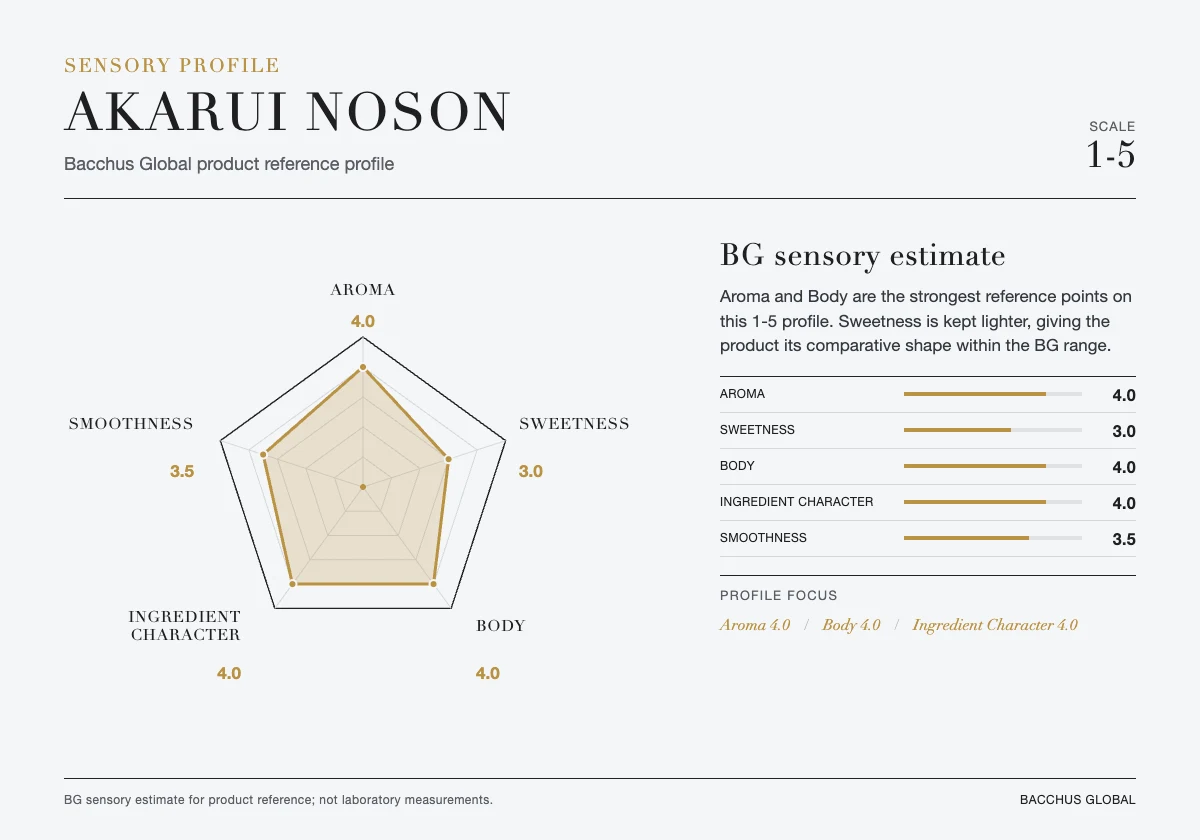
Sensory profile
Good shochu begins with good soil
The name Akarui Noson—“bright farming village”—comes from the distillery’s belief that good shochu begins with good soil, and that good soil belongs to a thriving agricultural community. The bottle is therefore presented not only as a product of Kirishima, but as an expression of the people and fields that sustain it.
Good shochu is born from good soil. Good soil is found in a bright farming village.
Kirishimacho Distillery — translated from the official brand philosophy
Koganesengan grown in Kagoshima
The principal ingredient is Koganesengan sweet potato grown in Kagoshima, brought together with rice koji. The agricultural origin remains at the centre of the product’s identity, linking the bottle directly to the fields from which its principal ingredient comes.
Fermentation held in traditional earthenware
The distillery identifies traditional Japanese clay-pot fermentation as a defining part of Akarui Noson. The pots receive the mash during fermentation and connect the present-day product with a method maintained at the Kirishima site across generations.
Natural water from the Kirishima mountains
Natural water from the Kirishima mountain range is used in production. Together with Kagoshima-grown sweet potatoes and the distillery’s clay pots, it locates the product in the landscape around Kirishima Jingu rather than reducing its identity to a list of technical specifications.
Independent observations, kept separate from maker claims
Independent professional assessments describe steamed sweet potato, subtle fruit and earthy notes on the nose, followed by a smooth texture, savoury depth, roasted sweetness, fine spice and a measured bitterness toward the finish. These are independent observations rather than an official distillery description.
Question 1
Which sweet potato is the main ingredient?
- Kogane Sengan
- Tamaakane
- Shiō (紫王)
Read the answer and explanation
Correct answer: A — Kogane Sengan
The ingredients field and the body text indicate Kogane Sengan.
Question 2
What vessel is described as holding the fermentation?
- Kametsubo (earthenware jars)
- Wine barrels
- Champagne bottles
Read the answer and explanation
Correct answer: A — Kametsubo (earthenware jars)
The page presents traditional kametsubo jar mashing.
Question 3
What is the source of the mashing water?
- Natural water from the Kirishima mountain range
- Deep-sea water from Muroto
- Pressed grape juice
Read the answer and explanation
Correct answer: A — Natural water from the Kirishima mountain range
The water connects the land of Kirishima with the ingredients.
Along the earthy notes and the plain umami
What is recorded above is the sweet aroma of steamed sweet potato, earthy notes suggesting hinoki cypress and mushroom, a smooth texture with plain umami, and a finish that closes on a mild bitterness. What follows are four directions read from those markers. They are not pairings the distillery states officially.
With water or soda, the weight and the way the aroma opens both shift, and the range of dishes shifts with them. Food-pairing literature records that the aroma compounds of mushrooms strengthen the perception of umami, and that earthy notes work better layered with aromas of the same family than covered over.
Two records tied directly to AKARUI NOSON
Awards are stated as competition records only; they are not presented as a guarantee of preference or quality.
At the gate of Kirishima Jingu, since 1911
Kirishimacho Distillery was founded in 1911 in Kirishima, Kagoshima. At the foot of the Kirishima mountains and close to Kirishima Jingu, it continues honkaku shochu production with natural water and traditional Japanese clay pots.
The distillery is ISO 9001 certified and is a supporting company of the Most Beautiful Villages in Japan association, placing quality management and the surrounding landscape within the same long-term outlook.
For current lot specifications, availability, storage requirements and trade terms, please contact the Bacchus Global team.