Drink
How to Read a Japanese Bottle Label Without Knowing Japanese
How to Read a Japanese Bottle Label Without Knowing Japanese
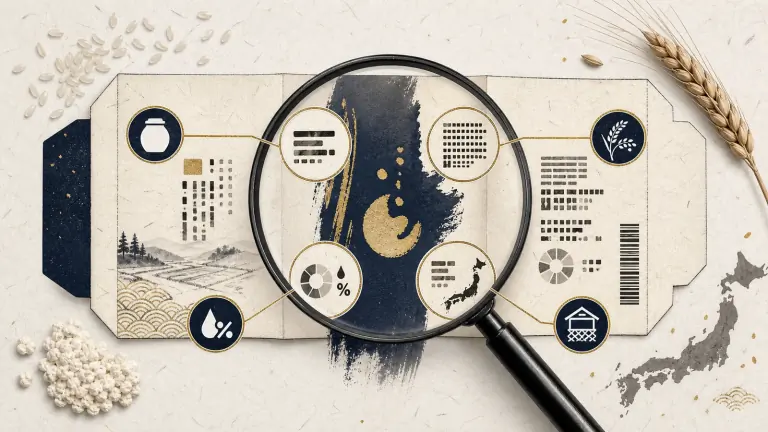
Start with four places to check: category, ingredients when shown, alcohol content, and producer.
A Japanese label can look like a wall of unfamiliar characters. The brand name may be written in calligraphy, the largest word may be poetic rather than descriptive, and the information that explains the bottle may be printed in the smallest type.
But the label does not need to be translated line by line. Most of the useful information can be found by checking four places. Once those places are familiar, the label stops being a code and becomes an index.
1. Find the legal category
Start with the legal category. Its heading may be 品目, 名称, 品名, 種類別, or 種類別名称. When the category name appears on the principal display panel, the heading itself may be omitted. The category answers the basic question: what kind of alcoholic beverage is this?
Common examples include:
- 清酒 (seishu): the statutory category; only seishu made in Japan using only Japanese-grown rice may also be labelled 日本酒
- 単式蒸留焼酎 (tanshiki joryu shochu): shochu distilled in a still other than a continuous still
- 本格焼酎 (honkaku shochu): not a separate statutory category, but a permitted designation for qualifying 単式蒸留焼酎
- リキュール: liqueur
- ウイスキー: whisky
- スピリッツ: spirits
The large name on the front may describe a brand, a place, or an idea. The legal category is different: it identifies the statutory class to which the contents belong. On bottles prepared for export, this information may also appear on an importer sticker in English or Thai.
2. Find 原材料名 when shown
Next, look for 原材料名 (genzairyo-mei), meaning ingredients, when it is shown. It is required for sake under the sake labelling standard, but Japan’s general food-labelling rules do not require an ingredients declaration for every alcoholic beverage. This line often explains more than the decorative front label.
On a sake label, the most common terms are:
- 米: rice
- 米こうじ / 米麹: rice koji
- 醸造アルコール: jōzō alcohol (brewer’s alcohol), distilled from fermented starch- or sugar-containing materials
The presence of 醸造アルコール does not by itself indicate low quality. Non-junmai ginjo, daiginjo, honjozo, and tokubetsu honjozo include jōzō alcohol; for these special designations, the amount is capped at 10% of the polished-rice weight. Junmai-labelled sake is made using rice, rice koji, and water without added jōzō alcohol. Water is excluded from sake’s required ingredients declaration.
For shochu, the ingredient line may reveal the main raw material before any tasting description does: さつまいも for sweet potato, 麦 for barley, 米 for rice, そば for buckwheat, or 黒糖 for brown sugar. It may also identify rice koji or barley koji.
For liqueurs and other spirits, the legal category and ingredients should be read together. A poetic front name does not always reveal whether the base is sake, shochu, another spirit, or a blended formulation.
3. Read the numbers in the right order
Three numerical fields are especially useful.
アルコール分 means alcohol content. It is the label’s ABV statement.
内容量 means net volume, commonly shown in millilitres.
On sake, 精米歩合 (seimai buai) is the weight of polished white rice expressed as a percentage of the brown rice from which it came. A value of 60% means that 40% was removed by weight. When a sake bears a special designation, this ratio must appear near the ingredients declaration. It describes production; it is not a universal score of quality.
Some sake labels also show 製造年月, the period when the sake was filled into and sealed in its container for sale, not when it was brewed. This field has been optional under Japan’s sake labelling standard since 1 January 2023 and is not an expiry date.
4. Separate special-designation terms from process and handling terms
Not every prominent word performs the same job.
For sake, terms such as 純米, 吟醸, 大吟醸, and 本醸造 are tied to defined production requirements. They are more than stylistic names.
Other words describe processing or handling. 生酒 indicates sake released without pasteurisation. 原酒 means no post-production water adjustment, except within a range that changes the alcohol content by less than one percentage point. 無濾過, by contrast, is not an optional term whose requirements are defined by this NTA standard and is not a grade; check the producer’s explanation of the filtration method.
These terms provide clues. They do not predict the complete aroma, texture, or finish on their own.
5. Find 製造者: the maker
The field 製造者 means producer or manufacturer. Nearby, 所在地 or 製造場所在地 identifies the address or production location.
This matters because the brand name, bottler, seller, and producer are not always the same entity. 販売者 means seller or distributor; 輸入者 means importer. When several company names appear, the word before each name tells you its role.
The producer and location also create a route for further research. They allow an unfamiliar label to be checked against an official producer page rather than interpreted from design alone.
A quick reading order
When the label feels crowded, use this sequence:
- 品目: identify the category.
- 原材料名: identify the base ingredients.
- アルコール分 / 内容量: confirm strength and volume.
- 製造者 / 所在地: identify who made it and where.
- Only then read optional words such as 純米, 生酒, 原酒, or a rice variety.
This order does not explain everything in the bottle. It does something more practical: it separates regulated and production information from brand and design language.
If your question begins with choosing a category rather than decoding a specific label, start with Selecting Your First Bottle. For unfamiliar terms, continue with the Glossary of Japanese Drinks. To understand how sake, shochu, liqueur and spirits relate, see the Map of Japanese Alcohol.
Reference points
- Japan’s National Tax Agency: Overview of the Sake Manufacturing and Quality Labelling Standards
- Japan’s National Tax Agency: Q&A on Alcohol Labelling under the Food Labelling Act
- National Research Institute of Brewing: Label Terms
Related article
Selecting Your First Bottle: A Thoughtful Guide for the Curious Mind
Related products
“KID Junmai-Ginjo Karakuchi-Kid” / “MOGURA” / “TSURUUME Yuzu” / “SAKURAO Single Malt Whisky”
How special designations relate to rice polishing
When 50% Rice Polishing Is Not Junmai Daiginjo
This article is provided solely as cultural and educational information about Japanese alcoholic-beverage labels. It does not aim to promote or encourage alcohol consumption. In Thailand, the sale of alcoholic beverages to persons under 20 is prohibited. / บทความนี้จัดทำขึ้นเพื่อให้ข้อมูลเชิงวัฒนธรรมและการศึกษาเกี่ยวกับฉลากเครื่องดื่มแอลกอฮอล์ญี่ปุ่นเท่านั้น มิได้มีเจตนาเพื่อส่งเสริมหรือโฆษณาการบริโภคเครื่องดื่มแอลกอฮอล์ กฎหมายไทยห้ามจำหน่ายเครื่องดื่มแอลกอฮอล์แก่บุคคลอายุต่ำกว่า 20 ปี
Related Articles
“720 Milliliters and Four Gō: The Edo-Period Standard on Modern Sake Bottles”
Discover the culture behind every bottle
We share brewery stories, tasting notes and the craft of koji & fermentation — for educational and cultural purposes only.
เราถ่ายทอดเรื่องราวจากผู้ผลิต บันทึกรสชาติ และศาสตร์แห่งโคจิและการหมัก — เพื่อการศึกษาและวัฒนธรรมเท่านั้น