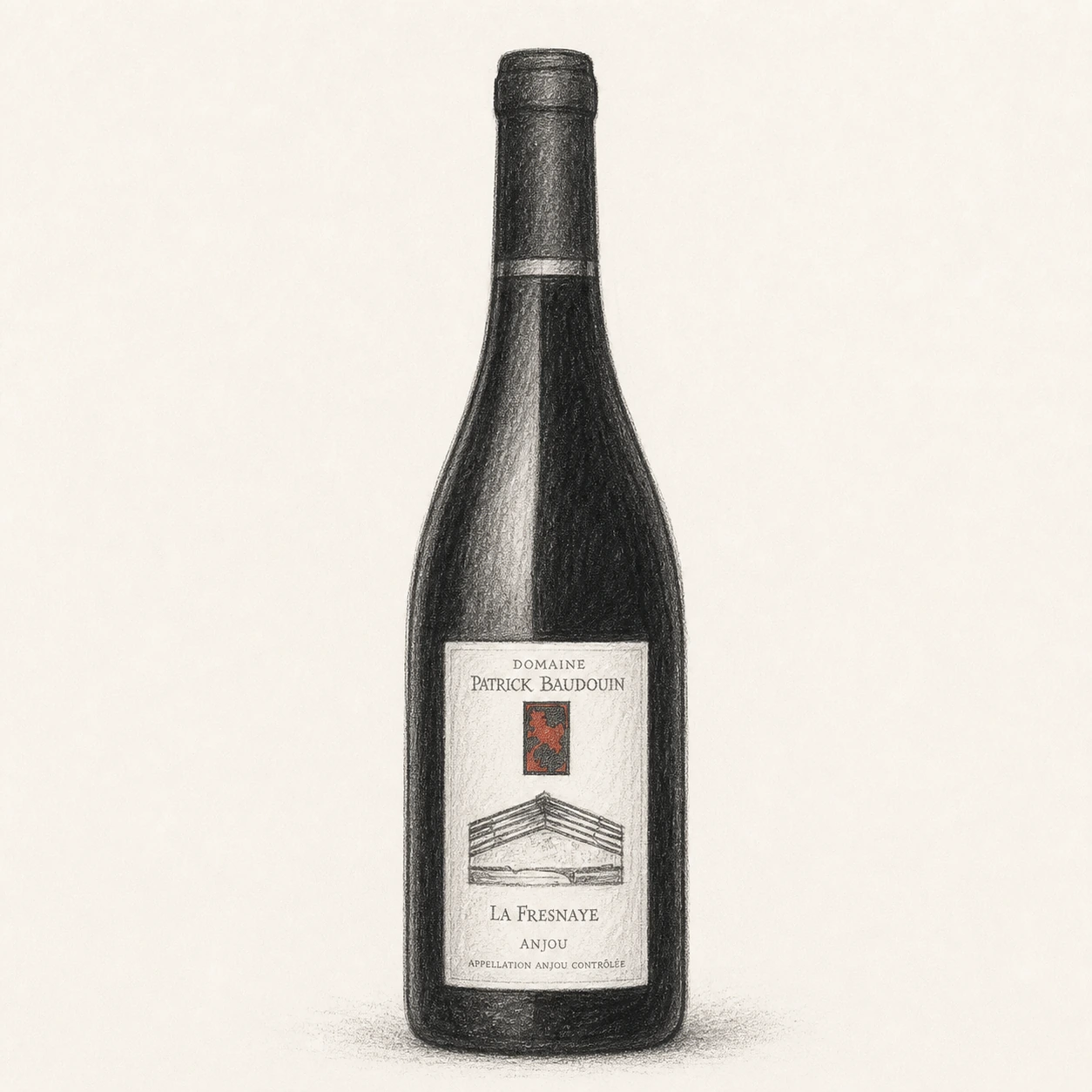
Original bottle illustration — Bacchus Global
Anjou Noir, Loire Valley
DOMAINE PATRICK BAUDOUINLa Fresnaye Rouge 2019
In the dark-stone country of Anjou Noir, a narrow seam of pale limestone breaks through ancient schist — and it is on this quiet outcrop that Domaine Patrick Baudouin's Cabernet Franc finds its particular voice, cool and mineral against the region's typical richness.
- Wine type
- Still red wine
- Grape
- Cabernet Franc 100%
- Appellation
- AOC Anjou (Rouge)
- Origin
- Anjou Noir, Loire Valley, France
- Drinking window
- Estimated drinking window: 2026–2032
- Recommended temperature
- 14–16°C
- Alcohol
- 13.0% ABV
- Bottle size
- 750 ml
About the Wine
Domaine Patrick Baudouin farms 13.5 hectares around Chaudefonds-sur-Layon in the Anjou appellation of the Loire Valley, and has been certified organic since 2005 after phasing out chaptalization, herbicides and synthetic treatments over the previous decade.
La Fresnaye is a one-hectare parcel within the estate, planted with old-vine Cabernet Franc on schist soils topped by a thin band of Devonian limestone; the grapes are fully destemmed, fermented with native yeasts, and aged in used Burgundian barrels before bottling.
Taste profile
In the glass
LA FRESNAYE ROUGE 2019
Scale1–5
BG wine structure estimate
Comparative profile within the Bacchus Global wine range.
Cedar and gentle green pepper open onto cassis, black cherry, violet, wet stone and a touch of cinnamon and cacao.
Concentrated fruit from low yields carries fine, well-integrated tannins, with limestone-driven acidity giving an elegant, mineral texture and a fresh finish.
Before it reaches the glass
Temperature
14–16°C
Timing
Estimated drinking window of 2026–2032; benefits from around an hour of aeration in a carafe before serving.
Glassware
A Bordeaux-style or wide Burgundy glass suits Cabernet Franc's aromatics.
At the table
The wine's cool aromatics and limestone-driven acidity give it flexibility across a range of savory dishes, from home cuisines to French classics.
Its fine tannins and fresh acidity work well with dishes that have some richness or char without excessive chili heat, while its cedar and mineral notes echo well against grilled or slow-cooked meats.
Japanese
- Duck roast
- Wagyu thigh tataki
- Venison stew simmered in red wine
Why it worksThe wine's fine tannins and cool fruit match the char and richness of roasted duck and seared wagyu, while its acidity cuts through the depth of a slow-cooked game stew.
Thai
- Nuea yang jim jaew (grilled beef, mild chili sauce)
- Panaeng nuea (mild beef red curry)
- Moo palo (five-spice pork stew)
Why it worksMild spice levels let the wine's green pepper and cedar notes stay in balance, while its acidity complements the five-spice depth of moo palo without clashing with stronger chili heat.
Western
- Magret de canard
- Agneau de pré-salé (salt-marsh lamb)
- Sainte-Maure de Touraine goat cheese
Why it worksThis pairing reflects the wine's home region, where its structure and cool fruit are traditionally matched with duck, lamb and local goat cheese.
From cellar to bottle
Winemaking
Grapes are fully destemmed and fermented slowly with native yeasts, followed by complete natural malolactic conversion, then aged for 14 months in used Burgundian barrels.
Product detail
Diatomaceous-earth filtered, lightly sulfured at racking and bottling, and bottled on 24 February 2021 in a lightweight Burgundy-style bottle sealed with natural cork.
Origin
The parcel's thin outcrop of Devonian limestone over ancient schist is associated with the elegant acidity and mineral texture found in wines from this site.
Official producer website→Certification

Agriculture Biologique (EU Organic) · Ecocert
Certified Organic
This wine is certified organic under Agriculture Biologique, a status the estate has held since 2005.
Trade information
Contact Bacchus Global for product documentation, availability and trade enquiries.