
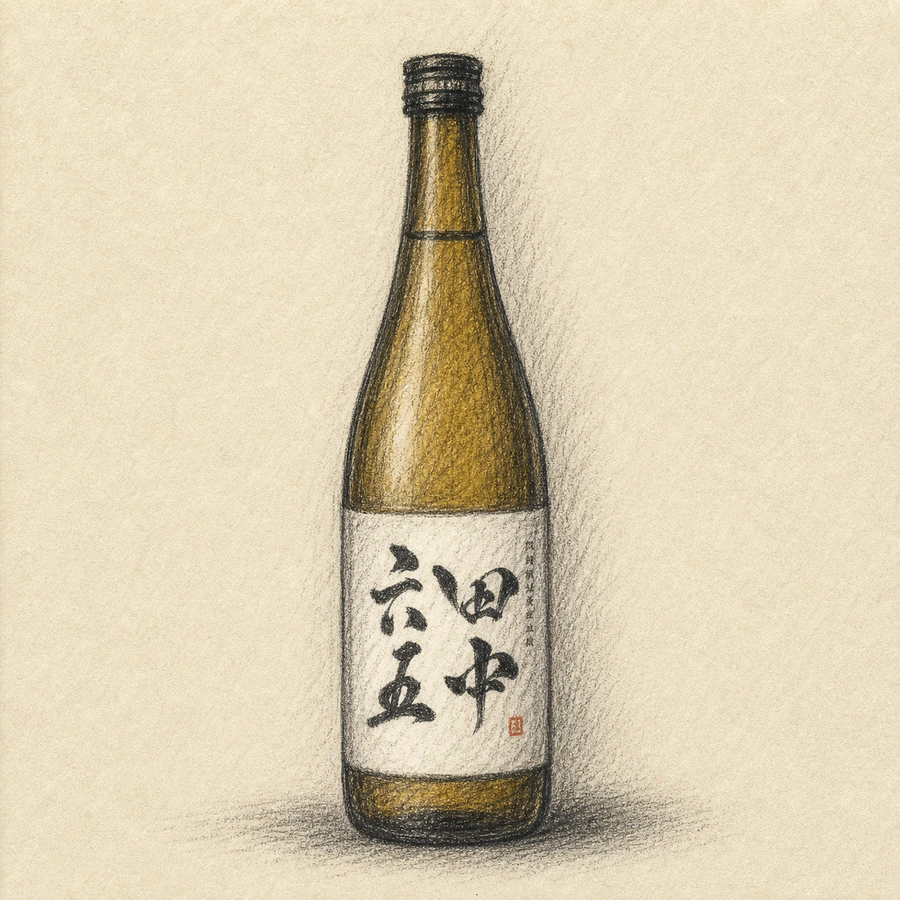
TANAKA ROKUJUGO Nama
Hane-gi lever-pressed, unpasteurized nama — Itoshima Yamada Nishiki umami with a bright, fresh fruit lift.
Thailand · Product information
Product information from Bacchus Global Co., Ltd., based in Bangkok, Thailand. About Bacchus Global

A defined expression of the range
TANAKA ROKUJUGO Nama is brewed from 100% Yamada Nishiki grown in the rice paddies surrounding the brewery in Itoshima, using underground water connected to Shiraito Falls. Pressing uses Shiraito Shuzo’s traditional hane-gi method — pressure applied slowly over time through the weight of oak beams and stone.
Unpasteurized, it goes straight from the press to the bottle. Onto the rice umami and clean structure the standard Tanaka Rokujugo is built on, this adds the fresh aroma and gentle vibrancy unique to nama.
How it tastes

A fresh, gentle aroma recalls grapes. On the palate, supple acidity draws together the concentrated umami of Itoshima Yamada Nishiki, with a light bitterness adding depth; the texture is smooth, and the finish resolves clean.
Keep refrigerated. The grape-like brightness and clean structure carry through to the finish.
TANAKA ROKUJUGO · Shiraito Shuzo · Fukuoka
Shiraito Shuzo was founded in 1855 in Itoshima City, Fukuoka Prefecture. Built around Itoshima-grown Yamada Nishiki and underground water from Shiraito Falls, every sake the brewery makes is finished using the traditional hane-gi press.
Eighth-generation head Katsunori Tanaka trained at Gochoda Shuzo in Saga and returned home in 2009. The name Tanaka reflects the brewery’s setting amid rice paddies (ta, “paddy field”; naka, “in the middle of”); Rokujugo, “65,” was chosen by taking one point off the 66% polish of Azuma Ichi, the sake his teacher brewed — a quiet tribute. The philosophy behind it is what Tanaka calls “NormCore,” refining a beloved, everyday standard; in this nama version, that philosophy comes through as a fresh, vivid expression.
Question 1
What difference does "Nama" indicate on this page?
- It does not undergo hi-ire (pasteurization)
- It is aged in barrels
- Shochu is added
Read the answer and explanation
Correct answer: A — It does not undergo hi-ire (pasteurization)
The text describes it as a nama-zake that does not undergo hi-ire (pasteurization).
Question 2
Which pressing method does it share with the standard bottling?
- Haneki-shibori (haneki press)
- In-bottle secondary fermentation
- Vacuum distillation
Read the answer and explanation
Correct answer: A — Haneki-shibori (haneki press)
It is a method that uses an oak beam and the weight of stones.
Question 3
What does "grape" describe?
- Added fruit juice
- The raw material rice
- An aroma impression
Read the answer and explanation
Correct answer: C — An aroma impression
In the tasting section, it is an aroma described as "reminiscent of" grape.
Four directions built on concentrated umami and a smooth texture
The brewery does not publish official food pairings. What follows are four directions read from the aroma and taste structure stated on this page — a grape-like aroma, concentrated rice umami, supple acidity, a light bitterness, and a smooth texture.
As a junmai nama built for the table around rice umami and acidity, we have drawn one dish each from Western, Thai and Japanese cuisine into every one of the four directions.
Related products
Compare a closely related expression, a contrasting bottle and a reference from the same range.
Related stories
Interested in listing TANAKA ROKUJUGO Nama at your restaurant or retail venue? Our team can provide information on availability, storage requirements and trade terms.

