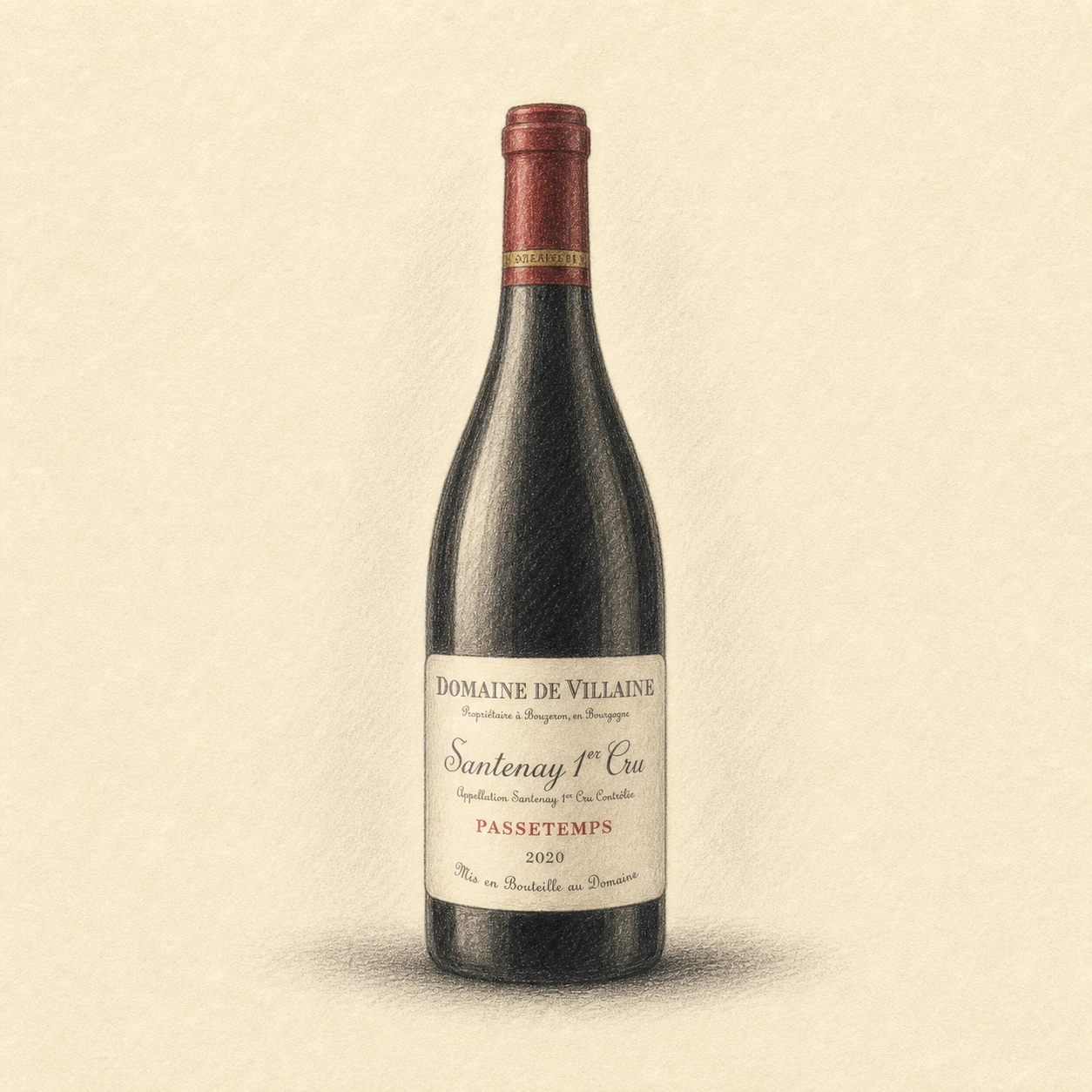
Original bottle illustration — Bacchus Global
Domaine de Villaine
DOMAINE DE VILLAINESantenay 1er Cru Passetemps 2020
A small Côte de Beaune vineyard closes a family circle: the same ancestor of today's proprietor, Jacques-Marie Duvault-Blochet, once owned this Santenay slope and went on to acquire Domaine de la Romanée-Conti in 1869. Domaine de Villaine, otherwise rooted in the Côte Chalonnaise, now farms the plot itself, bringing a Côte de Beaune Pinot Noir into an estate built around Bouzeron.
- Wine type
- Red wine
- Grape
- Pinot Noir 100%
- Appellation
- Santenay 1er Cru AOC
- Origin
- Santenay, Côte de Beaune, Burgundy, France
- Drinking window
- 2026–2035
- Recommended temperature
- 15–16°C
- Alcohol
- 14.5% vol (per retailer listings)
- Bottle size
- 750 ml
About the Wine
Domaine de Villaine is built around Bouzeron and the Côte Chalonnaise, yet the one vineyard it farms in the Côte de Beaune is this 0.44-hectare parcel of Santenay 1er Cru Passetemps, on the appellation's northern band near Chassagne-Montrachet. The plot was acquired in 2011 by Pierre de Benoist, who has directed the estate since 2000, and carried vines around forty-five years old at the time of the 2020 harvest.
The 2020 growing season was one of the earliest and driest on record in Burgundy, with harvest in the Côte de Beaune beginning around mid-August. Grapes are hand-picked, fermented with indigenous yeasts and aged mainly in large foudre with limited use of previously used barriques, then bottled unfiltered — an approach broadly consistent with the estate's other Pinot Noir cuvées, letting the fruit and site speak clearly.
Taste profile
In the glass
SANTENAY 1ER CRU PASSETEMPS 2020
Scale1–5
BG wine structure estimate
Comparative profile within the Bacchus Global wine range.
Dense and faintly sanguine, with black fruit and a note of licorice.
A taut, sturdy frame carries juicy, supple fruit; ripe tannins give fine structure, cherry-stem nuances appear alongside a saline finish that tempers the alcohol, and the texture carries a silky resonance associated with the Passetemps site.
Before it reaches the glass
Temperature
15–16°C
Timing
Approachable from 2026, with a peak drinking period between 2027 and 2032; young bottles benefit from sixty to ninety minutes of aeration.
Glassware
A wide-bowled Burgundy glass, such as a Riedel Sommeliers Burgundy Grand Cru or Zalto Burgundy, to accommodate the wine's dense tannins.
At the table
The wine's structured tannins and saline finish call for savory, umami-rich dishes rather than spicy ones, with enough richness to meet its density.
Across Japanese, Thai and Western tables, the pairing logic stays consistent: umami-forward, moderately rich dishes soften the tannic frame, while assertive chili or citrus can overwhelm it.
Japanese
- Roast duck (kamo no rōsuto)
- Sukiyaki-style chicken
- Marinated akami tuna (zuke)
Why it worksBroth-led, umami-forward preparations with restrained fat and sweetness soften the wine's tannic grip without competing with its saline finish.
Thai
- Mild massaman beef curry
- Northern-style sai oua sausage, mild
- Khao soi chicken, mild version
Why it worksKept away from heavy chili and lime, these dishes offer enough spice warmth and richness to meet the wine's density while staying within its structured frame.
Western
- Grilled beef fillet
- Roast saddle of lamb
- Aged Comté cheese
Why it worksClassic Burgundian partners: roasted red meat and a firm, nutty cheese echo the wine's structure and give the tannins something to work against.
From cellar to bottle
Winemaking
Grapes are hand-picked and sorted before fermenting with indigenous yeasts in large wood vessels, with daily punch-downs and a natural malolactic fermentation completed in barrel. Élevage relies mainly on large foudre, with limited use of previously used barriques, before the wine is bottled unfiltered and unfined.
Product detail
The 0.44-hectare Passetemps parcel was acquired by the estate in 2011; its vines were around forty-five years old at the time of the 2020 harvest. The wine is bottled in the traditional 750 ml Burgundy format under natural cork.
Origin & Vineyard
Passetemps lies on Santenay's northern band of 1er Cru vineyards near Chassagne-Montrachet. It is the one vineyard Domaine de Villaine farms in the Côte de Beaune, a domaine otherwise centered on Bouzeron and the Côte Chalonnaise. The plot was once part of a larger Santenay holding belonging to Jacques-Marie Duvault-Blochet, an ancestor of Aubert de Villaine who acquired Domaine de la Romanée-Conti in 1869.
Official producer website→Critical Recognition
Wine Spectator
Wine Spectator rated the 2020 Santenay 1er Cru Passetemps 92 points.
Trade information
Contact Bacchus Global for product documentation, availability and trade enquiries.