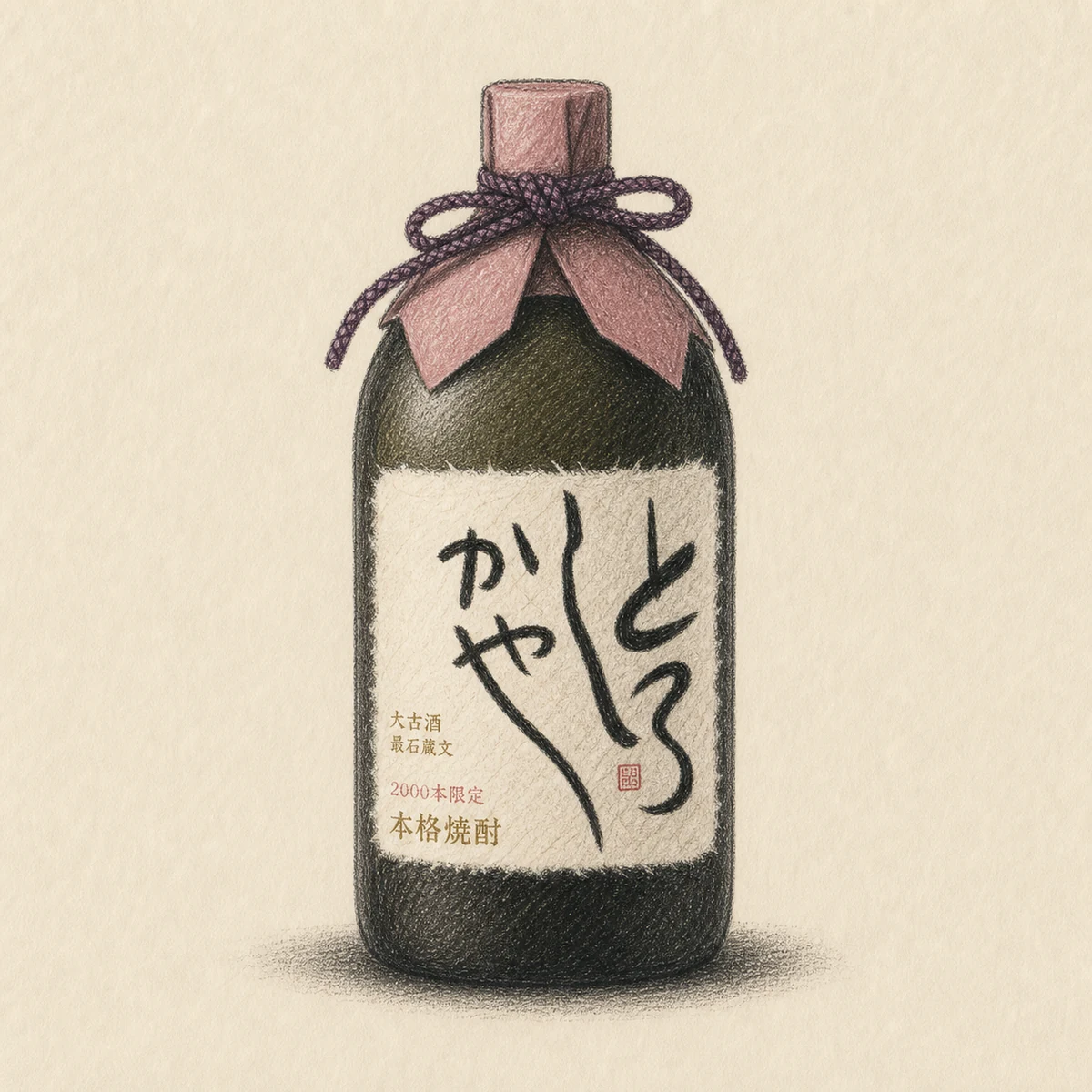
TOROSHIKAYA
TOROSHIKAYA is made only from aged components: long-aged rice shochu, with a thirty-year core, and oak-cask-aged barley shochu. No new spirit is added. Its limited release gives time—not raw specifications—the leading role.
Thailand · Product information
Product information from Bacchus Global Co., Ltd., based in Bangkok, Thailand. About Bacchus Global
A blend without new spirit
TOROSHIKAYA brings together long-aged rice shochu, centred on a thirty-year component, and oak-cask-aged barley shochu. It is built entirely from aged spirits. The release avoids a new-spirit addition and is numbered within an annual allocation of around 2,000 bottles.
An older layer of the place
The name TOROSHIKAYA refers to a figure in the ancient Kumoso tradition associated with the Kuma region. This is not a claim about flavour; it is a way the bottle carries the region’s older cultural memory alongside its long cask maturation.
Award record
The award record shown is specific to this product; it does not guarantee individual preference or quality.
Question 1
What forms the core of the blend?
- 30-year-aged rice shochu
- New sweet-potato shochu
- Unaged gin
Read the answer and explanation
Correct answer: A — 30-year-aged rice shochu
Answer: 30-year-aged rice shochu. The linked section gives the source detail.
Question 2
What is blended with the aged rice shochu?
- Wine
- Oak-aged barley shochu
- Fruit juice
Read the answer and explanation
Correct answer: B — Oak-aged barley shochu
Answer: Oak-aged barley shochu. The linked section gives the source detail.
Question 3
Is any new spirit added?
- Half the blend is new spirit
- New spirit is added for aroma
- No new spirit is added
Read the answer and explanation
Correct answer: C — No new spirit is added
Answer: No new spirit is added. The linked section gives the source detail.
Two layers, layered further
The record for this bottle shows a rice shochu koshu built around a thirty-year core, layered with a cask-aged barley shochu koshu, with not a single drop of new spirit added. The page does not state a specific aroma as a confirmed fact, so no aroma note is claimed here. Instead, the four directions below are built around the recorded structure of a “two-layer blend,” not aroma. These are not pairings the maker has stated officially; they are a reading of the recorded characteristics.
In approaches to building flavor, there are said to be two directions: “harmony,” which layers similar notes together, and “combination,” which builds depth by joining different elements. This bottle’s structure — rice and barley, aged for different lengths of time, blended together — points toward dishes that are themselves built from multiple layers rather than a single element. For this bottle as well, the directions here were built on the recorded structure of a “two-layer blend,” rather than on aroma.
Nishiki, Kuma, Kumamoto — Rokuchoshi Distillery
Rokuchoshi Distillery was founded in 1923 in Nishiki, Kuma, Kumamoto. Its expressions begin with the rice-distilling culture protected by the Kuma GI, and its cask programme asks how time can deepen that foundation without obscuring it.
For current-lot specifications, availability, storage requirements and trade terms, please contact Bacchus Global.