
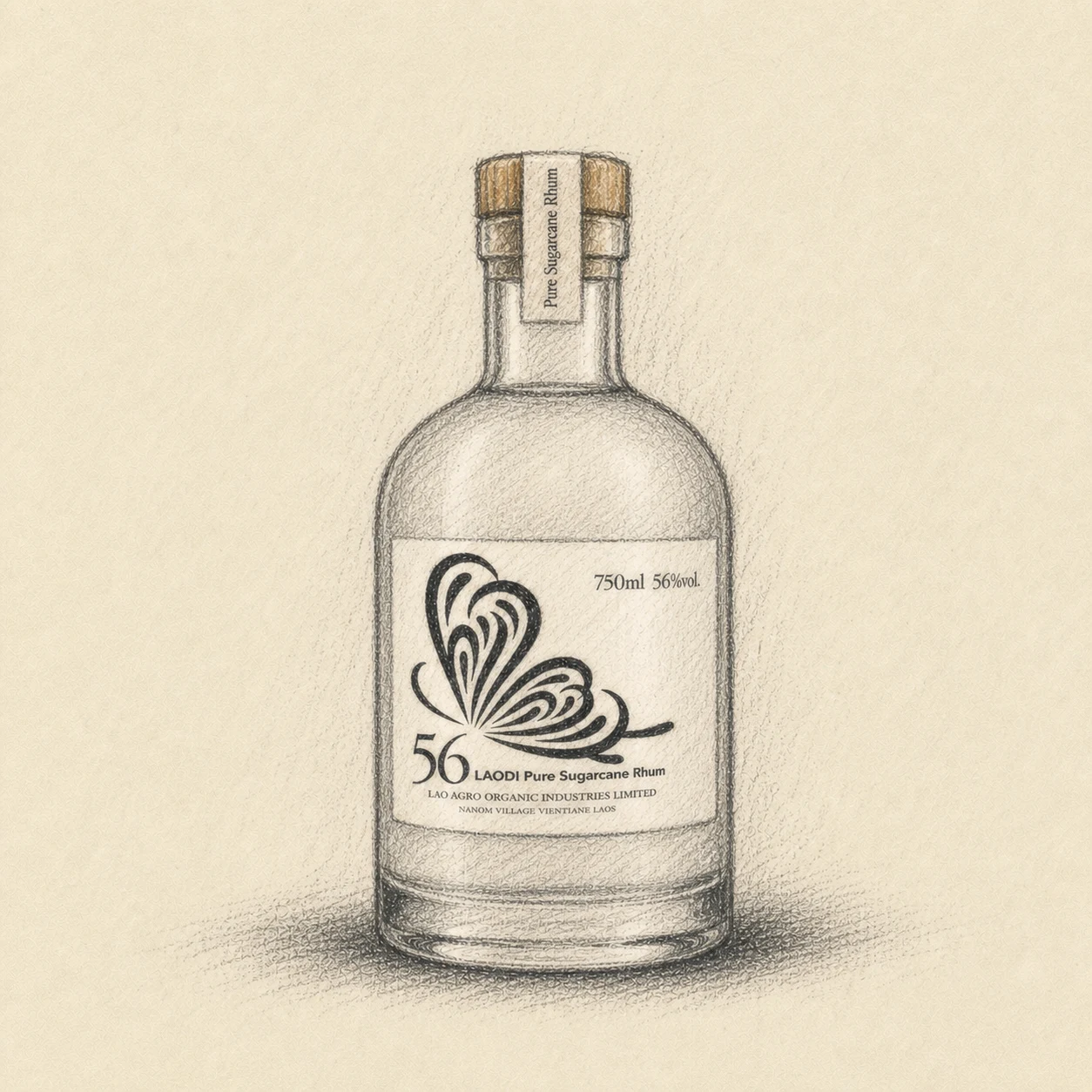
LAODI 56k White Rhum
First-press sugarcane juice, distilled in a 200-litre kabuto-kama still and bottled at 56% to preserve weight, fruit and texture.
Thailand · Product information
Product information from Bacchus Global Co., Ltd., based in Bangkok, Thailand. About Bacchus Global
UT-3 sugarcane, pressed once and distilled in a Japanese-style still.
Hand-harvested UT-3 sugarcane is pressed without dilution. The fresh juice ferments with wine yeast before small-batch distillation in a kabuto-kama pot still.
Small-batch distillation that keeps the cane's weight.
Harvest and press
Cane is hand-cut and the first juice is taken without dilution.
Ferment
Wine yeast ferments the fresh juice for approximately 72–96 hours.
Kabuto-kama distillation
A 200-litre Japanese-style pot still concentrates aroma and texture one batch at a time.
High-proof clarity with fruit, creaminess and a mineral edge.
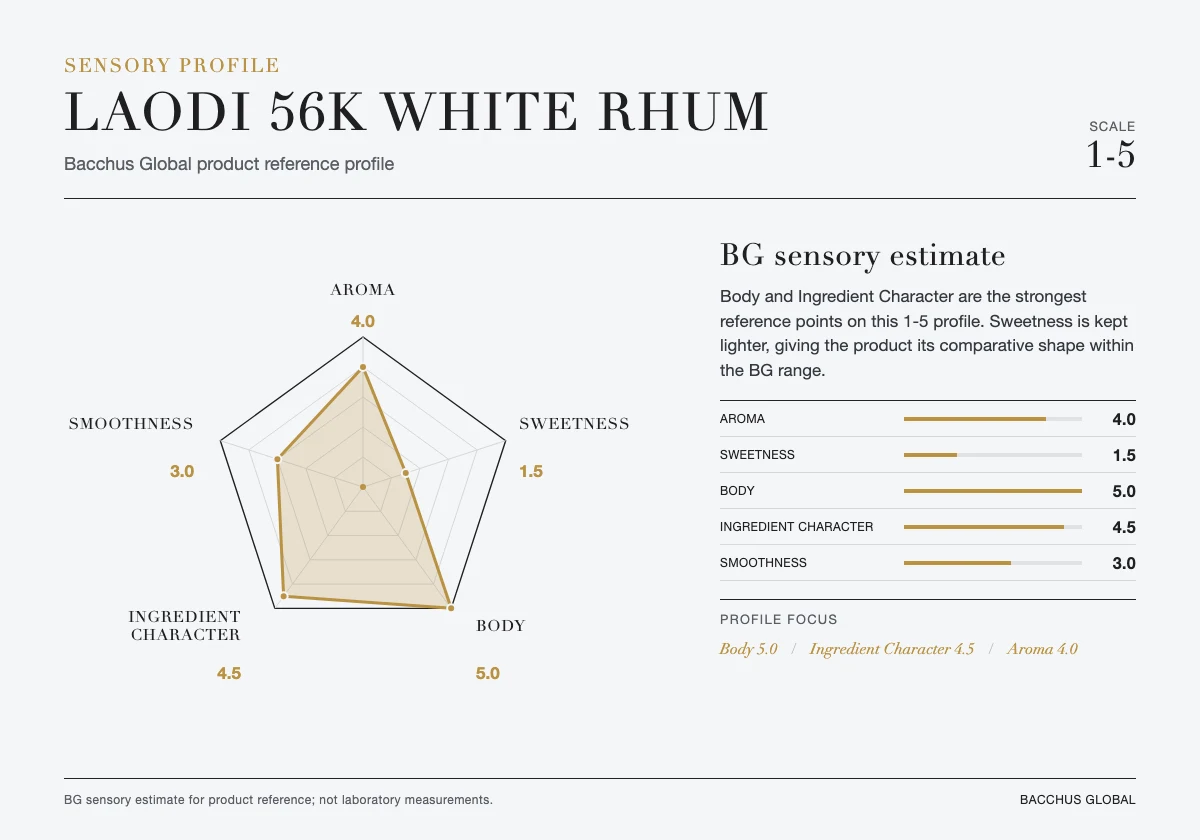
Lemongrass, white grape, pear and apple rise above a full, creamy body. Citrus and a lightly saline mineral line keep the long cane-sweet finish precise.
Keep the service simple enough to show the distillate.
The producer's first recommendation; use a small tulip-shaped glass.
A little water relaxes the 56% structure and releases fruit.
Serve in a measured pour and let it warm gradually in the glass.
Question 1
How is the sugarcane juice pressed?
- First pressing without added water
- Second pressing only
- Reconstituted from dried powder
Read the answer and explanation
Correct answer: A — First pressing without added water
Answer: First pressing without added water. The linked section gives the source detail.
Question 2
Which still is used?
- A 1,500 L vacuum still
- A 200 L Kabutogama
- ZEMON
Read the answer and explanation
Correct answer: B — A 200 L Kabutogama
Answer: A 200 L Kabutogama. The linked section gives the source detail.
Question 3
How is cask maturation handled?
- Three years in bourbon casks
- One year in wine casks
- No cask maturation
Read the answer and explanation
Correct answer: C — No cask maturation
Answer: No cask maturation. The linked section gives the source detail.
Concentration and a mineral edge from a high proof, in four directions
The food affinities for LAODI 56k White Rhum are not combinations officially presented by the producer, but a reading drawn from the characteristics recorded on this page. Built around the concentrated texture and the lemongrass and lightly saline mineral edge that come from small-batch kabuto-kama pot-still distillation and the higher 56% proof, they are organised into four directions.
Food-pairing theory notes that ingredients with strong aromas of the same type sharpen each other’s outline when layered together. These suggestions are a hypothesis built on that structural cue, and are not an official recommendation from the producer
Fresh sugarcane, distilled in the landlocked heart of Laos.
LAODI was founded in 2006 by Japanese founder Ikuzo Inoue with Lao partner Sihatta Rasphone. At Naxone in Vientiane Capital, the team grows sugarcane, presses it after harvest and distils the fresh juice on site.
Continue through the rum collection in English.
Contact Bacchus Global for product documentation, availability and trade information.

