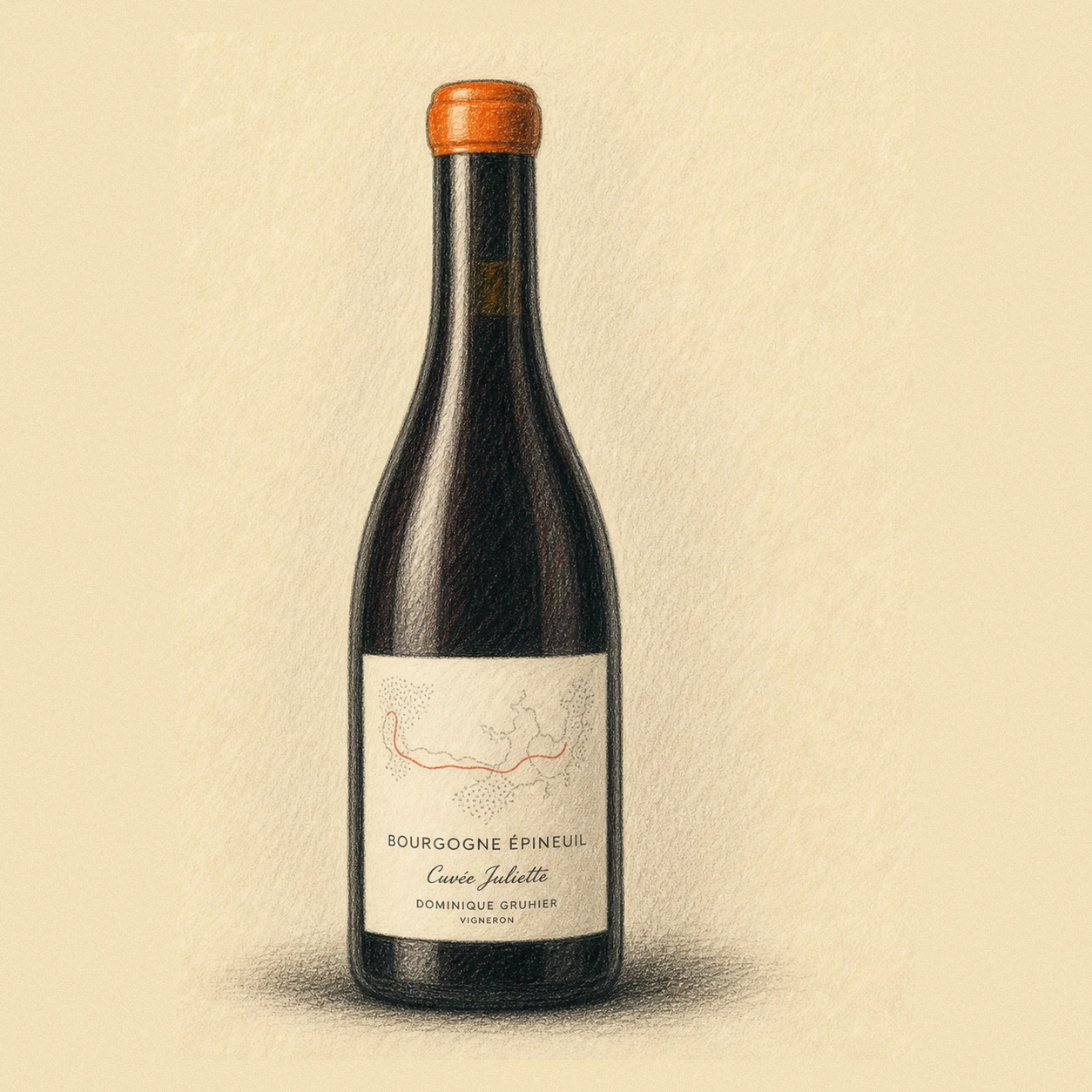
Original bottle illustration — Bacchus Global
Domaine Dominique Gruhier
DOMAINE DOMINIQUE GRUHIERBourgogne Épineuil 2023
At the northern edge of Burgundy, where the same chalky seabed that shapes Chablis runs beneath red-fruited Pinot Noir, this Épineuil bottling carries a story of freshness found where oyster fossils meet vine roots — floral, saline, and quietly energetic in the glass.
- Wine type
- Red wine
- Grape
- Pinot Noir 100%
- Appellation
- Bourgogne Épineuil AOC
- Origin
- Épineuil, Yonne, Burgundy, France
- Drinking window
- Drink 2028–2033 (est.)
- Recommended temperature
- 16°C
- Alcohol
- 13% vol.
- Bottle size
- 750 ml
About This Wine
Domaine Dominique Gruhier farms in Épineuil, a village in the Yonne's Tonnerrois district, some 20 kilometres from Chablis, on the same Kimmeridgian limestone-clay soils that define its more famous neighbour.
For this cuvée, grapes from 10 hectares of vines averaging 40 years old are vinified with a portion of whole clusters and aged in mostly older Burgundian oak, yielding a Pinot Noir built around freshness and precision rather than power.
In the glass
Appearance
Bright cherry-red hue.
Aroma
A captivating, highly perfumed nose shaped by whole-cluster fermentation, opening with a light reduction of blackcurrant and rose petal before red and dark berry aromas — raspberry, a touch of cherry — and a whisper of rose emerge.
Palate
Fruity and mouth-watering, the palate moves from a crystalline, energetic core into mineral-edged brightness, salinity and a root-like bitterness, with notes of eau-de-vie-soaked cherry carried on a texture shaped by the stems and ageing; the finish is fresh, thirst-quenching and gently saline, with a linear, Chablis-like acidity.
Before it reaches the glass
Temperature
Best served at 16°C; a touch of light chilling can heighten its freshness.
Timing
Estimated drinking window: roughly 2028–2033.
Glassware
A Burgundy-style glass suits its aromatic detail.
At the table
This Pinot Noir's fresh acidity, red-berry fruit and saline finish give it flexibility across a range of cuisines.
From the umami-driven simplicity of Japanese grilling to the herbal brightness of Thai home cooking and the classic richness of Burgundian charcuterie and duck, the wine's structure finds a natural echo in dishes built on salt, char and gentle fat.
Japanese
- Salt-grilled salmon (shioyaki)
- Yakitori with salt tare
- Mushroom rice (kinoko gohan)
Why it worksThe wine's saline finish and fresh acidity echo the light char and umami of salt-grilled fish and poultry, while its red-berry fruit softens the earthy sweetness of mushroom rice.
Thai
- Larb moo (northern-style minced pork salad)
- Moo ping (grilled pork skewers)
- Kai jeow yad sai (stuffed Thai omelette)
Why it worksIts bright acidity and light tannins keep pace with the herbal lift of minced-meat salads and grilled pork without overpowering the gentle spice of Thai home cooking.
Western
- Charcuterie platter
- Duck breast (magret)
- Aged cheese
Why it worksThese follow the producer's own pairing notes: the wine's structured red fruit and saline finish stand up to the richness of duck and cured meats, while its acidity cuts through the density of aged cheese.
From cellar to bottle
Winemaking
Grapes are fermented in stainless steel tanks with about 20% whole clusters, macerating for around 20 days with regular pump-overs and no additions; the wine is then aged in 228-litre Burgundian barrels, mostly from Tronçais oak, with only 5% new wood.
Product detail
The fruit is picked half by hand and half by machine; total SO2 sits at 42mg/L, and the wine is bottled at 750ml with an aging potential of roughly 5 to 10 years.
Origin & Terroir
These are estate-level details describing the broader vineyard and its history; specific vinification figures for this cuvée are detailed above.
Official producer website→Certification

Certified Organic (Ecocert) · Ecocert
Certified Organic (Ecocert)
These vineyards have been farmed organically since 2003, with Ecocert certification obtained in 2015.
Critical Recognition
Winehog (Steen Öhman)
Reviewed by Winehog critic Steen Öhman in March 2026, who highlighted its whole-cluster aromatics, pure red and dark berry fruit, and linear, Chablis-like acidity.
Trade information
Contact Bacchus Global for product documentation, availability and trade enquiries.