
Drink
Kimoto vs. Yamahai: Why Was It Possible to Eliminate the Rice-Mashing Process?
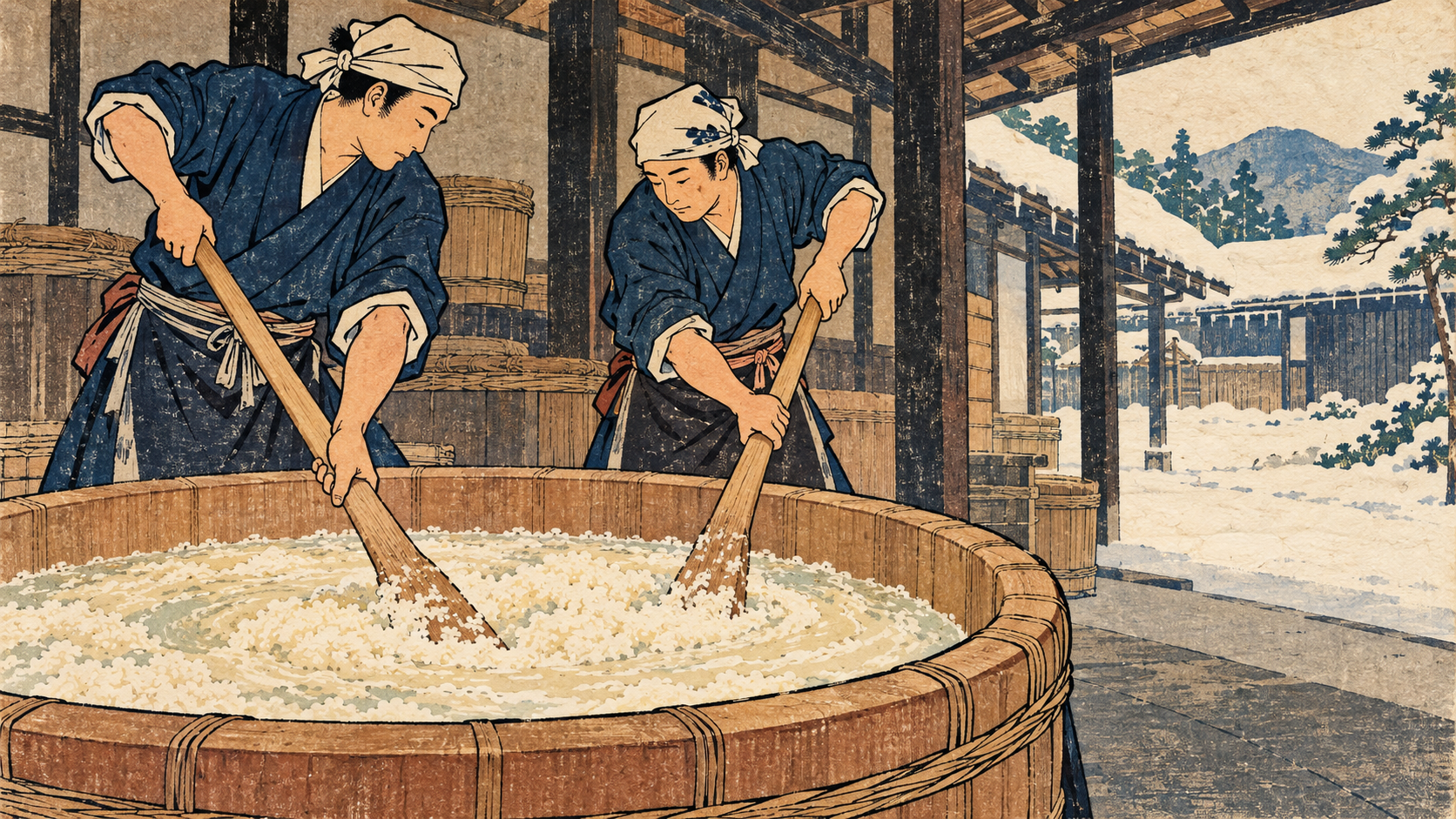
Kimoto and yamahai are two terms commonly found on Japanese sake labels. Both refer to methods of preparing the shubo, or yeast starter, in which yeast is cultivated before the main fermentation. Both rely on the activity of lactic acid bacteria, yet they differ in one particular step: whether brewers perform yamaoroshi, the process of mashing steamed rice and rice koji.
Yamahai is an abbreviation of yamaoroshi haishi moto, meaning a yeast starter made without yamaoroshi. Judging by its name, it may seem like a brewing method that simply omits a step. But how can brewers prepare a starter without mashing the rice? The answer reveals the respective roles of human labor and koji enzymes in sake brewing.
How Kimoto and Yamahai Yeast Starters Work
A shubo is a preparation in which yeast is cultivated in sufficient quantities before fermenting the main sake mash. Made using steamed rice, rice koji, and water, it provides conditions that support yeast growth. Lactic acid plays an essential role: the acidic environment suppresses the growth of undesirable bacteria while allowing acid-tolerant sake yeast to develop.
In both kimoto and yamahai, lactic acid bacteria are cultivated within the starter, and the acid they produce is used to establish this environment. In contrast, sokujo-moto involves adding brewing-grade lactic acid directly. When comparing kimoto and yamahai with sokujo, the clearest starting point is how each obtains its lactic acid.
Lactic acid bacteria produce lactic acid, while yeast converts sugars into alcohol. Both are microorganisms, but they perform different roles within the starter.
Understanding Yamaoroshi in Kimoto Through Koji Enzymes
In traditional kimoto brewing, steamed rice, rice koji, and water are placed in wide, shallow wooden tubs known as hangiri-oke. Once the rice has absorbed water, brewers use paddles called kai to mash the mixture. This is yamaoroshi: a physically demanding, time-consuming operation that breaks the rice into smaller particles so it dissolves more readily.
Yet human labor is not the only force at work. Rice koji is steamed rice on which koji mold has been cultivated. Enzymes are substances that promote chemical reactions, and those produced by koji mold include enzymes that break rice starch down into sugars. These enzymes also contribute to rice breakdown in kimoto brewing.
In yamahai, brewers use the action of koji enzymes to dissolve the steamed rice without performing yamaoroshi. One example is kumigake, in which enzyme-containing liquid is poured over the steamed rice to encourage starch breakdown. Instead of mashing the grains, brewers organize the process so the enzymes can act on them. Building on an understanding of these mechanisms, Japan’s government-run Brewing Experimental Station developed yamahai-moto in 1909.
What was eliminated was the operation of yamaoroshi; the cultivation of lactic acid bacteria was retained. Managing the starter remains essential, with close attention to temperature, elapsed time, and the extent to which the rice has dissolved.
Reading Brewing Methods and Rice Varieties at the Noguchi Naohiko Sake Institute
The Noguchi Naohiko Sake Institute, whose products Bacchus Global handles, is a brewery in Komatsu, Ishikawa Prefecture. Drawing on the techniques master brewer Naohiko Noguchi has developed, it produces a series of yamahai sakes using rice varieties including Gohyakumangoku, Miyamanishiki, and Aiyama.
The brewery’s “NOGUCHI NAOHIKO Junmai-Daiginjo Yamadanishiki 2019” is one of the products handled by Bacchus Global. It is a junmai daiginjo made from Hyogo-grown Yamada Nishiki with a rice-polishing ratio of 50%. The product information describes aromas reminiscent of lychee and pineapple, with a caramel-like flavor from maturation.
“Junmai daiginjo” is a designation relating to ingredients, rice polishing, and ginjo brewing, while “Yamada Nishiki” identifies the rice variety. “Yamahai,” by comparison, describes the starter-making method. The designation junmai daiginjo alone does not establish whether the starter was prepared using yamahai. Reading these terms according to the information they convey helps us understand how each sake is made.
Looking Beyond the Names Kimoto and Yamahai
Some sakes made using kimoto or yamahai have rich umami and pronounced acidity. The method’s name alone, however, cannot determine a sake’s aroma or flavor. Rice, yeast, fermentation of the main mash, and maturation also shape the result.
Both kimoto and yamahai make use of koji enzymes and lactic acid bacteria. With that common ground in mind, the distinction becomes clearer when we ask whether yamaoroshi is performed.
Behind the emergence of yamahai lies a history of identifying the essential mechanisms of starter-making and reorganizing the work around them. Brewers and researchers supported that evolution through trial and error, observing changes in rice and the activity of microorganisms as they refined the process.
This article explores the brewing techniques and cultural heritage of kimoto and yamahai sake, including Noguchi Naohiko Sake Institute. It is intended for educational and cultural information and does not promote the purchase or consumption of alcohol. For readers aged 20 and over.
บทความนี้นำเสนอความรู้เกี่ยวกับเทคนิคการผลิตและมรดกทางวัฒนธรรมของสาเกแบบคิโมโตะและยามาไฮ รวมถึง Noguchi Naohiko Sake Institute เพื่อการศึกษาและวัฒนธรรมเท่านั้น มิได้มีเจตนาส่งเสริมการซื้อหรือการบริโภคเครื่องดื่มแอลกอฮอล์ สำหรับผู้อ่านอายุ 20 ปีขึ้นไป
Discover the culture behind every bottle
We share brewery stories, tasting notes and the craft of koji & fermentation | for educational and cultural purposes only.
เราถ่ายทอดเรื่องราวจากผู้ผลิต บันทึกรสชาติ และศาสตร์แห่งโคจิและการหมัก | เพื่อการศึกษาและวัฒนธรรมเท่านั้น
Follow on Instagram FacebookRelated articles
Product information
Product information for the junmai daiginjo featured above and the brewery’s yamahai sake Yume Zukuri.

