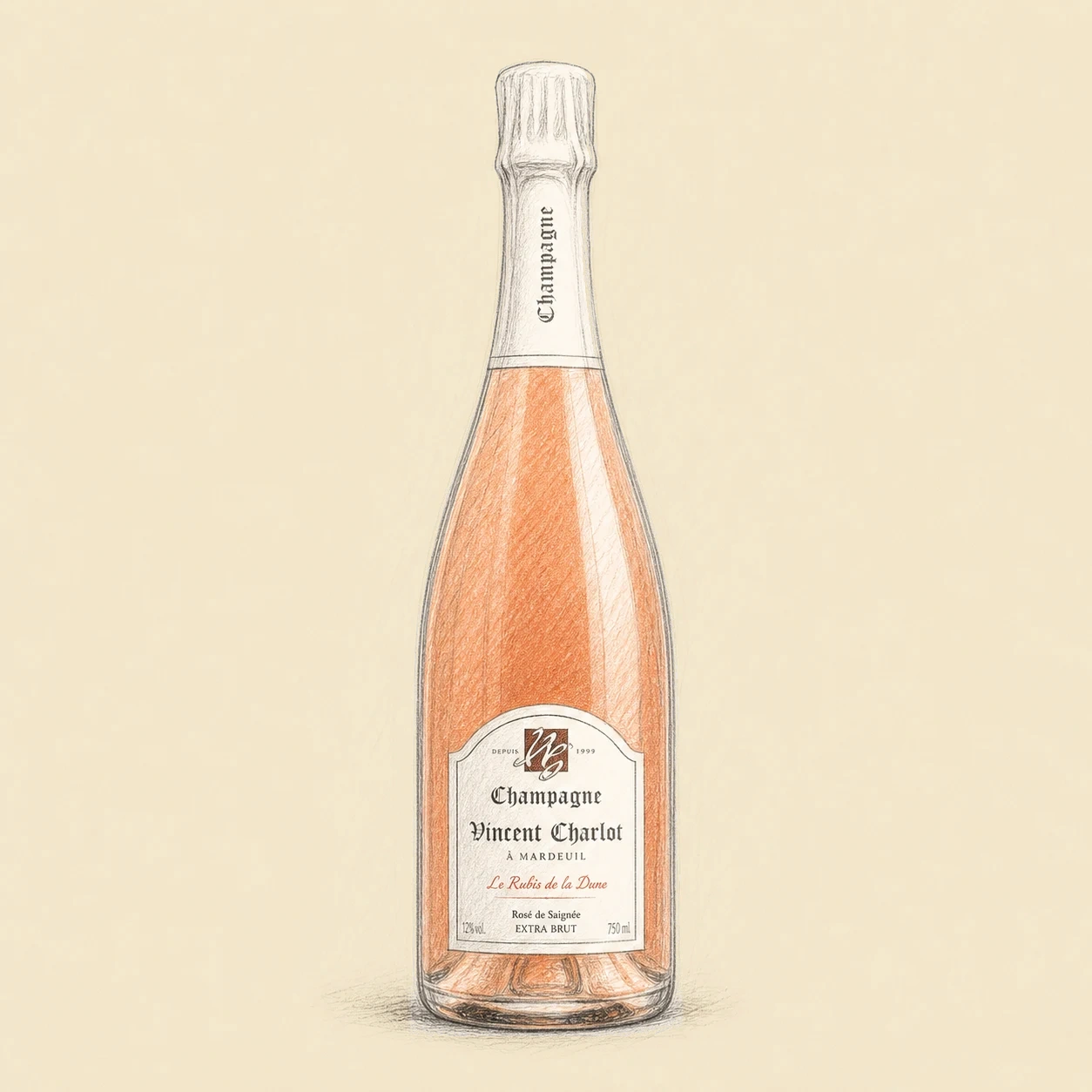
Original bottle illustration — Bacchus Global
Vincent Charlot, Champagne
VINCENT CHARLOTLe Rubis de la Dune Rosé de Saignée Extra-Brut Bio Millésime 2014
A rosé de saignée shaped by a single plot called La Dune, where sand, flint and iron-veined clay meet old vines. Vincent Charlot describes its texture as 'en dentelle' — lace-like, quietly assertive and slow to unfold in the glass.
Thailand · Product information
Product information from Bacchus Global Co., Ltd., based in Bangkok, Thailand. About Bacchus Global
- Wine type
- Vintage rosé de saignée Champagne, Extra-Brut
- Grape
- 80% Pinot Meunier, 20% Pinot Noir
- Appellation
- AOP Champagne
- Origin
- Mardeuil, Vallée de la Marne, Champagne, France
- Drinking window
- —
- Recommended temperature
- 10–12°C
- Alcohol
- 12.5%
- Bottle size
- 750 ml
About This Wine
Le Rubis de la Dune comes from La Dune, a single 0.28-hectare plot in Mardeuil planted in 1955, where sand, silex and iron-rich clay give the wine its structure. Vincent Charlot blends 80% Pinot Meunier with 20% Pinot Noir, macerating the skins for around 14 hours before pressing to extract color and character — a true saignée rather than a blended rosé.
The wine ferments spontaneously in neutral old oak barrels, ages nine months on its lees, then rests a further 36 months or more in bottle. At disgorgement, Charlot tops up the wine with itself rather than a dosage liqueur, keeping the cuvée close to its raw terroir. From 2016, fruit from La Dune was redirected to Blanc de Noirs, marking a new chapter for the parcel.
Taste profile
In the glass
LE RUBIS DE LA DUNE ROSÉ DE SAIGNÉE EXTRA-BRUT BIO MILLÉSIME 2014
Scale1–5
BG wine structure estimate
Comparative profile within the Bacchus Global wine range.
Cherry, cranberry and wild strawberry, layered with light savory wood, a whisper of smoke and butterscotch-like notes shaped by old-oak maturation.
Dry and full-bodied, with juicy red cherry and raspberry fruit, gentle wood spice, a chalky mineral edge and bright acidity.
Vivid ruby to raspberry hue with soft salmon highlights.
Before it reaches the glass
Temperature
Serve at 10–12°C, allowing a few minutes of aeration to let the aromatics open.
Timing
Its acidity and structure make it expressive now; a few minutes in the glass reveal the finer aromatic detail.
Glassware
A tulip-shaped Champagne glass concentrates the aromatics and shows the wine's structure better than a flute.
Question 1
What is the grape blend?
- 80% Meunier and 20% Pinot Noir
- 100% Chardonnay
- 100% Pinot Noir
Read the answer and explanation
Correct answer: A — 80% Meunier and 20% Pinot Noir
Answer: 80% Meunier and 20% Pinot Noir. The linked section gives the source detail.
Read the relevant passageQuestion 2
About how long is the skin maceration?
- Fourteen days
- Fourteen hours
- Fourteen months
Read the answer and explanation
Correct answer: B — Fourteen hours
Answer: Fourteen hours. The linked section gives the source detail.
Read the relevant passageQuestion 3
What is used to top up at disgorgement?
- Only sweetened liqueur
- Only water
- The same wine
Read the answer and explanation
Correct answer: C — The same wine
Answer: The same wine. The linked section gives the source detail.
Read the relevant passageAt the table
With ripe red fruit, chalky minerality and bright acidity, this rosé works well alongside grilled, smoky or richer dishes.
The structure drawn from saignée extraction cuts through fat and lifts smoky or char-grilled flavors, while the wine's own red fruit bridges naturally to the sweetness of poultry and shellfish.
Japanese
- Yakitori (salt-grilled chicken thigh)
- Shio-yaki grilled sea bream
- Ebi tempura
Why it worksThe char of grilled poultry and the sweetness of shellfish meet the wine's red fruit and chalky minerality.
Thai
- Gai yang (Isaan grilled chicken)
- Thai-style fried chicken
- Goong phao (charcoal-grilled river prawns)
Why it worksThe spice and smoke of Thai grilling are balanced by the wine's high acidity and Extra-Brut precision.
Western
- Roast free-range chicken
- Soft-ripened cheese such as Camembert
- Pan-seared white fish or shellfish
Why it worksRoasted poultry and the richness of soft cheese are echoed by the wine's savory wood notes and mineral edge.
From cellar to bottle
Winemaking
Skins from 80% Pinot Meunier and 20% Pinot Noir macerate for around 14 hours before saignée extraction, followed by spontaneous fermentation with indigenous yeast in neutral old oak. No malolactic fermentation takes place; the wine ages nine months on its lees in barrel, then a further 36 months or more in bottle.
Product detail
Produced entirely from the single 0.28-hectare La Dune plot in Mardeuil, planted in 1955. Certified organic by Ecocert and Demeter-certified since 2013. Bottled at 750 ml and disgorged with a top-up of the same wine rather than a dosage liqueur, finishing at approximately 4 g/L Extra-Brut.
Origin
The name La Dune refers to the sandy character of this small plot. From 2016, fruit from the same parcel was redirected into a Blanc de Noirs.
Official producer website→Certification

Ecocert Organic Certification · Ecocert

Demeter Biodynamic Certification · Demeter
Certified Organic & Biodynamic
This cuvée is certified organic by Ecocert and Demeter-certified since 2013, a status obtained by the estate ahead of this vintage.
Trade information
Contact Bacchus Global for product documentation, availability and trade enquiries.