From a mother’s ramen stall to a bowl on Soi 26No Name Noodle
We traced No Name Noodle on Sukhumvit Soi 26, where the kitchen makes its own noodles and broth, back to the work Shinji Inoue saw at his mother’s stall.
- Location
- 1F S&P Hall, Sukhumvit Soi 26
- Cuisine
- Ramen and tsukemen
- Opened
- 2022 (BK Magazine report)
Watching his mother at her ramen stall
In an interview published by the Michelin Guide in January 2026 we consulted, Inoue recalled his mother’s ramen stall and its small counter, where she looked after one customer at a time. He went on to manage restaurants, work as a cook and learn from ramen makers around Japan. He told the guide that he carried on his mother’s way of serving people individually while developing a menu of his own.
A restaurant that opened in 2022
We read that BK Magazine visited in January 2023 and reported that No Name Noodle had opened in early 2022. At the time it offered two regular choices alongside specials offered in limited numbers each day. The shio soba featured in the review came with pork and chicken chashu, egg, finely chopped mushrooms prepared as duxelles and yuzu paste. A small bowl of rice topped with pork was served with it.
Letting the food introduce the restaurant
Inoue told the Michelin Guide that he wanted diners to discover the restaurant through its atmosphere and food, with the name kept in the background. The guide we consulted describes grey brick and pale wood at the entrance in S&P Hall, which has no large sign. A triangular logo inside evokes Mount Fuji and clouds, the guide says.
Noodles made for Bangkok’s humidity
We looked at accounts of humidity and noodle making to see how the kitchen works in Bangkok. The MICHELIN Guide reports that the kitchen makes noodles on site each day with wheat flour from Hokkaido. The Michelin Guide reports that Inoue adjusts the amount of water in the dough from day to day as Bangkok’s humidity varies. The proportions of wheat bran, endosperm and germ in the flour blend can also change the flavour. The kitchen adapts its noodle-making to the conditions in Bangkok even as it works with flour from Japan.
Shio soba and shoyu tsuke soba
The Michelin Guide we consulted lists shio soba, noodles in a salt-seasoned broth, and shoyu tsuke soba, noodles served with a separate soy-seasoned dipping broth, among the restaurant’s signature dishes. The listing also describes a fermented blend of three soy sauces used in seasonal noodle and rice bowls. In its interview, the guide records kombu and dried fish, including niboshi, bonito and mackerel, among the ingredients for the dashi. The two styles use noodles, stock and seasoning in different ways, with the broth either in the bowl or served alongside it.
The restaurant today
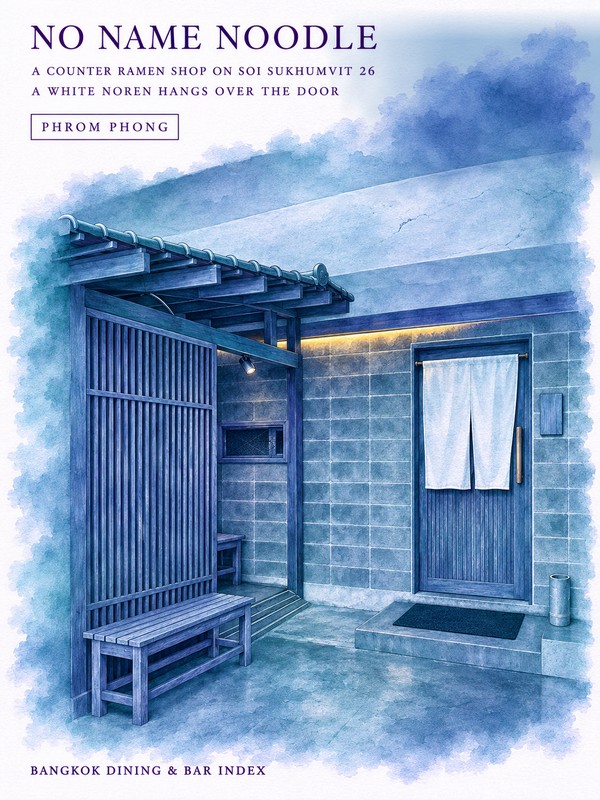
The small wooden tag at the entrance has no writing on it. No signboard and no name are displayed at the front of the shop.
The shop's name begins with the words “No Name,” meaning “without a name.” The shop is in Phrom Phong, Bangkok, on Soi Sukhumvit 26. A wooden bench sits beside the entrance. We list this shop as a ramen shop with counter seating and a private room.
The shop makes the noodles by hand every day. The flour is from Hokkaido, and the shop adjusts the amount of water to Bangkok's humidity. The broth uses kombu, niboshi (dried fish), bonito and mackerel.
The dishes include shio soba and shoyu tsuke soba (noodles with a soy-sauce-based dipping broth). There is also a shio ramen made with shellfish.
The entrance is set in a gray wall. On the right is a wooden door with a white noren curtain hanging. On the left stand a wooden vertical-lattice screen and a wooden bench. A thin line of light runs along the top of the wall.
The shop is a Bib Gourmand selection in MICHELIN Guide Thailand 2027. We list this shop as a Japanese ramen shop in the Phrom Phong area. Its category is a counter-seating restaurant.
Sources: BDI venue card, the MICHELIN Guide venue page and article, a photo of the entrance. We read and summarised these.