Drink
How Can We Read a Gin’s Connection to Place? Four Clues in the Official Information for ohoro GIN Standard
How Can We Read a Gin’s Connection to Place? Four Clues in the Official Information for ohoro GIN Standard
The Sake Staircase, Episode 8 | Step 5: Craft Gin
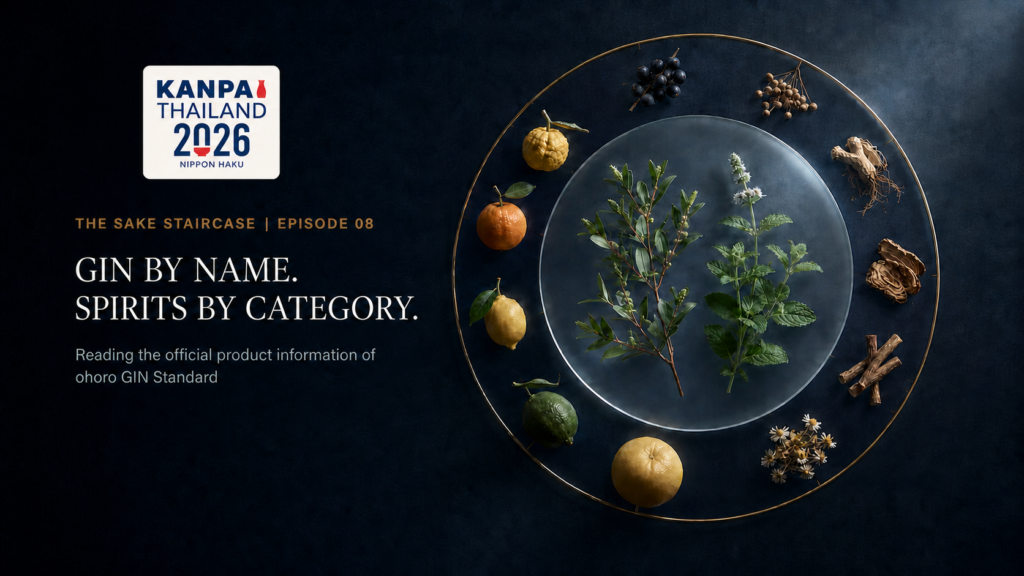
The official information for ohoro GIN Standard lists 13 botanicals, the plant ingredients used to add aroma and flavor. Of these, two are explicitly identified as being from Niseko Town, Hokkaido: sweet gale (yachiyanagi) and Japanese mint.
Does this mean that the other 11 botanicals are not from Niseko? The public information does not go that far.
To understand the distinction, this article examines four pieces of information in turn: “GIN,” “Spirits,” “domestically produced,” and “from Niseko Town, Hokkaido.” All four appear in the official information for the same product, but each answers a different question. Following Episode 7, “Layering Yuzu and Sea Salt over Sake”, this article looks at the official information for ohoro GIN Standard.
The sources examined here are the Japanese- and English-language product information published by the Japanese manufacturer. This article does not explain how the product is classified in Thailand for customs, excise, import, or labeling purposes.
1. “GIN” Is the Specific Name of the Product Type
The word “GIN” in the product name identifies this product specifically as gin.
2. “Spirits” Is the Broader Category Used in the Manufacturer’s Official Information
The manufacturer’s English-language product page states “Product: Spirits,” while its Japanese-language official release states “品目:スピリッツ,” or “Category: Spirits.”
For this product, “GIN” identifies the more specific type, while “Spirits” indicates the broader category used in the manufacturer’s public information. The two terms can therefore appear for the same product without contradiction.
This is a reading of information published by the Japanese manufacturer. The statement “Category: Spirits” should not be treated as a determination of the product’s classification in Thailand for customs, excise, import, or labeling purposes.
3. “Domestically Produced” Means Produced in Japan
The Japanese-language official release lists the ingredient as “醸造アルコール(国内製造).” The manufacturer’s English-language product page presents the same information as “Brewers alcohol (Japan made).”
In this context, “domestic” is written from the perspective of a Japanese source and therefore means Japan. It does not mean domestically made in Thailand. Brewers alcohol is the base alcohol used for this gin.
From this information, we can confirm only that the brewers alcohol was made in Japan. It does not tell us where the crops used to make that alcohol were grown, or in which part of Japan the alcohol was produced.
“Japan made” therefore cannot be read as meaning that every ingredient is of Japanese origin or that the base alcohol was made in Niseko. It is important to distinguish between what the published information states and what it leaves unstated.
4. “From Niseko Town, Hokkaido” Identifies the Origin of Two Botanicals
In gin production, the plant ingredients used to add aroma and flavor are called botanicals.
The official information for ohoro GIN Standard lists 13 botanicals. These include juniper berries, coriander, lemon, yuzu, sweet gale, and Japanese mint.
Of the 13, sweet gale and Japanese mint are explicitly identified as being from Niseko Town, Hokkaido. A 2026 official release also describes both as ingredients from Niseko Town.
This does not mean that the remaining 11 botanicals have been confirmed as coming from outside Niseko. Their origins are not stated in the official information examined for this article. What can be confirmed is limited to this: two of the 13 botanicals are explicitly identified as being from Niseko Town.
Niseko Also Appears in the Water and the Place of Production
The two botanicals are not the only published information connecting this gin to Niseko.
The official description states that the product uses underground water from Niseko Annupuri. This is water that has seeped into the ground and flows through layers of sand, gravel, and other material.
The manufacturer is NISEKO DISTILLERY CO., LTD., a company in the Hakkaisan Group, and production takes place in Niseko Town, Hokkaido. Counting only the plant ingredients explicitly identified as local would therefore overlook two other connections to place: the water and the location of production.
Reading the Four Pieces of Information Separately
The official information for ohoro GIN Standard can be summarized as follows:
- GIN: the specific name of the product type
- Spirits: the broader category used in the Japanese manufacturer’s official information
- Brewers alcohol (Japan made): the base alcohol, made in Japan
- From Niseko Town, Hokkaido: the origin explicitly stated for sweet gale and Japanese mint
Niseko also appears in the information about the water and the place of production. Although these terms appear together, they do not provide the same kind of information. One identifies the product type, another gives a broader category, another describes the base alcohol, and another states the origin of particular plant ingredients.
“Domestic” should not be reinterpreted as Thailand, and the classification used in the Japanese manufacturer’s information should not automatically be treated as the product’s classification under Thai requirements.
Reading the official information means looking beyond the prominent word “GIN” to the smaller statements placed beside individual ingredients. That is where the connection between this gin and Niseko gradually comes into view.
This article provides factual and educational information about ohoro GIN Standard. The terms “Spirits” and “Japan made” follow the terminology used in the Japanese manufacturer’s product information and should not be understood as statements of the product’s classification in Thailand. This article is not intended to advertise alcoholic beverages or encourage alcohol consumption. It is intended for readers aged 20 and over.
บทความนี้ให้ข้อมูลเชิงข้อเท็จจริงและความรู้เกี่ยวกับ ohoro GIN Standard คำว่า “Spirits” และ “Japan made” ยึดตามถ้อยคำที่ใช้ในข้อมูลผลิตภัณฑ์ของผู้ผลิตญี่ปุ่น และไม่ควรตีความว่าเป็นการระบุการจัดประเภทผลิตภัณฑ์ในประเทศไทย บทความนี้ไม่มีวัตถุประสงค์เพื่อโฆษณาสุราหรือส่งเสริมการบริโภค เนื้อหานี้จัดทำสำหรับผู้อ่านอายุ 20 ปีขึ้นไป
Related Articles
“Why Japanese Gin Alone Is Staying Afloat While the Global Gin Market Sinks” / “Terroir in a Bottle” / “The Logic of Subtraction” / “The Logic of the Seto Inland Sea”
Related Product(s)
“NISEKO OHORO GIN STANDARD” / “UMENOYADO GIN” / “SAKURAO JAPANESE CRAFT DRY GIN ORIGINAL”
Discover the culture behind every bottle
We share brewery stories, tasting notes and the craft of koji & fermentation — for educational and cultural purposes only.
เราถ่ายทอดเรื่องราวจากผู้ผลิต บันทึกรสชาติ และศาสตร์แห่งโคจิและการหมัก — เพื่อการศึกษาและวัฒนธรรมเท่านั้น