Stories Behind the Bottle
Muscadet Renaissance: When a Region Began Naming Its Differences
The turning point was not a new grape. It was the decision to stop treating every place as the same.
Muscadet was never geographically simple. Between Nantes and the Atlantic, vineyards follow the Loire, the Sèvre and the Maine across old crystalline ground. Yet the region was long reduced to a convenient shorthand: Melon de Bourgogne, a light white wine, and the words sur lie.
The renaissance of Muscadet did not begin when the grape changed. It began when growers and the appellation built a language for differences that were already present. Communal crus, lower yields, longer ageing on the fine lees and more exact parcel work turned geology and time into part of the name.
When a Style Became a Ceiling
The regional Muscadet appellation was recognised in 1937. Muscadet Sèvre et Maine, the subregional appellation at the centre of the Nantes vineyard, had been recognised the previous year. The sur lie tradition preserved wine on its fine lees after harvest and became one of the region’s defining practices.
That identity brought recognition, but it could also flatten the map. If Muscadet was understood primarily as one grape made in one familiar style, the distinctions between gneiss, gabbro, granite and orthogneiss remained difficult to see. The style was real. It was simply not the whole territory.
2011: A Hierarchy Begins to Speak
In 2011, Clisson, Gorges and Le Pallet became the first officially recognised crus communaux within Muscadet Sèvre et Maine. Seven more names followed. The Fédération des Vins de Nantes now presents ten communal crus cultivated by about one hundred growers across two hundred hectares: Clisson, Gorges, Le Pallet, Goulaine, Château-Thébaud, Mouzillon-Tillières, Monnières-Saint Fiacre, La Haye-Fouassière, Vallet and Champtoceaux.
The importance of those names is structural. They do not describe ten brands placed above the rest of the region. They identify delimited origins whose production rules ask growers to accept lower yields and long maturation on the lees. Depending on the cru, the minimum maturation period is eighteen to twenty-four months. Place is therefore recognised through constraints, not through a decorative reference to soil.
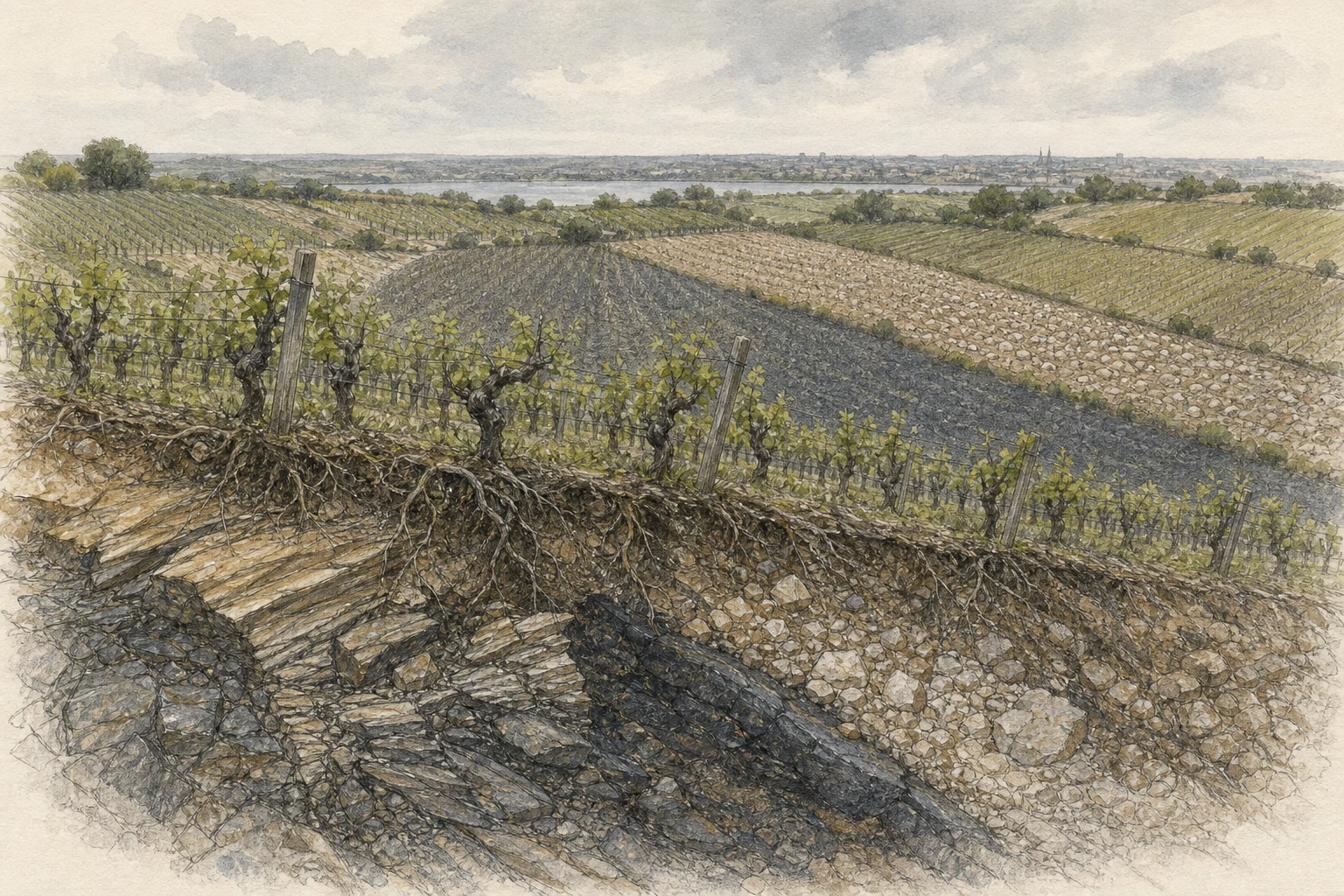
Time Became Evidence
Long ageing on the fine lees changed the role of time. It was no longer only a way to preserve a familiar style. For the communal crus, time became part of the evidence that a particular place could hold its shape.
Domaine Le Fay d’Homme’s Monnières-Saint Fiacre 2020 makes that principle concrete. The producer’s technical sheet identifies Melon de Bourgogne from vines more than sixty-five years old on two-mica gneiss. The fruit was harvested by hand, fermented with indigenous yeast for twenty-one days, then kept on its fermentation lees for thirty-four months in underground concrete tanks. It was bottled on 22 August 2023.
None of those numbers proves quality by itself. Together, they show what the new hierarchy demands: a delimited origin, reduced haste and enough time for a wine to be judged as more than a young regional style.
Vincent Caillé and the Choice to Narrow
Vincent Caillé took over his family’s vineyard in 1986. Domaine Le Fay d’Homme now describes a twenty-five-hectare estate spread across Monnières, Gorges, Maisdon-sur-Sèvre and Mouzillon, with gneiss, gabbro and orthogneiss among its principal soils.
The estate dates its organic work to 1996, its official organic conversion to 2007 and its biodynamic practice to 2012, with Ecocert and Demeter certification. Its account also notes the return of protected wild tulips to living vineyard soils after their decline in an area shaped by chemical treatments.
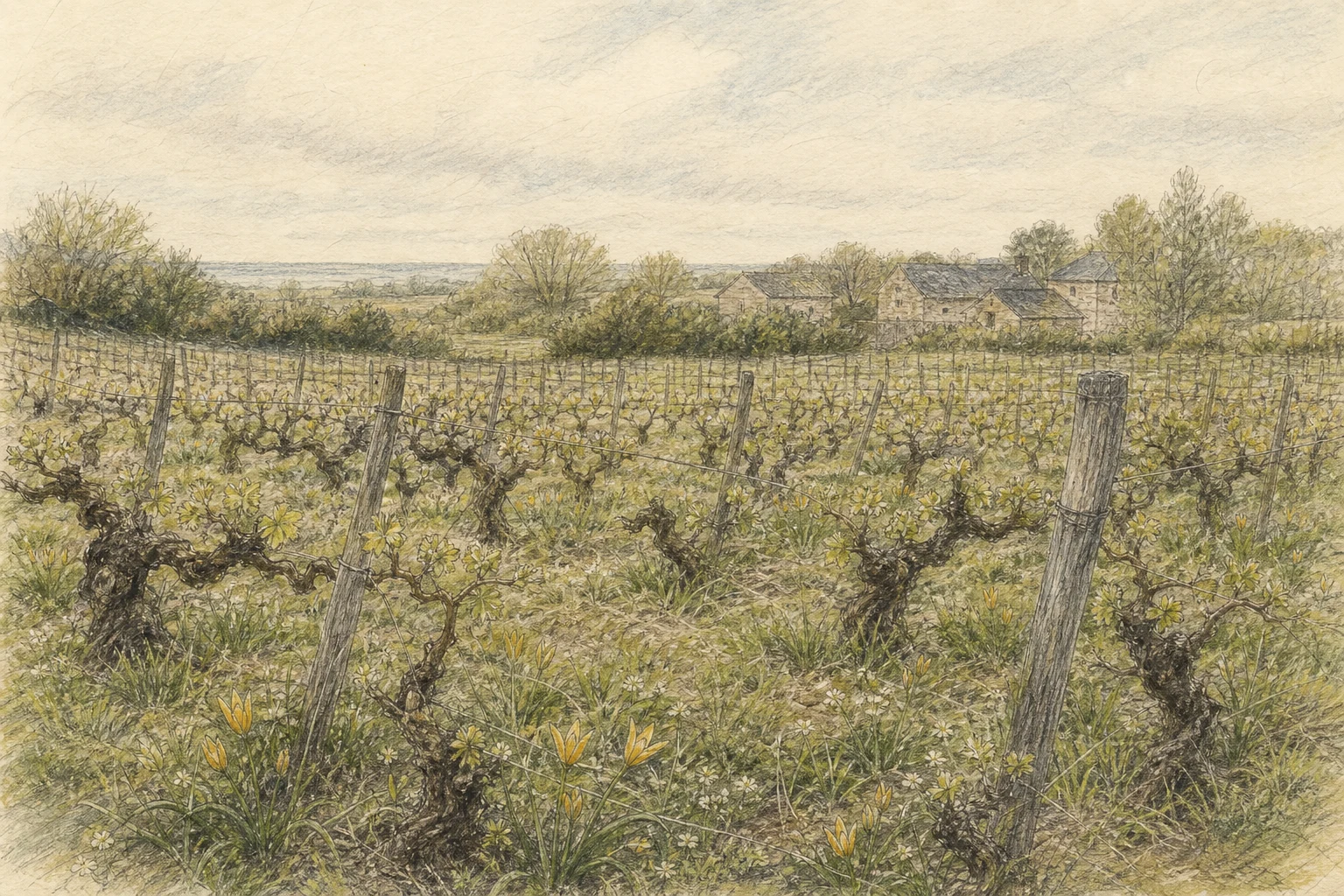
This work should not be used as a shortcut of its own. Biodynamic certification does not make every parcel identical, and the presence of flowers does not replace technical judgement. What it reveals is a consistent decision to narrow the means used in the vineyard and cellar so that differences between places are less easily erased.
Four Bottles, Four Scales of the Same Decision
Four Bacchus Global product-information pages show different scales of this work:
- LE FAY D’HOMME Monnières-Saint Fiacre Muscadet Sèvre et Maine 2020
- LE FAY D’HOMME Fief Seigneur 2023
- LE FAY D’HOMME Je t’aime mais j’ai soif N.V
- LE FAY D’HOMME X Bulles N.V
Monnières-Saint Fiacre names a communal cru and a long maturation. Fief Seigneur focuses on old Melon de Bourgogne vines on gneiss. Je t’aime mais j’ai soif and X Bulles sit outside that communal-cru frame and show that one producer’s range cannot be reduced to a single hierarchy. The four wines are not equivalent categories. Their value here is that they make the boundaries visible.
Three earlier BG articles provide broader and closer views: A Gneiss Vineyard Reshaping the Narrative of Muscadet, Domaine Le Fay d’Homm and The Wines of the Loire Valley.
Muscadet’s renaissance is sometimes told as a rise in prestige. The more useful account is a change in resolution. A region once described through one grape and one technique built a hierarchy capable of naming ten origins, then asked growers to support those names with lower yields, longer time and more exact work. Nothing new had to be invented beneath the vineyards. The difference was learning to stop hiding what was already there.
Source note: The current ten-cru structure, approximate area, number of growers and maturation range were checked against the Fédération des Vins de Nantes. Appellation history and the sur lie definition were checked against INAO’s Muscadet page and its Monnières-Saint Fiacre page. Estate history and certification dates follow Domaine Le Fay d’Homme’s official history. The 2020 communal-cru details follow the producer’s official technical sheet. Product names and vintages follow the linked Bacchus Global product-information pages.
This article presents appellation history, vineyard work and winemaking decisions for educational and cultural purposes. It is not intended to advertise alcoholic beverages or encourage their purchase or consumption. It is intended for readers aged 20 and over.
บทความนี้นำเสนอประวัติของเขตแหล่งกำเนิด การทำงานในไร่องุ่น และการตัดสินใจด้านการผลิตไวน์ เพื่อการศึกษาและวัฒนธรรมเท่านั้น มิได้มีวัตถุประสงค์เพื่อโฆษณา หรือส่งเสริมการซื้อหรือการบริโภคเครื่องดื่มแอลกอฮอล์ บทความนี้จัดทำขึ้นสำหรับผู้อ่านอายุ 20 ปีขึ้นไป
Discover the culture behind every bottle
We share brewery stories, tasting notes and the craft of koji & fermentation — for educational and cultural purposes only.
เราถ่ายทอดเรื่องราวจากผู้ผลิต บันทึกรสชาติ และศาสตร์แห่งโคจิและการหมัก — เพื่อการศึกษาและวัฒนธรรมเท่านั้น
Follow on Instagram Facebook