Blog
Choosing a Brewery for Each Product: SAKE HUNDRED’s BYAKKO BESPOKE and NIKO
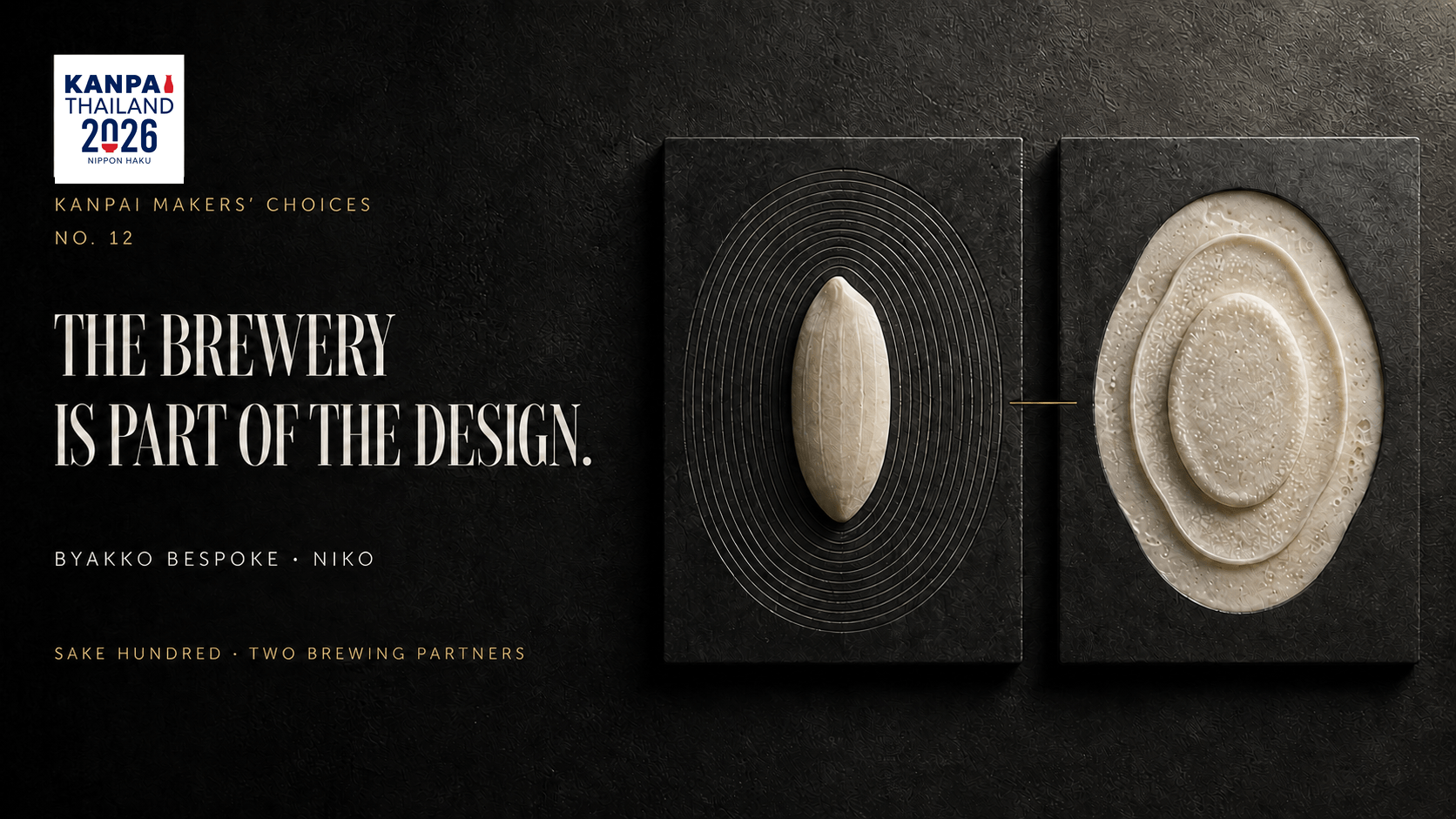
KANPAI Makers’ Choices No.12
In traditional sake making, a label is inseparable from its brewery|a reflection of local water, regional rice, microclimate, and generations of mastery.
SAKE HUNDRED reinterprets this tradition. Clear Inc., the brand’s parent company, operates without its own physical brewery. Instead, it collaborates with breweries across Japan, pairing each product concept with the production capabilities needed to fulfill it. These collaborators are known simply as “brewing partners.”
Featured in the Bacchus Global selection at KANPAI THAILAND 2026, BYAKKO BESPOKE and NIKO demonstrate this philosophy. BYAKKO BESPOKE is crafted by Tatenokawa Shuzo in Yamagata, while NIKO stems from Shirataki Sake Brewery in Niigata. Though sharing the same brand ethos, they diverge in ingredients, technique, and terroir.
Rather than comparing these expressions hierarchically, this edition explores how SAKE HUNDRED aligns product design with partner selection, drawing on distinct regional strengths to achieve different results.
Connecting Brewery Expertise Without Owning a Brewery
Clear Inc. was established in 2013 and launched a brand that served as the precursor to SAKE HUNDRED in 2018. Rather than owning its own sake-production equipment, it develops a concept for each product and works with a brewery suited to realizing it.
This approach does not diminish the role of the brewery. The brand develops the product concept while drawing on local water, equipment, and the skills cultivated by the brewery as conditions for bringing it to life. The brand presents the concept, and the brewing partner gives it concrete form through its accumulated expertise. Neither side alone could realize the product.
The relationship is clear when BYAKKO BESPOKE and NIKO are considered side by side. For BYAKKO BESPOKE, the rice is polished to an 18% polishing ratio, and the rice and yeast combinations are reconsidered. For NIKO, a fourth stage is added to the standard three-stage brewing process, making use of white koji and rice bran. Rather than asking both breweries to use the same method, the brand connects their different techniques under one name.
BYAKKO BESPOKE: Reimagining Rice and Yeast
Tatenokawa Shuzo, located in Sakata, Yamagata, was established in 1832. In 2010, the brewery moved to producing only Junmai Daiginjo, a designated sake category made without added distilled alcohol and subject to a rice-polishing ratio of 50% or lower.
For BYAKKO BESPOKE, Yamada Nishiki rice from Hyogo Prefecture undergoes a milling process lasting more than 200 hours, until 18% of the grain remains. In addition to the rice selection and polishing, the choice of yeast was re-examined in relation to aroma and fermentation.
True to its name, “Bespoke” refers to a product formulated to a particular brief. From the original BYAKKO baseline, the rice variety and yeast combination were reviewed to create a different balance of sweetness, acidity, and umami.
The significance lies not merely in the 18% figure, but in how Tatenokawa Shuzo’s experience with highly polished rice is connected with the selection of rice and yeast in the final design.
NIKO: Introducing a Fourth Mash Addition
Shirataki Sake Brewery, maker of NIKO, was established in 1855 in Echigo Yuzawa, Niigata. The brewery uses snowmelt from the Tanigawa mountains, which travels underground for roughly 50 years before being drawn from three wells on the brewery grounds. Official information describes it as soft water with a hardness of approximately 41 mg/L.
Beyond its water source, NIKO is distinguished by the structure of its mash additions. Sake commonly follows sandanjikomi, in which rice, koji, and water are added in three stages. NIKO introduces a fourth addition (yondanjikomi).
In this final addition, white koji|more commonly associated with shochu|is used instead of the yellow koji common in sake production. Because white koji produces citric acid, it is also relevant to the design of acidity. The stage further incorporates rice bran generated during the production of SAKE HUNDRED’s separate flagship product BYAKKO, not BYAKKO BESPOKE. NIKO uses this outer layer of the grain, which is not commonly used in standard sake brewing, as a source of sweetness. The mash is also fermented at a lower temperature than in standard ginjo brewing so that carbon dioxide produced during fermentation remains dissolved in the sake.
Where BYAKKO BESPOKE reviews the rice and yeast combination, NIKO changes the mash-building process by adding a fourth addition and altering the koji and raw material used at that point. The differences therefore extend beyond the product names and labels to choices made before and during fermentation.
One Brand, Distinct Philosophies of Craft
BYAKKO BESPOKE and NIKO are not intended for linear comparison. BYAKKO BESPOKE is a Junmai Daiginjo made with highly polished rice, while NIKO changes the mash structure through white koji and rice bran. Their approaches to raw materials, rice polishing, koji, and fermentation control are different.
Their common bond lies not in standardized technique, but in shared intent: defining a product concept, then identifying a brewery with the techniques needed to realize it.
At Tatenokawa Shuzo, that choice draws on experience with highly polished rice and production focused on Junmai Daiginjo. At Shirataki Sake Brewery, snowmelt water is combined with a fourth mash addition using white koji, the use of rice bran, and low-temperature fermentation control. Regional conditions and each brewery’s areas of expertise thus become elements of product design.
Selection as an Act of Design
In previous editions, KANPAI Makers’ Choices examined decisions made within the cellar|from milling ratios and press fractions to filtration, dilution, and vessel selection.
For this Bacchus Global feature in No.12, the focus shifts to the step before brewing begins: matching a product concept with a brewing partner.
Rather than applying a single house style across its portfolio, SAKE HUNDRED selects a partner according to each product’s objective. BYAKKO BESPOKE centers on the combination of rice, yeast, and high polishing, while NIKO centers on a fourth mash addition using white koji and rice bran. The choice not to place both products in the same mold is part of SAKE HUNDRED’s brand design.
This article is intended solely to provide factual and cultural information about the product-development philosophy of SAKE HUNDRED, BYAKKO BESPOKE, NIKO, and their brewing partners. It does not aim to promote or encourage the purchase or consumption of alcohol. It is intended for readers aged 20 and over.
บทความนี้จัดทำขึ้นเพื่อให้ข้อมูลเชิงข้อเท็จจริงและวัฒนธรรมเกี่ยวกับแนวคิดการพัฒนาผลิตภัณฑ์ของ SAKE HUNDRED, BYAKKO BESPOKE, NIKO และโรงสาเกพันธมิตรเท่านั้น มิได้มีเจตนาเพื่อส่งเสริมการซื้อหรือการบริโภคเครื่องดื่มแอลกอฮอล์ บทความนี้จัดทำขึ้นสำหรับผู้อ่านอายุ 20 ปีขึ้นไป
Related Products
SAKE HUNDRED BYAKKO BESPOKE / SAKE HUNDRED NIKO
Related Reading
KANPAI THAILAND 2026 Feature / The Philosophy of Bespoke / The Counterintuitive Excellence of NIKO / Connecting Expertise Without Owning a Brewery
Discover the culture behind every bottle
We share brewery stories, tasting notes and the craft of koji & fermentation | for educational and cultural purposes only.
เราถ่ายทอดเรื่องราวจากผู้ผลิต บันทึกรสชาติ และศาสตร์แห่งโคจิและการหมัก | เพื่อการศึกษาและวัฒนธรรมเท่านั้น
Follow on Instagram FacebookRelated reading
SAKE HUNDRED: Three Distinct Expressions Named Category Champions at the Oriental Sake Awards 2026