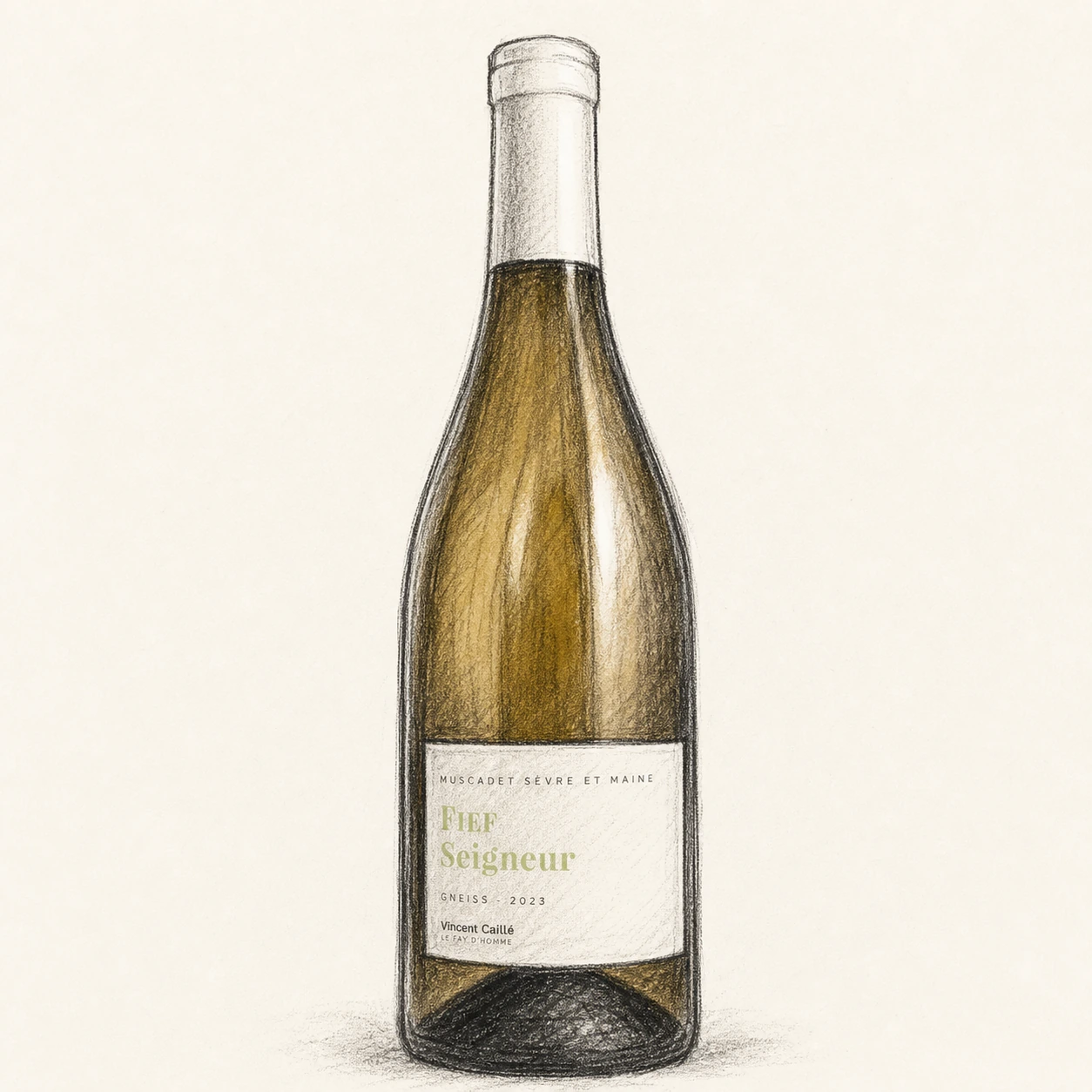
Original bottle illustration — Bacchus Global
Domaine Le Fay d'Homme
DOMAINE LE FAY D'HOMMEFief Seigneur
Grown on a single gneiss-veined plot above the village of Monnières, this Muscadet comes from vines around sixty years old. Aged sur lie, it builds its savoury depth and mineral edge slowly, layer by layer.
- Wine type
- Dry white wine
- Grape
- Melon de Bourgogne 100%
- Appellation
- Muscadet Sèvre et Maine AOP
- Origin
- Monnières, Pays Nantais, Loire Valley, France
- Drinking window
- —
- Recommended temperature
- 10–12°C
- Alcohol
- —
- Bottle size
- —
About the Wine
Vincent Caillé, who leads Domaine Le Fay d'Homme, is recognised as one of the driving figures of the Muscadet renaissance. Across roughly 25 hectares spread over the villages of Monnières, Gorges, Maisdon-sur-Sèvre and Mouzillon, he vinifies each parcel according to its distinct bedrock — gneiss, gabbro or orthogneiss.
Fief Seigneur is a single-parcel wine from Monnières, grown on gneiss soils from Melon de Bourgogne vines around 60 years old. The grapes are hand-picked, gently pressed, left to settle naturally overnight, then fermented with indigenous yeasts and aged sur lie.
Taste profile
In the glass
FIEF SEIGNEUR
Scale1–5
BG wine structure estimate
Comparative profile within the Bacchus Global wine range.
Aromas of white orchard fruit and citrus, with a fine mineral edge.
Fresh and well balanced on the palate, with lively acidity and a saline finish.
Pale gold with green reflections.
Before it reaches the glass
Temperature
10–12°C
Timing
—
Glassware
A Burgundy-style white wine glass or a rounded universal white glass
At the table
Fief Seigneur's saline minerality and lively acidity naturally align with dishes that let the ingredient itself lead.
Across Japanese, Thai and Western tables, the wine finds its footing with shellfish and white fish, where its structure has room to work.
Japanese
- White fish nigiri sushi
- Scallop and shellfish sushi
- White fish sashimi
Why it worksThe rice vinegar in the shari echoes the wine's own acidity, while the delicate sweetness of white fish and shellfish meets the wine's mineral, saline finish.
Thai
- Thai-style raw oysters with fish sauce and lime
- Yam Pla Duk Foo (crispy catfish salad)
- Pla Kapong Neung Manao (steamed sea bass with lime)
Why it worksThe oysters' brininess and the lime's acidity mirror the wine's saline finish, while its freshness offsets the richness of the fried catfish.
Western
- Raw oysters
- White fish meunière
- Soft cheese
Why it worksA classic Muscadet pairing: the wine's mineral acidity balances the oysters' brine and the butter of the meunière, while cutting through the richness of soft cheese.
From cellar to bottle
Winemaking
Hand-picked grapes are gently pressed and left to settle naturally overnight before fermenting with indigenous yeasts alone. The wine is then aged on its lees to build texture while preserving its mineral line.
Product detail
The wine comes from a single parcel on gneiss soils in Monnières, planted with Melon de Bourgogne vines around 60 years old. At estate level, farming has followed organic principles since 1996, with biodynamic trials beginning in 2011 across the domaine's parcels.
Origin
Domaine Le Fay d'Homme farms around 25 hectares across some 50 parcels in the villages of Monnières, Gorges, Maisdon-sur-Sèvre and Mouzillon, shaping distinct cuvées according to each plot's bedrock.
Recognition
Sommelier Wine Awards 2025
Awarded to the 2023 vintage of Fief Seigneur Gneiss.
Trade information
Contact Bacchus Global for product documentation, availability and trade enquiries.