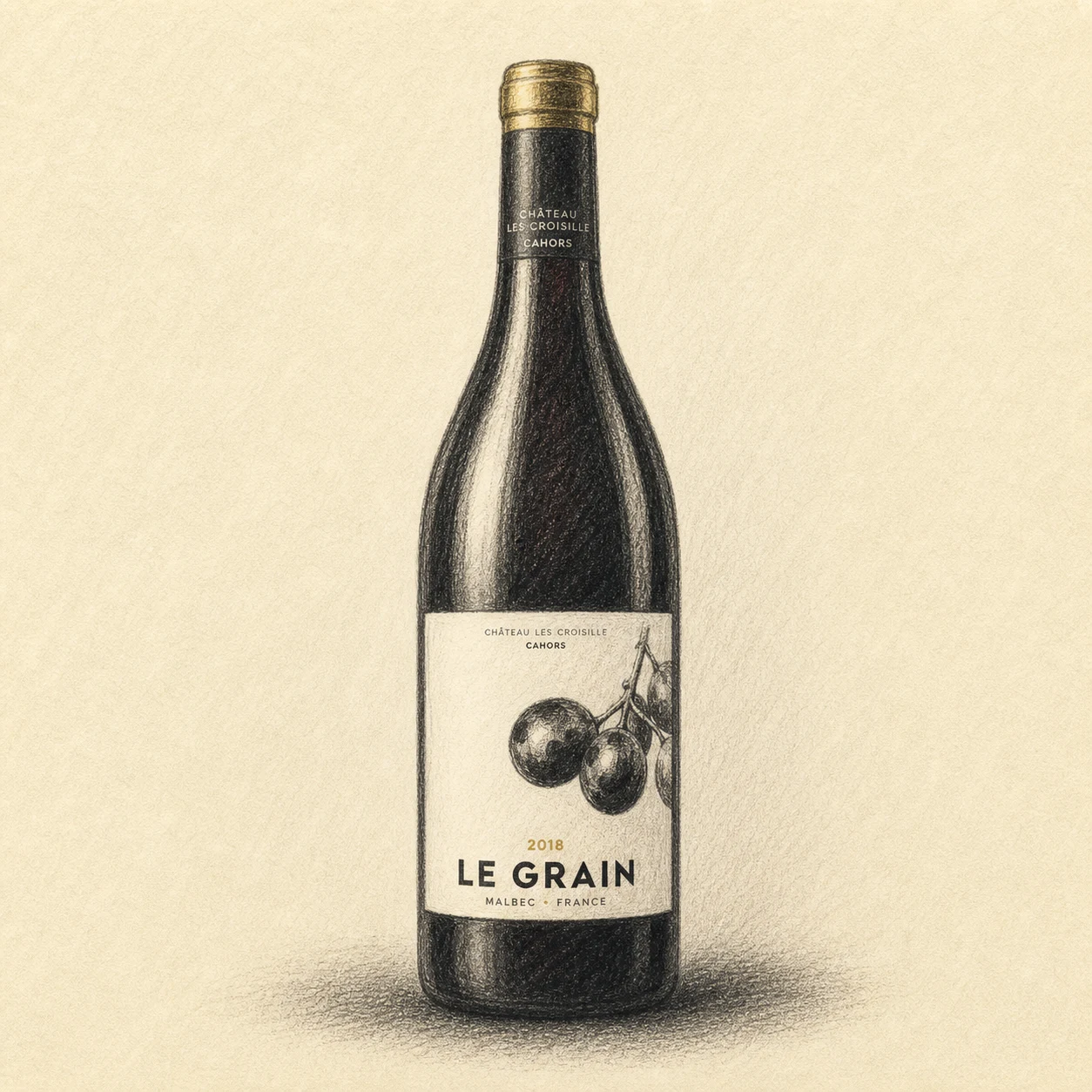
Original bottle illustration — Bacchus Global
Cahors AOP — Flagship Malbec
CHÂTEAU LES CROISILLELe Grain 2018
On a limestone plateau above the Lot Valley, each berry of this flagship Malbec is chosen by hand, grain by grain, before the wine settles into a single vessel to find its own quiet balance.
- Wine type
- Dry red wine (still)
- Grape
- Malbec 100%
- Appellation
- Cahors AOP
- Origin
- Le Puy-l'Évêque (Luzech), Lot Valley, Sud-Ouest France
- Drinking window
- 2026–2036
- Recommended temperature
- —
- Alcohol
- —
- Bottle size
- —
The Story of Le Grain
Founded in 1979, Château Les Croisille has been reshaped by a younger generation led by Germain, moving Cahors away from its historically heavy, rustic style toward a more refined, mineral-driven expression.
2018 brought heat and drought comparable to 2003. The estate's limestone-clay soils held enough moisture to protect the vines from stress, allowing the Malbec to reach full ripeness while retaining the firm acidity drawn from the Kimmeridgian limestone.
Taste profile
In the glass
LE GRAIN 2018
Scale1–5
BG wine structure estimate
Comparative profile within the Bacchus Global wine range.
Burlat cherry and ripe blackberry lead, layered with blackcurrant, chocolate, fresh tobacco and fine oak nuances.
Powerful and concentrated yet velvety and silky in texture, with licorice and menthol notes framed by the firm, elegant acidity of limestone soils.
Deep, dark purple in the glass.
Before it reaches the glass
Temperature
Best enjoyed at a cool room temperature typical of full-bodied reds — chilling mutes the wine, while warmth pushes the alcohol forward.
Timing
Decanting one to two hours ahead lets the oak-aged structure unfold gracefully; the wine shows a long arc of development through 2026 to 2036.
Glassware
A large-bowled Bordeaux glass suits its concentration and structure.
At the table
The wine's firm structure and limestone-driven acidity carry well across three culinary traditions — Japanese, Thai and Western.
Umami-rich, savory dishes and dense cuts of meat give the tannin and acidity something substantial to meet.
Japanese
- Wagyu akami steak
- Sukiyaki
- Beef shigureni (soy-simmered beef)
Why it worksUmami-rich, dashi- and soy-based preparations meet the wine's ripe fruit and firm tannin, letting its structure carry the savory depth of the dish.
Thai
- Neua yang (grilled beef)
- Massaman beef curry
- Slow-braised lamb
Why it worksRich, moderately spiced beef and lamb dishes match the wine's concentration and structure; very spicy or lime-forward dishes are better avoided, as they can clash with its tannin.
Western
- Grilled red meat
- Beef steak
- Aged Cantal, Salers or 24-month Comté
Why it worksA classic Sud-Ouest pairing: dense fruit and oak-derived structure stand up to red meat and match the intensity of long-aged mountain cheeses.
From cellar to bottle
Winemaking
Hand-harvested and sorted grain by grain, the wine is partially destemmed and fermented with indigenous yeast in an open demi-muid, with gentle early pigeage and around 25 days of skin contact before ageing 18 to 24 months in the same sealed vessel.
Product detail
Grown under organic certification (Qualisud, FR-BIO-16) on vines averaging 40 years of age, sourced from a Kimmeridgian limestone-clay plateau micro-parcel above the Lot Valley.
Where Le Grain Is Grown
The estate's limestone-clay plateau soils are associated with the wine's firm acidity and defined structure.
Official producer website→Certification

Organic Farming Certification · Qualisud · FR-BIO-16
Certified Organic Viticulture
The vineyard is certified organic under Qualisud (FR-BIO-16).
Trade information
Contact Bacchus Global for product documentation, availability and trade enquiries.