Drink
What Kusu Means: Okinawa’s Culture of Home-Aged Awamori and the Idea of Inheriting Time
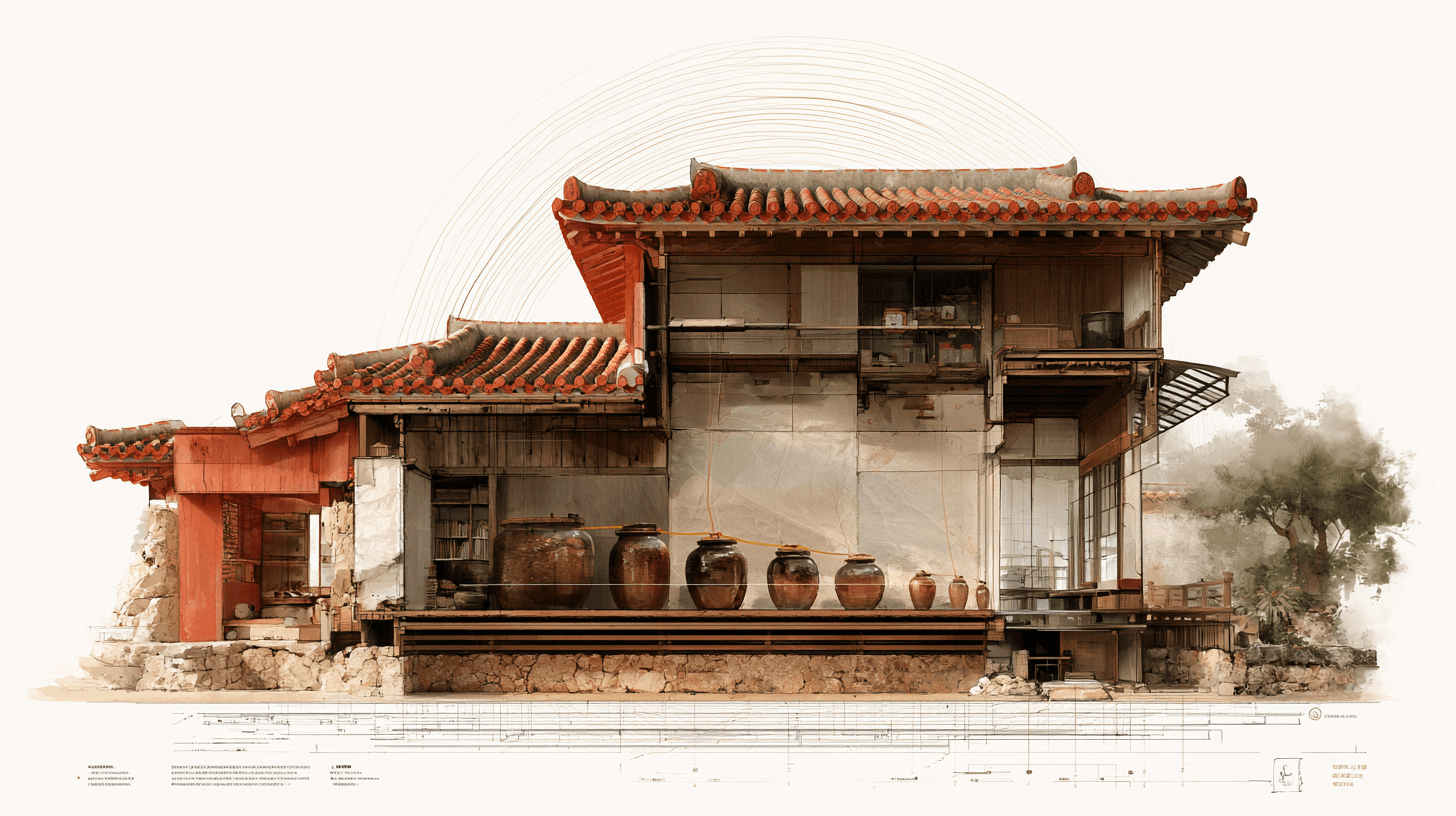
The age of kusu cannot be read from its color alone. Nor does awamori have to be aged in an earthenware jar to become kusu.
To understand Okinawan kusu simply as “awamori that has been stored for a long time” is to see only half the picture. Kusu encompasses not only the techniques used by distilleries to mature the spirit, but also a domestic tradition of caring for aging vessels, replenishing their contents, and passing them on to the next generation. For convenience, this article refers to that household practice as iegura (literally a “home cellar”), a small-scale storehouse maintained within the family.
If two bottles bear the same age statement, then, can we really say they have passed through the same kind of time?
Three Years Is Only the Beginning
Awamori is Okinawa’s distilled spirit, made by fermenting rice koji produced with black koji mold together with water, then distilling the resulting mash in a pot still. Its origins lie in distillation techniques that reached the Ryukyu Kingdom through trade around the 15th century and subsequently developed into a distinct local tradition.
Today, awamori may be labeled “kusu” only when 100 percent of its contents have been aged for at least three years. This standard has been in effect since August 2015. In regulatory terms, three years of maturation is the threshold. When spirits of different ages are blended, the age shown on the label is based on the youngest component.
But the number “three years” tells us very little about a kusu’s individual character. What kind of spirit was aged? In what vessel, and under what conditions? Was it replenished through shitsugi along the way? Kusu is a spirit shaped by multiple layers of time.
This is where the distinction between labeling rules and cultural practice becomes important. A label tells us the age of the youngest spirit in the blend. A family vessel, by contrast, accumulates not only the awamori added to it over the years, but also the memories and practices of the people who have cared for it. The former can be verified as a number. The latter cannot be read from numbers alone.
The Jar Is Not a Magical Vessel
The ceramic jar is the most recognizable symbol of traditional kusu aging. But awamori also matures in glass bottles, and modern distilleries use tanks as well. An earthenware jar is not what defines kusu; it is one tool for managing time.
Unlike wooden barrels, which impart aromatic and colored compounds from the wood itself, awamori aged in jars or bottles develops primarily through changes in compounds already present in the spirit. Research has documented an increase in vanillin during maturation, while sensory studies have identified aromas reminiscent of dried fruit, caramel, and vanilla as characteristic of aged awamori. At the same time, some aspects of how ceramic vessels contribute their own distinctive aromas remain insufficiently understood. Describing the jar simply as something that “breathes” risks flattening a process that is considerably more complex.
Shitsugi: A System for Connecting Time
One of the practices that makes kusu culture distinctive is shitsugi, the replenishment of aged awamori. When some kusu is removed from a vessel, the missing volume is replaced with younger awamori in order to maintain both quantity and quality. In the traditional multi-jar system, vessels containing spirits of different ages are arranged in sequence. What is taken from the oldest jar is replaced with awamori from the next-oldest jar; that vessel is then replenished from a younger one, and so on. By moving the spirit through the sequence, the continuity of maturation in the oldest vessel is preserved.
According to the Okinawa Regional Taxation Office, shitsugi today is practiced more often by enthusiasts, restaurants, retailers, and other consumers than by distilleries themselves. Okinawa also had a tradition of giving aging jars as gifts and raising kusu at home. What is preserved in these vessels is therefore more than liquid. Layered into them is the memory of the household: who began the jar, when it was replenished, and to which generation it was eventually entrusted.
Three Clues for Understanding Kusu
When bars and restaurants in Bangkok introduce kusu, it is not enough to say that older is simply better. Three things are worth asking about: the stated age, the storage vessel, and the history of shitsugi. Even when two spirits carry the same age statement, differences in vessel and replenishment history can mean that they have passed through very different kinds of time.
Rather than simply asking, “How old is it?” we can ask, “Where was it aged, what was it kept in, and who cared for it?” Those questions transform the story of kusu from a simple ranking by age into an expression of Okinawa’s relationship with time.
If koji making is the craft of creating the conditions for fermentation, kusu making is the craft of waiting for, managing, and transmitting the changes that occur after distillation. Time is not literally an ingredient. Yet in Okinawa, people have learned to shape their relationship with time in ways that give the spirit new character. What kusu reveals is not merely how old a spirit is, but who has carried its time forward, and how.
This article is intended solely to explore the distillation techniques, aging practices, and cultural heritage of Ryukyu Awamori and kusu. It does not aim to promote or encourage the purchase or consumption of alcohol. It is intended for readers aged 20 and over.
บทความนี้จัดทำขึ้นเพื่อนำเสนอข้อมูลเกี่ยวกับเทคนิคการกลั่น แนวทางการบ่ม และมรดกทางวัฒนธรรมของริวกิวอาวาโมริและคูซุเท่านั้น มิได้มีเจตนาเพื่อส่งเสริมการซื้อหรือการบริโภคเครื่องดื่มแอลกอฮอล์ บทความนี้จัดทำขึ้นสำหรับผู้อ่านอายุ 20 ปีขึ้นไป
Related Reading
From the “Awamori Fungus” to the “Ryukyu Fungus”
The Unwritten Age: Deciphering the Identity of Koshu and Awamori
A Journey Restored
Koji making and a cocktail competition
A Four-Day Craft: The Okinawan Spirit Behind Edinburgh’s Winning Cocktail
Related Product
Discover the culture behind every bottle
We share brewery stories, tasting notes and the craft of koji & fermentation | for educational and cultural purposes only.
เราถ่ายทอดเรื่องราวจากผู้ผลิต บันทึกรสชาติ และศาสตร์แห่งโคจิและการหมัก | เพื่อการศึกษาและวัฒนธรรมเท่านั้น
Follow on InstagramFacebook