Drink
Steeping 136 Kilograms of Strawberries—and Finishing Crystal Clear
AWAYUKI Strawberry Gin, and the Day Umenoyado Sake Brewery Was Called a “Disgrace”
Until the bottle is opened, no one realizes it is a strawberry gin. AWAYUKI Strawberry Gin is completely colorless—clear as water, indistinguishable from an ordinary gin. But the moment the cap is twisted open, the aroma of ripe strawberries rises from the bottle. The scent is sweet, yet the palate yields a refined, bone-dry finish. The American lifestyle magazine The Manual described it as “a gin that looks perfectly ordinary—until you open it and strawberry bursts out.”
Its defining characteristic lies in this absolute transparency. Each batch of this gin uses about 136 kilograms of premium Japanese strawberries—more than 400 supermarket packs’ worth. And yet, despite steeping that much fruit, almost no color remains in the finished spirit. No sugar is added, either. What is left is aroma, and the firm backbone of a true gin.
How is that possible? The answer lies not in the strawberries, but in the history of a single brewery in Katsuragi, Nara.
The Decision Once Called “a Disgrace to Sake Breweries”
AWAYUKI is produced by Umenoyado Sake Brewery. Founded in 1893 by first-generation brewer Kumataro Yoshida, the brewery took its name from an old plum tree, some 300 years in age, that stands before the kura. Each spring, bush warblers would visit the tree, and the sight was said to be “truly a lodging place for plums”—ume no yado.
For more than a century, Umenoyado was a sake brewery. The turning point came in 2001. Faced with declining sake consumption, fourth-generation head Akira Yoshida obtained licenses to produce liqueur and shochu. A brewery built on rice, water, and koji had begun working with fruit. At the time, the industry looked on coldly. The brewery later recalled being called “a disgrace to sake breweries.”
But Akira Yoshida did not back down. In 2007, Umenoyado fully launched its Aragoshi series—liqueurs packed with whole fruit pulp—and the line became a major success. Today, Umenoyado products account for roughly one in every six bottles in Japan’s fruit liqueur market. The brewery had developed an unparalleled expertise in the nuances of infusing fruit into alcohol—mastering maceration, the precise technique of drawing out a raw ingredient’s essence through liquid. A choice once dismissed as shameful had, over two decades, become a strength no one else could easily imitate.
Keeping the Aroma, Letting Go of the Color
Only a master of fruit maceration could make possible the idea of using 136 kilograms of strawberries while finishing the gin clear.
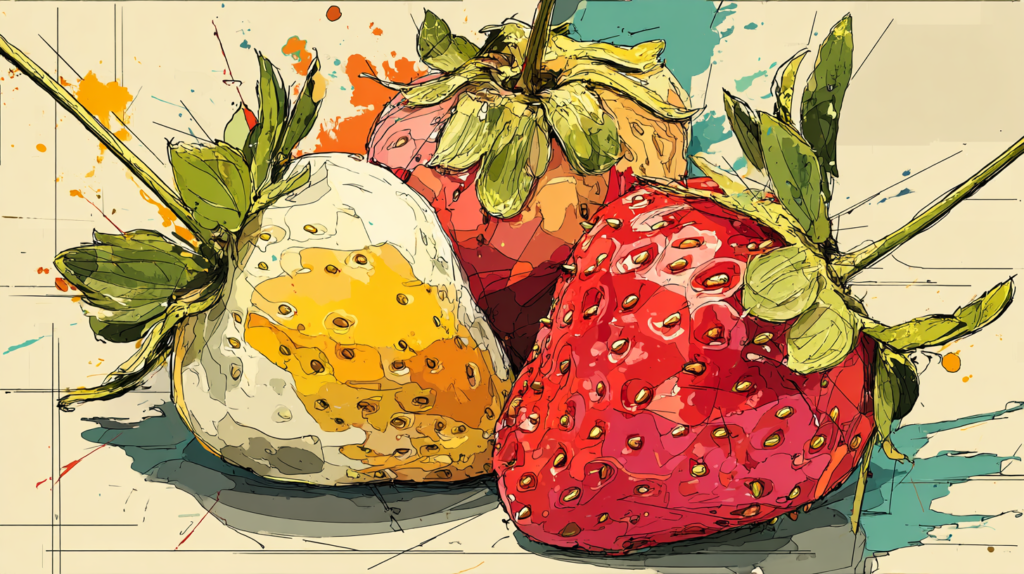
The strawberries consist of three distinct varieties: Awayuki, Pearl White, and Kotoka. Awayuki and Pearl White are rare white or very pale pink strawberries, genetically less prone to accumulating anthocyanins—the pigments that give red strawberries their color. Their faint hue means they are less likely to darken the spirit during steeping. A small amount of red Kotoka is then layered in to give the aroma greater depth. The solution to the challenge—extracting fragrance without drawing out color—is built into the very choice of fruit.
The flavor design runs counter to expectations, too. While many strawberry gins lean sweet, AWAYUKI builds a dry structure around classic botanicals such as juniper, coriander, and cardamom. At 44% ABV, it stands apart from many pink gins, which hover around 37.5%. The nose is lush and expressive, but the palate does not rely on sweetness. That is why, in serious mixology settings, this strawberry gin is treated not as a novelty, but as a first-rate gin.
Some of the premium strawberries used are said to be fruit that might otherwise have been discarded because their shape or size failed to meet market standards. Here, they become a source of aroma. From mis-shapen fruit emerges a fragrance of singular purity. It is a quiet study in upcycling, giving new purpose to what nature provided.
When the Words “Strawberry Gin” Begin to Change
To view AWAYUKI completely, a subtle distinction must be noted: AWAYUKI is not Umenoyado Sake Brewery’s own brand. It is a brand planned and owned by ICONIC Spirits in the United States, with Umenoyado serving as its producer. It stands separate from Umenoyado’s own UMENOYADO GIN and from its Aragoshi strawberry liqueur. Even if the same brewery’s name stands in the background, they should not be conflated.
Japanese craft gin is now enjoying a quiet tailwind. Since The Kyoto Distillery released KI NO BI in 2016 as Japan’s first dedicated gin distillery, global attention on Japan’s distilling craft has only grown. Pink, sweet, beginner-friendly—that has long been the label attached to strawberry gin. A colorless, bone-dry bottle is quietly peeling that label away.
Until the bottle is opened, no one realizes it is a strawberry gin. But once you know its aroma, you can no longer call it by the same old name. It is the scent of an arrival point—one reached over twenty years after a decision once called a disgrace. (Mr. Bacchus)
This article is intended solely to explore the distillation craft and cultural heritage of Umenoyado Brewery and the AWAYUKI Strawberry Gin brand, and does not aim to promote or encourage the consumption of alcohol. / บทความนี้จัดทำขึ้นเพื่อนำเสนอข้อมูลเกี่ยวกับเทคนิคการกลั่นและมรดกทางวัฒนธรรมของ Umenoyado Brewery และแบรนด์ AWAYUKI Strawberry Gin เท่านั้น มิได้มีเจตนาเพื่อส่งเสริมหรือโฆษณาเครื่องดื่มแอลกอฮอล์ สำหรับผู้มีอายุ 20 ปีขึ้นไป โปรดดื่มอย่างรับผิดชอบ
Discover the culture behind every bottle
We share brewery stories, tasting notes and the craft of koji & fermentation — for educational and cultural purposes only.
เราถ่ายทอดเรื่องราวจากผู้ผลิต บันทึกรสชาติ และศาสตร์แห่งโคจิและการหมัก — เพื่อการศึกษาและวัฒนธรรมเท่านั้น
Follow on Instagram FacebookRelated Articles
“The Logic of the Seto Inland Sea” / “Terroir in a Bottle” / “Why Japanese Gin Alone Is Staying Afloat While the Global Gin Market Sinks” / “Beyond Whisky”