
Course Pairing Design
Thinking of Non-Alcoholic Pairings as a Course of Their Own
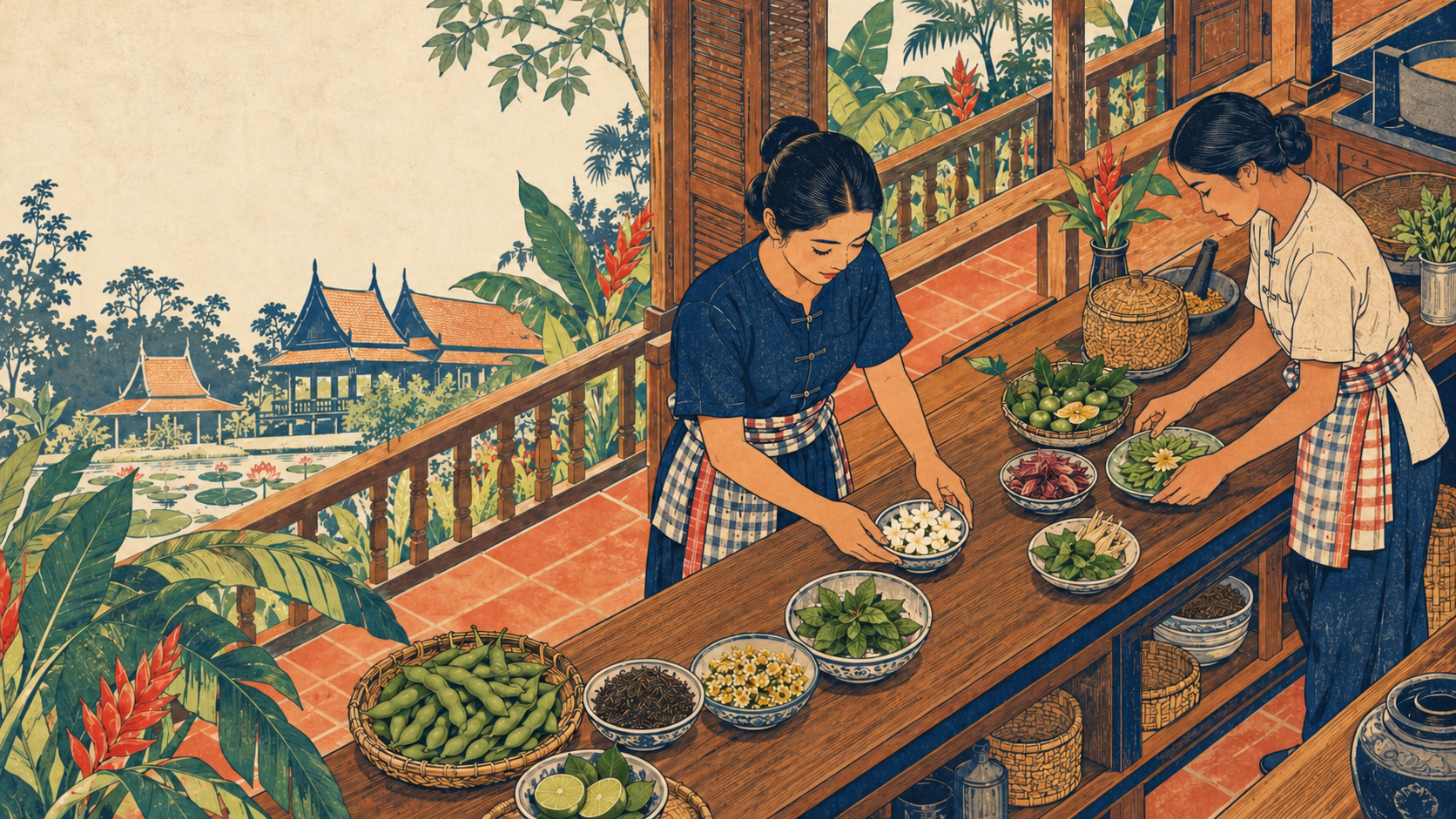
A multi-course meal has a sequence, from appetizers to dessert. What would happen if non-alcoholic drinks also followed a sequence, each matched to the food? We would be considering not only the taste of each drink, but also how the pairings work across the entire meal.
An official article accompanying the announcement of the MICHELIN Guide Thailand 2026 was published on November 27, 2025. It reports that non-alcoholic options made with herbs and flowers are growing in popularity alongside wine. Taking this report as a starting point, I would like to consider how a sequence of drinks can be planned around a meal in Bangkok’s restaurants.
The Range of Ingredients Seen in Published Menus
Published menus offer a glimpse of how these pairings are structured. A summer 2025 menu published by a restaurant in Bangkok lists seven drinks for its non-alcoholic pairing, along with the ingredients in each.
One combines jasmine tea, edamame and sansho pepper. Another brings together amazake, chamomile and saffron. Alongside tea and flowers, the menu includes ingredients derived from beans and grains. Each drink is described through a different combination of ingredients.
The use of amazake also reveals a connection with Japanese ingredients. However, this list alone does not tell us the proportions, how the amazake is made, or the alcohol content of each drink. Nor does the list alone establish the intensity of the flavors or the character of the finished drinks.
This example shows a structure in which several drinks are presented as a pairing. It does not establish when the practice began or how widely it has spread across the industry, but it offers a concrete starting point for understanding the work of developing individual drinks.
KOJI CLEAR, carried by Bacchus Global, is one example of a drink that adapts the methods used to make amazake. Made from rice koji, rice and water, it is a clear, non-alcoholic drink that its maker describes as having sweetness and fruit-like acidity. Considering where that sweetness and acidity might fit within the course is another part of planning the drinks. This is a separate product example, not an identification of the brand used in the published restaurant menu.
From an Individual Drink to the Sequence of an Entire Meal
From here, I would like to consider what goes into planning a sequence of drinks. Alongside checking how a drink pairs with a particular dish, we can also look at its relationship with the drinks that precede and follow it. If similar sweetness or aromas continue from beginning to end, changes may be difficult to perceive even when the ingredients differ.
Consider, for example, a drink with a long-lasting aroma followed by a dish with a gentler aroma. Thinking about how that lingering aroma will overlap with the next dish can change how we choose the drink. This involves arranging each dish with its accompanying drink, then checking the pairings across the entire course.
Serving size and timing are also part of these pairings. If much of a drink prepared for one dish remains unfinished, it will still be on the table when the next dish arrives. The number of drinks does not necessarily have to match the number of dishes, but it is worth deciding which part of the meal each drink will accompany.
Will the drink change with every dish, or will one drink accompany several dishes? Considering serving size and temperature as well connects the items listed on the menu with the way the meal actually progresses.
Connecting Sourcing and Service to the Whole Meal
For those responsible for sourcing drinks, where a product fits within the meal offers a basis for comparison, alongside its individual characteristics. Is it a candidate to accompany an appetizer, or to pair with the sauce of a main course? Sharing its intended place in the meal with the kitchen and service teams allows them to consider aromatic intensity, sweetness and mouthfeel with a common purpose in mind.
That purpose should also carry through to the explanation given to guests. Rather than simply naming the ingredients, briefly explain why the drink accompanies that dish. If the relationship between the food and drink is clear, guests who do not drink alcohol can follow the intention behind the pairings as they move through the meal.
MICHELIN stars assess the quality of the cooking; the discussion of trends in the MICHELIN article is not an announcement of new assessment criteria. While drawing on examples from particular restaurants, what matters is developing a structure that suits one’s own food and approach to service.
A menu listing seven drinks reveals the work of selecting ingredients and considering how to combine them. There is also the work of matching their sequence, serving sizes and timing to the food. Perhaps it is the accumulation of these decisions that turns non-alcoholic pairings into a course of their own.
This article explores non-alcoholic beverage pairing and the planning of a dining course for educational and cultural purposes. It does not promote the purchase or consumption of alcoholic beverages. For readers aged 20 and over.
บทความนี้นำเสนอความรู้เกี่ยวกับการจับคู่เครื่องดื่มไม่มีแอลกอฮอล์กับอาหาร และการวางลำดับการเสิร์ฟในมื้ออาหาร เพื่อการศึกษาและวัฒนธรรม มิได้มีเจตนาส่งเสริมการซื้อหรือการบริโภคเครื่องดื่มแอลกอฮอล์ สำหรับผู้อ่านอายุ 20 ปีขึ้นไป
Discover the culture behind every bottle
We share brewery stories, tasting notes and the craft of koji & fermentation | for educational and cultural purposes only.
เราถ่ายทอดเรื่องราวจากผู้ผลิต บันทึกรสชาติ และศาสตร์แห่งโคจิและการหมัก | เพื่อการศึกษาและวัฒนธรรมเท่านั้น
Follow on Instagram Facebook
