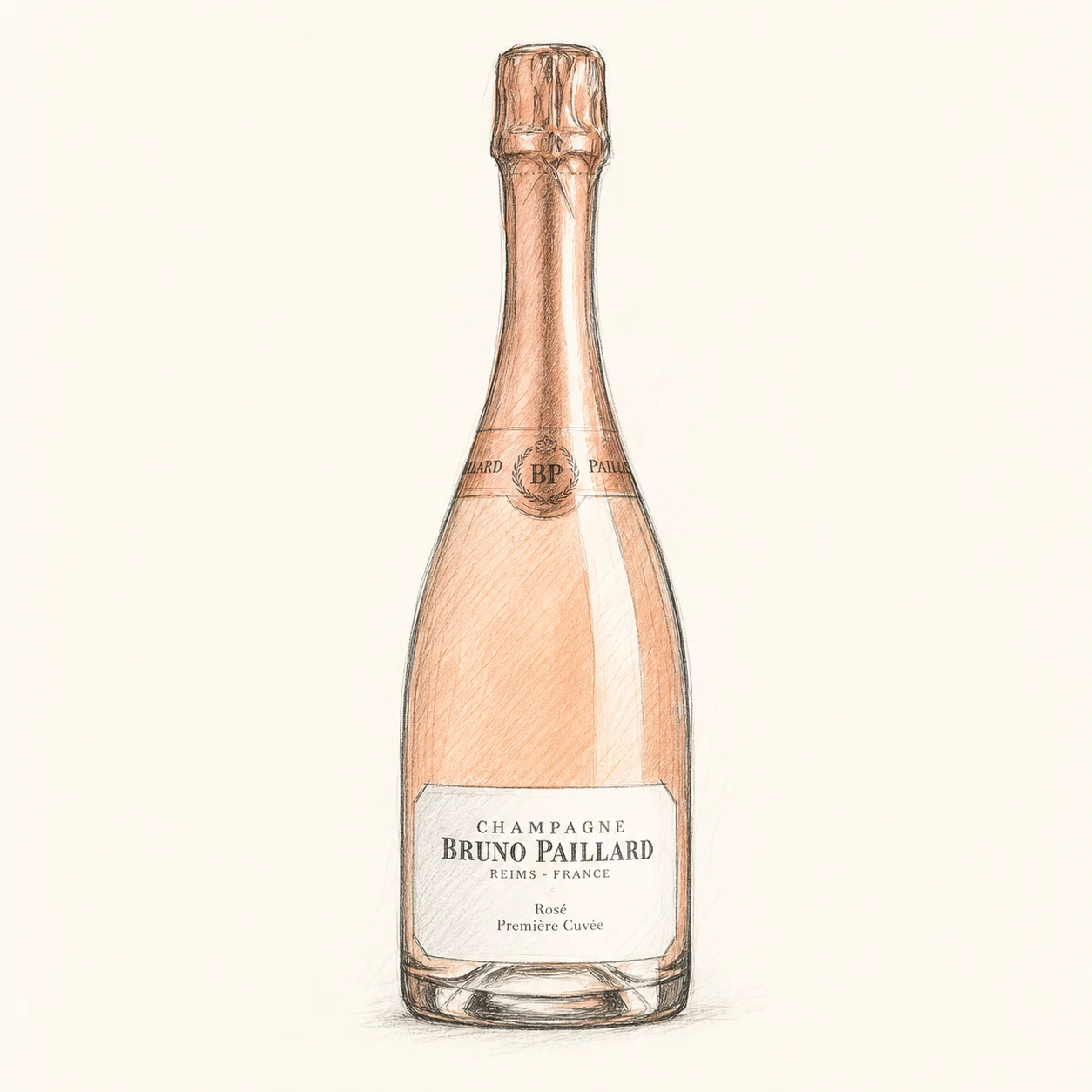
Original bottle illustration — Bacchus Global
BRUNO PAILLARD · AOC CHAMPAGNE · EXTRA-BRUT ROSÉ
BRUNO PAILLARDRosé Première Cuvée M.V.
White-pressed Pinot Noir meets a small touch of red wine and a secret line of Chardonnay. The result moves from wild berries to violet and citrus—a rosé that belongs beside dinner, not only before it.
- Wine type
- Champagne / Extra-Brut Rosé · Multi-Vintage
- Grape
- Pinot Noir-led · Chardonnay 10–20%
- Appellation
- AOC Champagne
- Origin
- Verzenay · Bouzy · Mailly · Les Riceys
- Drinking window
- Current release
- Serving temperature
- 8–10°C
- Alcohol
- 12%
- Bottle size
- 750 ml
A gastronomic rosé built from two expressions of Pinot Noir.
Most Pinot Noir is vinified as white wine; less than 5% becomes red wine for colour and red-fruit depth. A secret proportion of Chardonnay, observed at 10–20%, adds citrus line.
Perpetual reserve wine begun in 1985 can reach 50% of the blend. The wine spends at least three years on lees and another five to six months after disgorgement before release.
Taste profile
In the glass
ROSÉ PREMIÈRE CUVÉE M.V.
Scale1–5
BG wine structure estimate
Comparative profile within the Bacchus Global wine range.
Redcurrant, wild strawberry and Morello cherry lead to violet, lemon, fig and blackberry.
Dry and energetic, with red-fruit breadth, citrus lift and a savoury, finely textured finish.
Pink copper when young, moving toward salmon with age, with a fine and persistent bead.
Before it reaches the glass
Temperature
Enjoy at 8–10°C. Beginning near 8°C lets red fruit, flowers and citrus unfold gradually.
Timing
The current observed lot was based on 2018, disgorged in March 2023 and contained 33% reserve wine.
Glassware
Use a tulip-shaped Champagne or white-wine glass; a narrow flute suppresses its aromatic development.
At the table
Red-fruit depth, low dosage and fine bubbles make this rosé suitable for poultry, lamb and seafood as well as aperitif service.
Pinot Noir meets roasted meat and spice, while Chardonnay and mousse refresh shellfish, coconut and herbs.
Japanese
- Duck tataki with sansho
- Tuna sashimi
- Lamb with chestnut and truffle
Why it worksThe producer’s Robuchon lamb pairing links Pinot Noir, earthy truffle and sweet chestnut; tuna and duck follow the same savoury structure.
Thai
- Spice-charred duck
- Tom kha gai
- Grilled river prawns
Why it worksRed fruit and Pinot Noir follow charred duck, while Chardonnay and bubbles lighten coconut and shellfish.
Western
- Roast poultry
- Lamb cocotte with chestnut and truffle
- Salmon or tuna tartare
Why it worksProtein and roast flavours meet the wine’s Pinot structure; acidity and mousse keep the finish fresh.
From cellar to bottle
Winemaking
Pinot Noir is vinified both as white wine and as less than 5% red wine. A secret Chardonnay component and up to 50% perpetual reserve complete the blend.
Product detail
At least three years on lees and five to six months after disgorgement. Extra-Brut dosage remains below 6 g/L; alcohol 12%.
BRUNO PAILLARD
Reims, Champagne
Maison Bruno Paillard was founded in Reims in 1981 and remains an independent family house. Alice Paillard has led the maison since 2018.
Official producer website→Environmental standards
Estate-level environmental recognition.
The estate records HVE Level 3 and Viticulture Durable en Champagne, with some parcels under AB organic certification. This does not certify the complete cuvée as organic.
Selected scores for Rosé Première Cuvée.
Vinous · Antonio Galloni
March 2023 disgorgement · December 2024 review
Jeb Dunnuck
March 2023 disgorgement
Wine Advocate
Multi-vintage assessment
Decanter
Decanter rated this Rosé Première Cuvée 92 points (tasted 4 October 2024).
Wine Enthusiast
Wine Enthusiast rated this Rosé Première Cuvée 90 points.
Trade information
Contact Bacchus Global for product documentation, availability and trade enquiries.