
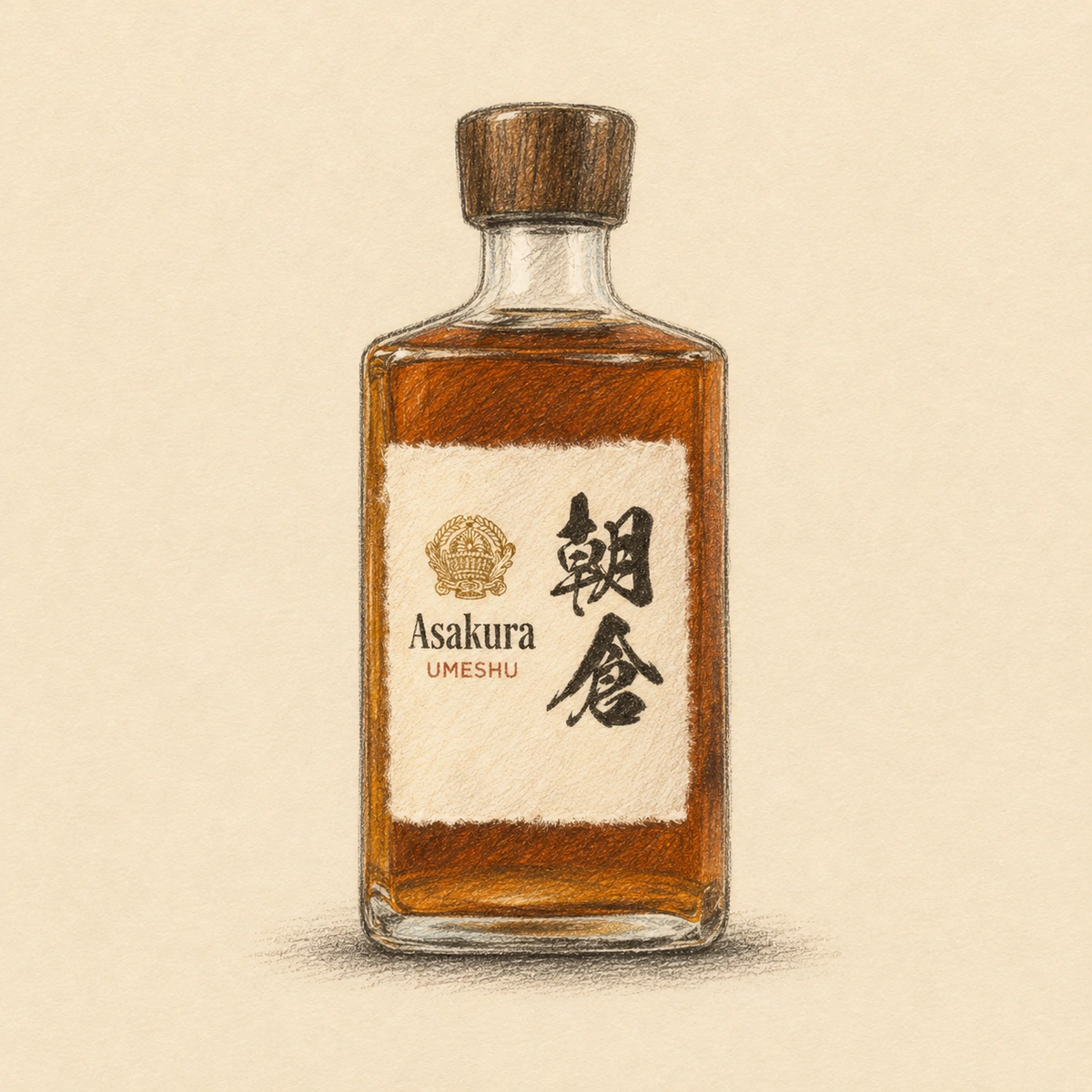
This illustration supplements the product information; it is not a photograph. Bottle shape, colour and label details may differ from the actual product.
ASAKURA Umeshu
Shinozaki ages this umeshu in casks previously used to mature its Asakura liqueur.
Thailand · Product information
Product information from Bacchus Global Co., Ltd., based in Bangkok, Thailand. About Bacchus Global
Barrel-aged Japanese plum liqueur
The story behind this bottle
Aya and Kenji follow the amber bottle to Shinozaki in Fukuoka and trace how a cask once used to age Asakura, a spirit made with barley koji, came to hold umeshu. English · approximately 8 minutes.
Reusing Asakura liqueur casks
After emptying its Asakura liqueur casks, Shinozaki uses them to age the umeshu for several years.
How Asakura liqueur is made and what inspired it
Shinozaki makes Asakura liqueur by ageing barley shochu in casks. The producer drew inspiration from Jokichi Takamine, who experimented with using koji to make whisky in the United States in the late 19th century.
Ume fruit, honkaku shochu and the other ingredients
Shinozaki lists five ingredients: honkaku shochu made in Japan, spirits, ume fruit, granulated sugar and liqueur. Its product information does not specify the origin or variety of the ume.
Amber umeshu and the ume pictured on the red box
The square bottle has a wooden stopper and a Japanese paper-style label marked 朝倉 (Asakura). The red, leather-textured box carries the name in silver calligraphy alongside an illustration of ume fruit. The amber colour of the liquid is visible through the clear bottle in the producer’s photograph.
Aroma and flavour after cask maturation
- Aroma
- Unrated
- Sweetness
- Unrated
- Acidity
- Unrated
- Umami
- Unrated
- Finish
- Unrated
Shinozaki says cask ageing gives the umeshu a richer aroma and deeper flavour.
Question 1
Which casks are used to mature the umeshu?
- Casks previously used to mature Asakura liqueur
- Casks used to store ume fruit
- Casks used to mature sake
Read the answer and explanation
Correct answer: A — Casks previously used to mature Asakura liqueur
Shinozaki matures the umeshu in casks previously used for its Asakura liqueur.
Question 2
Which ingredient does Shinozaki list?
- Sake
- Honkaku shochu
- Rice vinegar
Read the answer and explanation
Correct answer: B — Honkaku shochu
Shinozaki lists honkaku shochu made in Japan among the ingredients.
Question 3
What is the volume of ASAKURA Umeshu?
- 180 mL
- 720 mL
- 500 mL
Read the answer and explanation
Correct answer: C — 500 mL
The bottle holds 500 mL.
Shinozaki in Hiramatsu, Asakura
Shinozaki began brewing sake in the late Edo period. Today it makes sake and shochu at its Asakura production site in Hiramatsu, Asakura, Fukuoka.
Mud entered the production site during the 2017 floods in northern Kyushu. In its account of the recovery, Shinozaki recalls local residents helping to clear the site.
Contact Bacchus Global for product documentation and trade information.

