

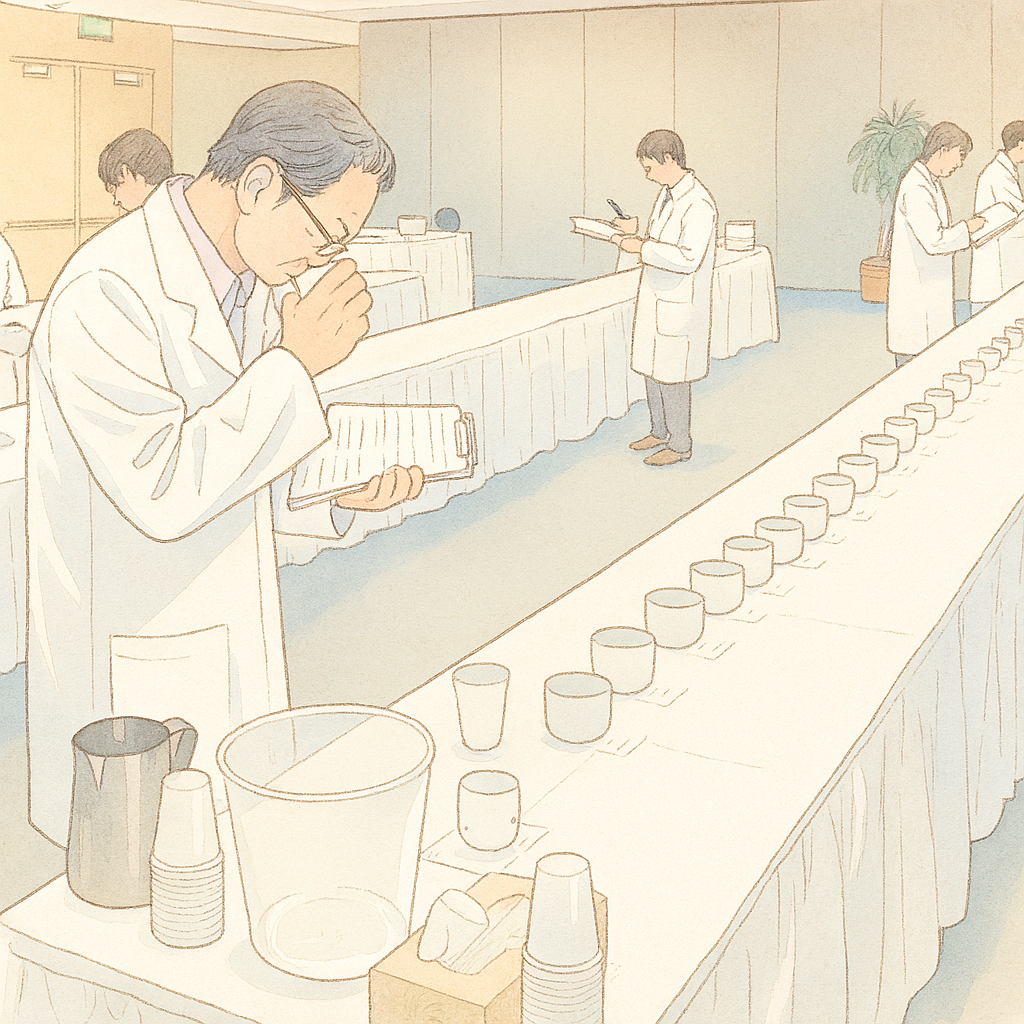
On May 28, 2025, the Hiroshima Industry Hall was heavy with early-summer humidity. The moment the doors opened, a sweet mix of banana, pear, and green-apple aromas swept through the room. This was the tasting session of the National New Sake Appraisal. Along the long stainless-steel tables stood 809 fresh labels, and about 500 brewers bowed and lifted their glasses. Their eyes were totally focused, yet I caught happy whispers: “This year smells so bright.”
The surprise shows up in the data, too. A long-term study by the National Research Institute of Brewing tracked these entries and found the average Sake Meter Value (SMV) flipped from +4.6 in 1998 → +3.5 in 2008 → +0.9 in 2018 → –0.2 in 2022. In just 25 years, it moved to the opposite side. Tellingly, over 80 percent of this year’s 202 gold-medal winners had an SMV below zero. Drinkers now look for soft, fruit-like sweetness, not the sharp cut of dry sake. The game-changer was Kyokai Yeast No. 1801, released in 2006. Even convenience-store buyers say their “300-yen cup sake” sells better when it is sweeter, showing the market-wide shift.
Yeast 1801 is nicknamed the “aroma monster.” Compared with older strains, it boosts isoamyl acetate by about 40 percent and ethyl caproate by about 50 percent, while keeping isoamyl alcohol low so the fruit notes stay clear. Mr. Sato, a toji at Nippon Brewery in Miyagi (pseudonym), laughs, “In my 40-year career, this is the first time the mash room smelled as sweet as ripe bananas.”
The aroma cues the brain for sweetness, and the low acid with smooth texture stretches that sweet finish. Because the yeast ferments strongly, lowering the mash temperature by just 1 °C can set the SMV to –1 or –2, letting brewers reproduce a “blueprint sweetness” for their target market. The resulting fruity daiginjo, when poured into a wine glass, releases a bouquet like white-peach nectar and instantly grabs premium-minded drinkers. It pairs easily with ripe-mango carpaccio or rich foie gras, resonating with global cuisine far beyond the idea that “sake only matches Japanese food.”
So, can dry-sake fans enjoy it? Yes. The lively aroma of Yeast 1801 mellows with aging; after six months it gains a cool melon-like note. When refrigerated aging lets it fuse with the rice umami, the finish is surprisingly crisp even at a negative SMV. This “multi-layered savoriness” that rises above the sweet-dry scale is the yeast’s second gift.
“Why not explore the heart of Yeast 1801 by comparing three breweries?”
▶ Yamagata – Tatenokawa (Tatenokawa Shuzo Brewery)
TATENOKAWA Extreme Ultra 8 Kyokugen : To create the most superior sake in the highest sake classification Junmai Daiginjo,with a quality the world has never seen before: rice polished in-house down to 8%, and that has all of aroma, subtlety, fullness, and beautiful afterglow. This desire from 6th Generation Brewer, Jumpei Sato, made “TATENOKAWA KYOKUGEN”(TATENOKAWA Ultra) with all the technologies of TATENOKAWA as it established in 1832 and the whole brewers’s enthusiasms. You will have a new sense of possibility of sake as the difference from ordinary Daiginjo or Junmai Daiginjo, and enjoy experience of this ultimate sake.
▶ Yamanashi – Shichiken (Yamanashi Meijo Brewery)
SHICHIKEN Selection Alain Ducasse Sparkling-sake : Created in partnership with the French master chef Alain Ducasse, this sake uses Japanese-grown rice and blends a sweet kijoshu with junmai aged in cherry-wood barrels, then undergoes the same in-bottle secondary fermentation as Champagne.
▶ Saga – Shichida (Tenzan Brewery)
SHICHIDA Junmai-Ginjo Non-filter Nama Omachi : This junmai ginjo uses the rice variety Omachi, known for rich flavor and a melon-like aroma, polished to 50 percent. At 16 percent alcohol, it won Champion at Kura Master 2017 and earned Bronze at the International Wine Challenge 2025
▶ Wakayama – Kid (Heiwa Brewery)
KID Muryozan Junmai Ginjo : Channels Mount Kōya’s pristine springs and Yamada-nishiki polished to 50%. Slowly matured, the sake glides across the palate with a velvet-soft texture. Aromas of white peach, lychee, and muscat unfold into succulent melon, pineapple, and a flicker of sanshō spice, then close crystal-dry at 15.5% ABV.
In 2020, it swept the International Wine Challenge, winning both the Junmai Ginjo Trophy and the ultimate Champion Sake title—the first Wakayama label ever to achieve that double honour.
“Muryozan” recalls a 12th-century temple once tended by the founding family, while KID (紀土) means “Land of Kii,” celebrating local terroir and the youthful brewers reimagining sake’s future.