

Thailand’s Dining Market Moves From “Quantity to Quality,” and the Future of Beverage Programs
Cuisine Has Evolved. What About Drinks?
Thailand’s Dining Market Moves From “Quantity to Quality,” and the Future of Beverage Programs
Thailand’s culinary landscape continues its upward trajectory. Market projections indicate sustained expansion at an annual rate of approximately 7.6%, poised to exceed 1.4 times its 2025 scale by 2031. This momentum is not confined to the capital; regional cultural hubs and resort destinations such as Chiang Mai and Phuket are deeply supporting the market’s dimensions.
However, the transformation underway here is not merely a matter of scale—of the market simply becoming larger. What is clearly unfolding across Thailand’s dining scene is a quiet shift from “quantity to quality.” At the heart of this evolution lies the curation of the glass—the intentional design of beverage programs.
What Is Happening at Bangkok’s Tables
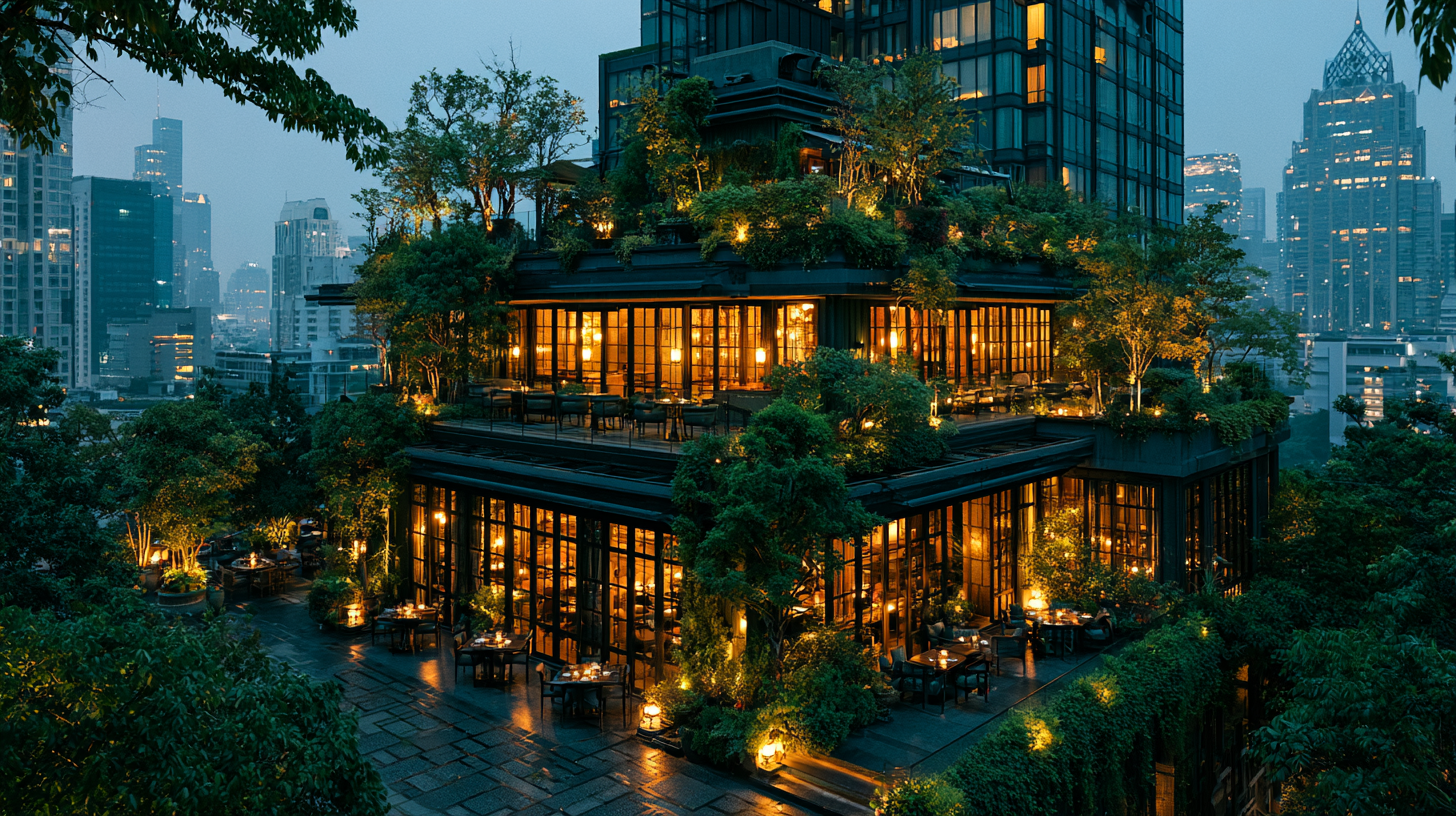
Over the past few years, Bangkok’s dining landscape has reshaped itself dramatically.
With consistent recognition in Asia’s 50 Best Restaurants and the annual updates of the Michelin Guide Thailand, the city’s culinary expectations have seamlessly aligned with global standards. At THAIFEX 2026, the region’s premier food trade exhibition, the defining theme was the “multisensory experience.” Dining is no longer conceived merely as a means to satisfy hunger, but as an immersive journey perceived through all five senses—encompassing aroma, sound, and temperature.
This shift is not driven solely by international travelers. It is fueled equally by urban Thai consumers who have experienced local food cultures firsthand in Tokyo, Paris, and other cultural capitals. An increasing number of individuals are choosing to invest in the singular value of a dining experience rather than the frequency of dining out. This deliberate investment in experience is organically raising the benchmark for gastronomy in Bangkok.
Cuisine Has Evolved. What About Drinks?
Here, a certain asymmetry reveals itself.
Cuisine evolves at a breathless pace. Ingredients are meticulously reconsidered, techniques are continuously updated, and presentation is thoughtfully refined. Amid constant competition, investment never wavers, and the culinary standard at many Bangkok establishments has achieved remarkable heights.
Yet, what of the beverages? Many establishments still rely on conventional wine lists and predictable selections of beer and spirits. While the plate continues to evolve, the glass remains stationary. This disparity is not without reason. Crafting a sophisticated beverage program demands a depth of specialized knowledge that goes far deeper than menu updates. Training staff to articulate the nuances of wine or sake requires time and dedication. Consequently, the beverage program is often deferred.
Viewed differently, however, this gap represents uncharted territory for differentiation. In a competitive arena where standing out through cuisine alone becomes increasingly challenging, beverages offer a compelling new axis of distinction.
Drinks Viewed Through Both Commercial Balance and Experience
The growing focus on beverage programs stems from two distinct realities.
The first centers on commercial balance. Structurally, beverages offer streamlined cost and inventory management, facilitating stable, resilient margins. Within course-led formats where pairings are integrated, it is well understood that the beverage architecture significantly shapes both the average guest spend and the overall revenue composition.
The second, and perhaps more profound, reality is experiential. As appreciation for the dining ritual deepens, drinks are no longer viewed as a mere accompaniment to food. Instead, they are recognized as an essential component of the overall experience’s architecture.
Designing Drinks with the Same Passion as Food
This returns us to the disparity between food and beverage. Gastronomy has long been refined with rigorous care and creativity, from the provenance of the ingredients to the final aesthetic on the plate. What the beverage offering often lacks is that same level of intentionality.
Distinction does not lie in merely expanding the volume of a cellar. Even when presenting a familiar bottle, can an establishment articulate in its own words why it was chosen, the philosophy of the artisan who crafted it, and the character of the soil from which it came? Just as a chef imbues each dish with meaning, a beverage program requires a defined reason for being. The presence or absence of this narrative fundamentally alters the guest’s journey.
A symbolic difference manifests in the very first exchange. There are tables where the dialogue concludes with, “Is it dry or sweet?” And then there are tables where the conversation moves a step deeper: “This bottle reflects the producer’s philosophy and the character of the land.” The latter accords beverages the same intellectual weight as the cuisine. This nuance shapes not only immediate satisfaction, but the enduring desire to return—the quiet pulling power of an unforgettable establishment.
Beverages rich in regional narrative and artisanal character—such as sake, craft shochu, and natural wine—are uniquely suited to this approach. They possess a context worth sharing. When these expressions begin to find their place on urban tables, it is not the result of price competition. Rather, it is part of a broader, quieter movement to reunite food and drink into a single, seamless experience.
As the market projects toward that 1.4-fold expansion by 2031, the central question remains how the glass will catch up to the already evolved plate. It is a question being posed to Bangkok’s culinary community at this very moment. (Mr. Bacchus)
This article is intended solely to explore structural shifts in Thailand’s foodservice industry and the evolving role of beverage programs, and does not aim to promote or encourage the consumption of alcohol. / บทความนี้จัดทำขึ้นเพื่อนำเสนอข้อมูลเกี่ยวกับการเปลี่ยนแปลงเชิงโครงสร้างของอุตสาหกรรมบริการอาหารในประเทศไทยและบทบาทของโปรแกรมเครื่องดื่มเท่านั้น มิได้มีเจตนาเพื่อส่งเสริมหรือโฆษณาเครื่องดื่มแอลกอฮอล์ สำหรับผู้มีอายุ 20 ปีขึ้นไป โปรดดื่มอย่างรับผิดชอบ
Discover the culture behind every bottle
We share brewery stories, tasting notes and the craft of koji & fermentation — for educational and cultural purposes only.
เราถ่ายทอดเรื่องราวจากผู้ผลิต บันทึกรสชาติ และศาสตร์แห่งโคจิและการหมัก — เพื่อการศึกษาและวัฒนธรรมเท่านั้น
Follow on Instagram FacebookRelated Articles
“The Evolution of Bangkok” / “The 2026 Table According to Michelin” / “The Day Sake Stands Beside Wine” / “Three Hurdles a Bottle of Whisky Must Clear Before It Reaches Bangkok”