Drink
The Day Sake Stands Beside Wine
London, Bangkok, and the Work of Translation
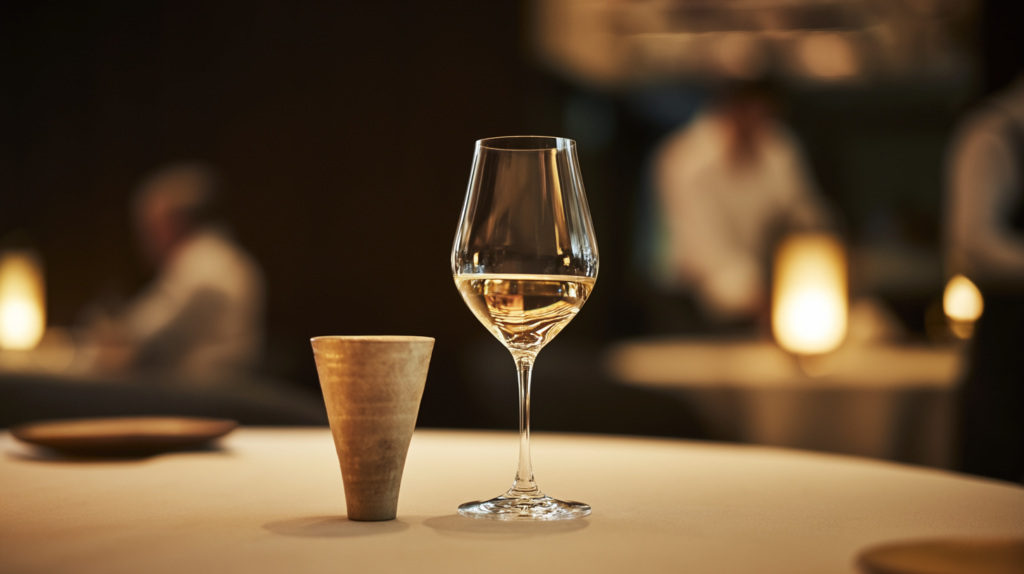
In Bermondsey, London, there’s a two-Michelin-star restaurant called Trivet, led by chef Jonny Lake and master sommelier Isa Bal. Bal is known as one of the few sommeliers who, early on, began treating sake on equal footing with wine.
In February 2026, these two became the starting point for an initiative involving multiple London restaurants. Called “Sake Food Sensations,” the campaign was a simultaneous experiment: pairing sake not with Japanese cuisine, but with each restaurant’s own contemporary European dishes.
Sake Beyond the Sushi Counter
For a long time, there were fixed places overseas where sake was poured|sushi counters, yakitori joints, tempura bars. The moment it left the context of Japanese cuisine, sommeliers’ attention would return to the wine list. That era lasted for quite a while.
But in recent years, the tide has begun to shift. In Paris, Copenhagen, New York|restaurants are starting to place sake not in the corner of the wine list, but at the center of the table. What made the London initiative significant was its scale: it wasn’t confined to a single restaurant, but included leading names in the city’s dining scene like Da Terra, Galvin La Chapelle, and Ormer Mayfair.
A Different Structure of Acidity
To understand sake’s role as a counterpart to wine, one must look at the nature of its acidity.
Wine’s acidity often possesses a sharp, angular quality designed to cut through richness. Sake, conversely, is framed by the softer profiles of succinic and lactic acids. Rather than slicing through weight, it envelops the inherent umami of the ingredients. This quality creates pairings from an entirely different angle than wine.
European sommeliers often point to cheese. Even with strongly aromatic washed-rind varieties, the umami of junmai sake acts as a bridge, enhancing both sides. With game or aged meats, layering the lactic complexity of kimoto-style sake produces a harmony unlike anything wine can achieve.
Where Fermentation Meets Fermentation
Observing Bangkok’s culinary landscape, sake pairings remain largely within the bounds of Japanese establishments. Yet, the city’s vibrant gastronomic scene holds an immense, untapped potential|anchored by a shared foundation of umami.
Thai cuisine is often described as one of the most umami-dense in the world. Fish sauce, shrimp paste, fermented soybean pastes|fermentation-derived umami forms the backbone of most dishes. Sake, too, is built around amino-acid-driven umami created by koji. When fermentation meets fermentation, there’s room for a resonance that goes beyond theory.
Take khao soi, with its rich curry broth, paired with a slightly off-dry junmai ginjo. Instead of washing away the spice, the coconut milk’s roundness and the rice’s gentle sweetness overlap, deepening the dish. Or pair the smoky basil and chili of pad krapao with a firmly acidic kimoto junmai|the brightness of Thai basil and the lactic tang intertwine more naturally than expected.
In Search of Translators
What “Sake Food Sensations” revealed was not just sake’s versatility, but a deeper truth: whenever one food culture meets another, translation is inevitable.
Simply placing sake on the table isn’t enough|it ends up pushed to the edge of the wine list. It has to be re-presented in a way that aligns with local ingredients, cooking methods, and the rhythm of dining. What Isa Bal practiced in London was translating sake’s flavors into the language of wine, then reconnecting it to European ingredients.
Bangkok awaits a similar dialogue. It requires finding a shared vernacular between the umami of fish sauce and the depth of koji. Discovering where Thai herbs meet the aromatics of ginjo. It’s a quiet, meticulous process|like compiling a dictionary that no one has written yet, one dish at a time.
In London, Isa Bal sparked a quiet revolution. In Bangkok, the search for those who will translate this dialogue into a new culinary chapter has only just begun. (Mr.Bacchus)
This article is intended solely to explore evolving global sake pairing culture and the philosophy of cross-cultural gastronomy, and does not aim to promote or encourage the consumption of alcohol. / บทความนี้จัดทำขึ้นเพื่อนำเสนอข้อมูลเกี่ยวกับวัฒนธรรมการจับคู่สาเกระดับโลกและปรัชญาการผสมผสานอาหารข้ามวัฒนธรรมเท่านั้น มิได้มีเจตนาเพื่อส่งเสริมหรือโฆษณาเครื่องดื่มแอลกอฮอล์ สำหรับผู้มีอายุ 20 ปีขึ้นไป โปรดดื่มอย่างรับผิดชอบ
Discover the culture behind every bottle
We share brewery stories, tasting notes and the craft of koji & fermentation | for educational and cultural purposes only.
เราถ่ายทอดเรื่องราวจากผู้ผลิต บันทึกรสชาติ และศาสตร์แห่งโคจิและการหมัก | เพื่อการศึกษาและวัฒนธรรมเท่านั้น
Follow on Instagram FacebookRelated Articles
“Cuisine Has Evolved. What About Drinks?” / “The Evolution of Bangkok” / “The 2026 Table According to Michelin”