Drink
Wine Reclined, Sake Upright
The Logic of Bottle Orientation in the Cellar
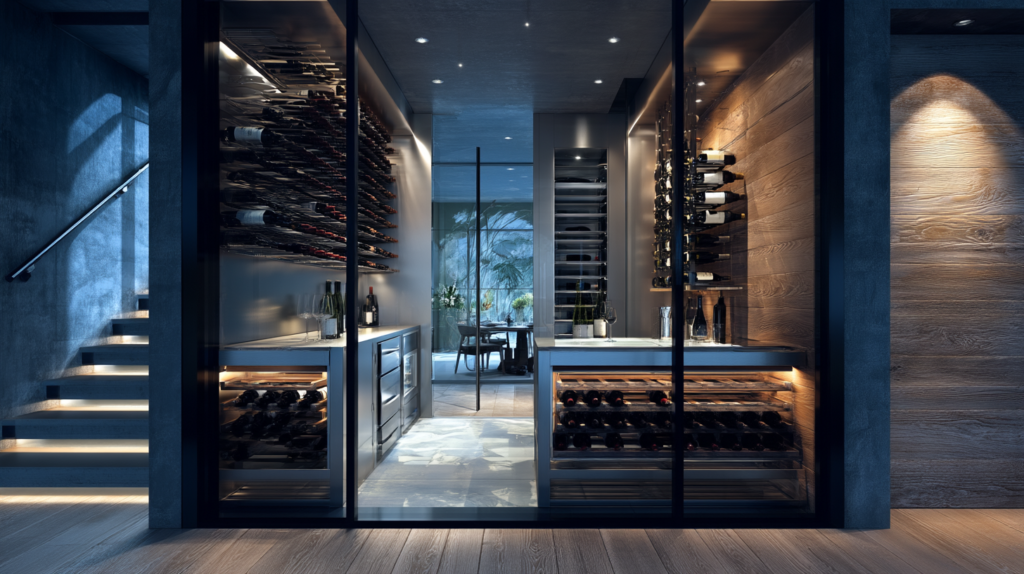
Wine Reclined, Sake Upright: The Logic of Bottle Orientation in the Cellar
In restaurant cellars in Bangkok, it is not unusual to see wine and sake stored side by side within the same refrigerated spaces. Look closely, however, and you will notice that the bottles are positioned differently. Wine is laid on its side, while sake is stored upright. Neither is wrong. This difference in position is rooted in a clear logic based on the structure of each container.
In tropical Bangkok, whether or not this difference is understood directly affects the quality of the inventory.
The Horizontal Logic of Wine
The tradition of storing wine horizontally has long been tied to the nature of the cork.
Cork is a porous material made from the bark of the cork oak tree. It is said to shrink when it dries out, loosening its seal against the mouth of the bottle. By laying the bottle on its side and keeping the wine in contact with the cork, the cork can be prevented from drying. This has been the main reason horizontal storage has been described as a global standard.
In recent years, however, this premise itself has been questioned. Some argue that the humidity in the sealed bottle’s headspace reaches nearly 100%, allowing the cork to remain moist from the humidity inside the bottle alone. In other words, it is not necessarily true that “the cork will dry out if the bottle is stored upright.” In 2018, a researcher at Amorim, the Portuguese company that is the world’s largest cork producer, even described the need for horizontal storage as a “myth.” Some have gone further, suggesting that continuous contact between wine and cork may actually damage the cork. In fact, in storage tests lasting at least five years, no identifiable difference in taste or aroma was found between upright and horizontal storage.
On the other hand, the Australian Wine Research Institute still recommends storing wines sealed with cork on their side, and the issue has not been settled when it comes to long-term storage. What is certain is that screw-cap wines have no inherent need to be stored horizontally. The conventional wisdom that “wine should be laid down” is becoming less of an absolute rule that applies to all wines.
The Vertical Necessity of Sake
Most sake bottles are sealed with metal caps. Unlike cork, there is no concern about drying out. Does that mean the bottle’s position does not matter? Not quite. Horizontal storage has two disadvantages.
The first is oxidation. When a bottle is laid on its side, the way the small amount of air inside the bottle comes into contact with the sake changes, and oxidation is thought to progress more easily. The second is the risk of deterioration caused by the sake remaining in constant contact with the metal parts of the cap or its gasket. When stored upright, the liquid stays at the bottom of the bottle, minimizing contact with the closure.
Just as the horizontal storage of cork-sealed wine has traditionally been understood as a response to the structure of the cork closure, the upright storage of sake is a response to the structure of the metal cap. This variance is born not of cultural preference, but of structural necessity.
The Tropical Factor: Bangkok’s Microclimate
In Japan, it may be enough simply to say, “Store upright in a cool, dark place.” In Bangkok, the situation is different.
Humidity in the city reaches 70% to 80% throughout the year. Since the ideal humidity for storing sake is said to be 50% to 70%, Bangkok’s environment easily exceeds the upper limit. With bottles laid on their side, moisture can accumulate on the contact surface, making mold more likely to develop on labels and bottle surfaces. High humidity can also cause metal caps to rust, and if rust progresses, the seal itself may be compromised.
In the tropics, then, upright storage is not only a measure against oxidation but also a measure against humidity. Bottles should be stored upright, spaced apart from one another, and positioned so that labels do not press directly against the wall. What may be a minor detail in Japan becomes a major element of quality control in Bangkok.
Form Follows Function in the Cellar
Wine laid horizontally and sake stored upright. The question of which is correct does not apply. Each position follows a different logic related to the material of the closure and the structure of the container.
For restaurants in Bangkok that handle both wine and sake, this means that shelves for bottles laid on their side and shelves for bottles stored upright will coexist within the same cellar. While such custom configurations demand meticulous attention, reading the logic of the container through this small observation reveals that storage is far more than a matter of temperature. Closure material, humidity, light: it ultimately comes down to what kind of container each drink is placed in, and what it is vulnerable to. The depth of that understanding quietly determines the quality that reaches the glass. (Mr. Bacchus)
This article is intended solely to explore the storage practices and quality management of Japanese sake and wine for food and beverage professionals, and does not aim to promote or encourage the consumption of alcohol. / บทความนี้จัดทำขึ้นเพื่อนำเสนอข้อมูลเกี่ยวกับแนวทางการจัดเก็บและการจัดการคุณภาพของสาเกญี่ปุ่นและไวน์สำหรับผู้ประกอบการร้านอาหารและเครื่องดื่มเท่านั้น มิได้มีเจตนาเพื่อส่งเสริมหรือโฆษณาเครื่องดื่มแอลกอฮอล์ สำหรับผู้มีอายุ 20 ปีขึ้นไป โปรดดื่มอย่างรับผิดชอบ
Discover the culture behind every bottle
We share brewery stories, tasting notes and the craft of koji & fermentation | for educational and cultural purposes only.
เราถ่ายทอดเรื่องราวจากผู้ผลิต บันทึกรสชาติ และศาสตร์แห่งโคจิและการหมัก | เพื่อการศึกษาและวัฒนธรรมเท่านั้น
Follow on Instagram FacebookRelated Articles
“Sake Storage in Bangkok: Product-Specific Handling” / “The Nuances of Room Temperature: Pasteurization and Environmental Realities” / “Sake Temperature Management by Product and Logistics Stage” / “One Shipment: −2°C Container Setpoint and Reported −7°C Storage”