Drink
The Art of Waiting
The Quiet Resurgence of Kimoto and Yamahai in 2026
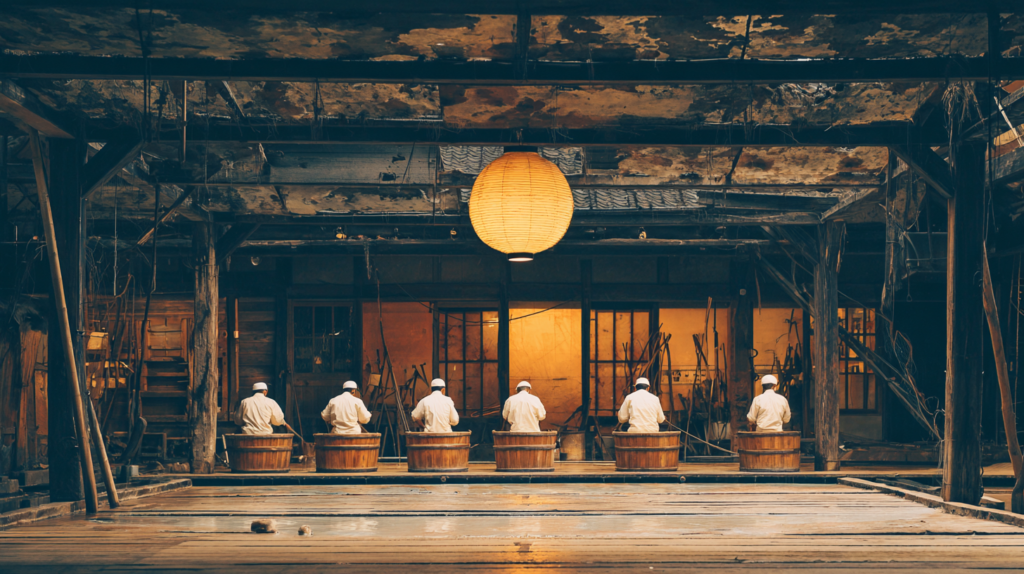
Before dawn in a sake brewery, a young kurabito grips a paddle and stands over a shallow tub known as a hangiri, grinding together steamed rice, koji, and water. The “moto-suri uta,” a work song repeated like a chorus, echoes low across the freezing wooden floor. This is the scene of kimoto brewing|a method that has continued from the Edo period with almost no change.
Most modern sake is not made this way. Since the quick starter method known as sokujo-moto was proposed by a national research institute in the late Meiji era, it has become the industry standard: brewing lactic acid is added by hand, and the yeast starter is built in about two weeks. Sake made with kimoto, and with its offshoot yamahai, is still said to account for only around 1 percent of the total. Even so, since the start of 2026, trade publications have increasingly begun to note that a quiet resurgence of these traditional methods is unfolding.
The “Efficiency” of Sokujo, and the “Time” of Kimoto
The yeast starter is the earliest stage of the brewing process, where large quantities of yeast are propagated. The challenge at this stage is the wild bacteria present in the brewery. A highly acidic environment created by lactic acid suppresses those microbes and leaves a space where only the yeast can thrive. In sokujo, brewing lactic acid is added and the starter is ready in about two weeks.
In kimoto, no lactic acid is added. Instead, the brewer waits for lactic acid bacteria living in the brewery itself to multiply naturally in the ice-cold hangiri. After the grueling labor of yama-oroshi|the traditional mashing process|a quiet microbial succession unfolds over roughly four weeks: nitrate-reducing bacteria, then lactic acid bacteria, then yeast. Yamahai is a later variation that omits the yama-oroshi step; it was introduced by the National Research Institute of Brewing in 1909. But at its core, it belongs to the same philosophy as kimoto: waiting.
Layers of Complexity Woven by Wild Microbes
When a brew is entrusted to the microorganisms living in the brewery itself|and to time|unexpected layers of complexity are written into the liquid. The aromas can overlap with notes of dairy-like creaminess, yogurt, burnt caramel, dried mushrooms, and the undergrowth of a forest. On the palate, there is a powerful acidity and a deep, lingering umami that sokujo often does not produce.
A longer process means more variables enter along the way, and things do not always unfold exactly as the brewery intends. Yet this very inability to fully control the outcome can create entirely new flavor landscapes when the sake meets spices, fermented foods, fat, and bitterness on the plate.
A Modern Return to Traditional Fermentation
This renewed appreciation stems from a broader cultural shift. Over the past decade, our palates have been trained by the broader movement toward natural fermentation|natural wine, sourdough bread, craft miso, and wild-yeast beer. When kimoto and yamahai, which rely on brewery-native lactic acid bacteria and time, are placed within that context, their meaning finally comes into sharp focus.
Parallel to this is a generational shift among young toji, or master brewers, that began in the late 2010s. Many of them take the efficiency of sokujo as a given, and then deliberately choose to return to kimoto and yamahai. Finally, preferences are evolving among drinkers themselves. The generation that favored only chilled ginjo is gradually giving way to a broader audience that appreciates the acidity and umami these styles reveal when warmed.
A Shared Continuum: From the Brewery to the Bangkok Table
On a Thai table, fermentation, acidity, richness, and heat are always present at once. Nam pla, pla ra, nam prik. The fermentation culture of Bangkok home cooking belongs to the same continuum as the world of brewery-native microbes. Kimoto and yamahai, which draw in wild lactic acid bacteria over time, can be read as sakes that extend naturally into the fermentation cultures of tropical Asia.
When a lightly chilled yamahai junmai is placed next to som tam with green papaya and dried shrimp, a new harmony unfolds. The robust acidity created by brewery-native lactic acid bacteria overlaps with the tartness of lime and the savoriness of fish sauce, gently tightening the salty edges of the dish. In hot climates, people often pour sake straight from the refrigerator, but kimoto and yamahai show their true character closer to body temperature|around 18 to 20 degrees Celsius.
The fact that kimoto and yamahai still account for only about 1 percent of all sake does not indicate technical inferiority. Sokujo is more stable and more efficient. And yet some breweries continue to make these styles because they create layers of flavor that cannot be written any other way|and because there are drinkers who seek exactly those layers out. The next time you spot the words “kimoto” or “yamahai” on a label, remember that behind them, quietly waiting, is a sake made not only by human hands, but by the brewery itself. (Mr. Bacchus)
This article is intended solely to explore the traditional brewing techniques and cultural heritage of kimoto and yamahai sake methods, and does not aim to promote or encourage the consumption of alcohol. / บทความนี้จัดทำขึ้นเพื่อนำเสนอข้อมูลเกี่ยวกับเทคนิคการผลิตดั้งเดิมและมรดกทางวัฒนธรรมของสาเกแบบคิโมโตะและยามาไฮเท่านั้น มิได้มีเจตนาเพื่อส่งเสริมหรือโฆษณาเครื่องดื่มแอลกอฮอล์ สำหรับผู้มีอายุ 20 ปีขึ้นไป โปรดดื่มอย่างรับผิดชอบ
Discover the culture behind every bottle
We share brewery stories, tasting notes and the craft of koji & fermentation | for educational and cultural purposes only.
เราถ่ายทอดเรื่องราวจากผู้ผลิต บันทึกรสชาติ และศาสตร์แห่งโคจิและการหมัก | เพื่อการศึกษาและวัฒนธรรมเท่านั้น
Follow on Instagram FacebookRelated Articles
“The Silent Synergy of Fermentation” / “What Is Kijoshu? Why Does Replacing Water with Sake Make It Sweet?” / “Pressed Before Time” / “Why Cheese and Sake Resonate: A Shared Transformation Through Fermentation”