

The Birthplace of Yamanashi Meijo’s “Shichiken Onakaya”
When people hear “Hakushu,” many think of the Suntory Hakushu Distillery. But there is another brewery that has long used the same underground water from the Ojira River—the soft water filtered over thousands of years through the granite layers of Mount Kaikoma in the Southern Alps—that serves as the distillery’s brewing water. That brewery is Yamanashi Meijo, maker of Shichiken. In 1750, Nakaya Ihee, the first head of the Kitahara family, fell in love with the pristine water of Daigahara and established his brewery there. More than 275 years have passed since its founding.
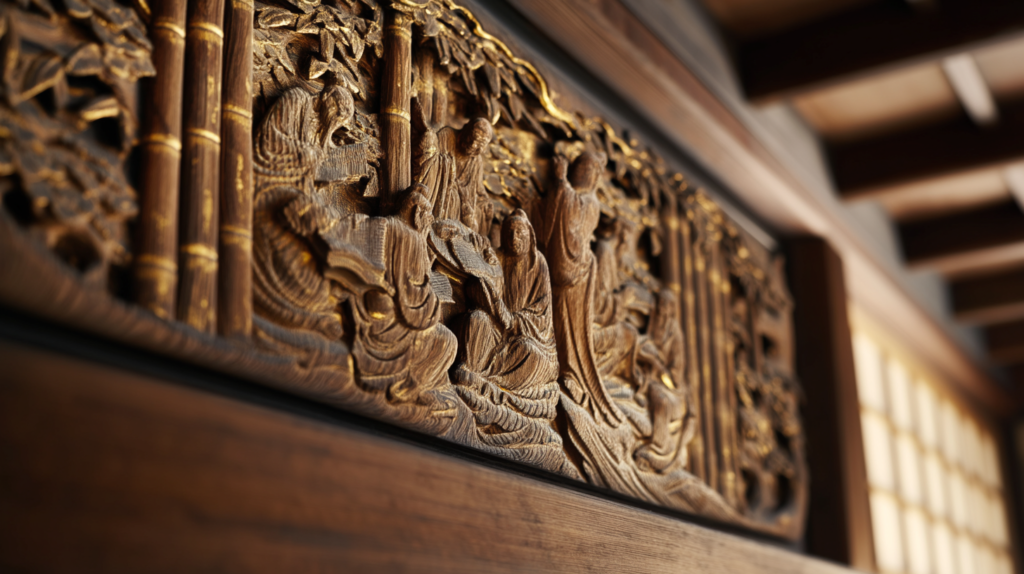
The Day the “Seven Sages of the Bamboo Grove” Transom Arrived in 1835
The brewery has gracefully evolved with each turning point in history. In 1835, Kitahara Ihee Nobushige, the fifth-generation head of the brewery, built a new main residence. At that time, Naito Suruga-no-kami, lord of Shinshu’s Takato Castle, presented him with a beautifully carved transom titled “The Seven Sages of the Bamboo Grove,” created by Tatekawa Senshiro Tominetane, a master shrine and temple carpenter from Suwa. Inspired by the classic Chinese tale from the Wei and Jin dynasties, in which seven wise men gathered in a bamboo grove to recite poetry and share wine, the brewery naturally adopted the name “Shichiken,” meaning “Seven Sages,” for its sake.
In 1880, during Emperor Meiji’s imperial tour, the inner room of this main residence was used as an anzai-sho—lodging for the emperor. That residence, now the brewery’s main building, is still carefully preserved and designated as a Tangible Cultural Property of Yamanashi Prefecture.
A Flagship Junmai Daiginjo Brewed with Hakushu Water
“Shichiken Onakaya” stands as Yamanashi Meijo’s flagship junmai daiginjo. Onakaya is also the name of the agricultural corporation established by the Kitahara family in 2014. Brothers Kitahara Tsushima, the 13th-generation president, and Kitahara Ryogo, executive director and head brewer, made the bold decision to discontinue the brewery’s ordinary sake, unifying the entire lineup under premium classified sake categories. They also began cultivating sake rice in their own fields and the surrounding region. It was the moment the brewery’s deep-rooted philosophy—“sake is 20% rice and 80% water”—was carried all the way back to the earth itself.
The brewing water is underground water from the Ojira River, which flows through the Southern Alps UNESCO Eco Park. It is a remarkably soft water, filtered through granite layers and recognized among Japan’s 100 Famous Waters. Crafted predominantly from Yamada Nishiki rice sourced from Hyogo Prefecture’s premier Special A district and polished to a refined 37 percent, this expression represents a profound dedication to the craft. At 16 percent alcohol, the sake is orchestrated so that a gentle sweetness and a delicate finish overlap effortlessly within a single glass.
An International Resonance: The Alain Ducasse Connection
Shichiken’s dedication has steadily resonated on the global stage. Judged by prominent sommeliers in France at Kura Master 2021, it earned the Platinum Award in the Junmai Daiginjo category, and has consistently garnered prestigious accolades at the International Wine Challenge over consecutive years. Yamanashi Meijo itself was also honored with a Gold Award at the 2024 Annual Japan Sake Awards.
Beyond traditional competitions, Shichiken is known as a brewery that has cultivated a close, collaborative partnership with French culinary master Alain Ducasse since 2021. The same visionary brewery that created “SHICHIKEN Selection Alain Ducasse Sparkling Sake” now presents Onakaya as another of its defining masterworks.
To the Tables of Bangkok
Now, this storied legacy quietly finds its way to the discerning tables of Bangkok. International perspectives highlight intriguing nuances; tasting notes from North America mention hints of tangerine and marshmallow, while a French perspective describes jasmine and white tea as part of this sake’s elegant character. Designed to be served gently chilled in a wine glass, its delicate aromatic structure pairs seamlessly with both French cuisine and modern Thai tasting menus.
Sake brewing shaped by Hakushu’s pristine water since 1750. The masterfully carved transom of 1835. The honored imperial lodging of 1880. And today, a continuous dialogue with the world of international gastronomy. This sake, layering centuries of history and modern refinement in a single glass, is beginning to whisper its story at the fine-dining counters of Bangkok. (Mr. Bacchus)
This article is intended solely to explore the brewing philosophy and cultural heritage of Yamanashi Meijo (Shichiken) and its flagship junmai daiginjo “Onakaya”, including the 1750 founding in Hakushu, the 1835 origin of the Shichiken name from the “Seven Sages of the Bamboo Grove” transom, the 1880 designation as Emperor Meiji’s anzaisho, and the international recognition through Kura Master 2021 Platinum and IWC 2020 Gold, and is not intended to promote or encourage the consumption of alcohol. / บทความนี้จัดทำขึ้นเพื่อนำเสนอข้อมูลเกี่ยวกับปรัชญาการผลิตและมรดกทางวัฒนธรรมของ Yamanashi Meijo (Shichiken) และสาเก Junmai Daiginjo เรือธง “Onakaya” รวมถึงการก่อตั้งในปี 1750 ที่ Hakushu, ที่มาของชื่อ Shichiken ในปี 1835 จากภาพแกะสลัก “Seven Sages of the Bamboo Grove”, การกำหนดให้เป็น Anzaisho ของจักรพรรดิ Meiji ในปี 1880 และการได้รับการยอมรับในระดับสากลผ่านรางวัล Kura Master 2021 Platinum และ IWC 2020 Gold เท่านั้น มิได้มีเจตนาเพื่อส่งเสริมหรือโฆษณาเครื่องดื่มแอลกอฮอล์ สำหรับผู้มีอายุ 20 ปีขึ้นไป โปรดดื่มอย่างรับผิดชอบ