

An Intellectual Shift in Cultivating Craft Culture
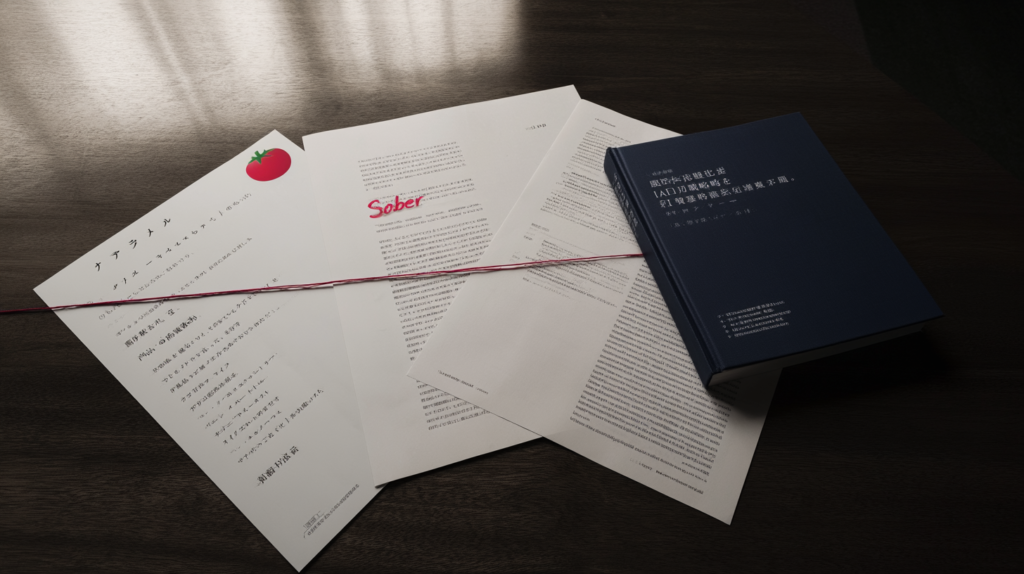
Three Disparate Threads One morning, three pieces of material were sitting on my desk. One was a note regarding KUMA TOMATO, a unique tomato-based liqueur from Tsutsumi Distillery, a respected Kuma shochu producer in Kumamoto Prefecture. Another was a summary of Takafumi Nakanishi’s book, Next-Generation AI: Japan’s Path to Victory. The third was an editorial on menu design trends shaped by the growing “Sober Curious” movement in Bangkok’s dynamic dining scene.
Their categories could not have been more different: traditional liqueur, artificial intelligence, and modern restaurant culture. On the surface, there was almost nothing linking them.
But when placed side by side, a fascinating through-line began to appear. All three reveal a structure in which a breakthrough is found simply by removing a single mainstream assumption.
The Assumption Left Behind KUMA TOMATO removes a foundational piece of common sense from the liqueur category. Normally, a liqueur is crafted as a “finished liquid.” The producer decides the exact flavor profile, and the consumer simply enjoys it. Instead, Tsutsumi Distillery envisioned a liquid combining the rich umami of locally grown tomatoes with the structural depth of traditional Kuma shochu—not as a conclusion, but as an open-ended canvas. They presented it as an element for mixologists to bring to life on-site. Not a finalized product, but a beautifully crafted raw material. That single philosophical shift established an entirely new approach to the category.
What Nakanishi removes in his analysis of AI development is a much larger assumption: that the field is purely a competition of scale. For a long time, the dominant argument was that one had to relentlessly chase data volume, computing power, and parameter counts. Nakanishi steps away from that assumption and presents another path: focusing on domain specialization, reliability, and social integration. Not sheer technological scale, but contextual depth.
The steady rise of Sober Curious thinking similarly challenges the basic premises of gastronomy. Historically, dining establishments were largely modeled around the assumption that the beverage pairing must be alcoholic. Non-drinking patrons were often viewed outside the core culinary experience. Yet, in cosmopolitan cities around the world, the number of guests who consciously choose not to drink is steadily increasing, and Bangkok is certainly no exception. Rather than ignoring this demographic, visionary establishments are embracing them through sophisticated low-alcohol and non-alcoholic pairings, building a completely new layer of culinary appreciation.
A Shared Intellectual Movement When observing these phenomena together, a shared intellectual movement becomes visible. Rather than competing directly within established paradigms, one simply removes a foundational assumption to reveal a completely different landscape. This is distinctly different from a conventional “niche strategy,” which merely divides an existing market. What is happening here is the elegant replacement of an underlying premise.
Tsutsumi Distillery removes the assumption that “a liqueur must be a finished product.” Nakanishi removes the assumption that “in AI, sheer scale is absolute.” Gastronomes embracing the Sober Curious audience remove the assumption that “fine dining requires traditional alcohol.” None of them sought to tear down the entire system. One assumption was enough. Remove one, and a new world of possibilities comes into view.
A New Perspective on Heritage This structural shift resonates deeply within the world of traditional spirits.
If sake is perceived merely as a beverage meant for inebriation, the Sober Curious movement might appear as a cultural shift away from it. However, if we reframe sake as a catalyst for experiencing the profound heritage of Japanese koji fermentation, a remarkable new horizon emerges. Individuals who wish to learn about the science of fermentation. Epicureans fascinated by regional food cultures. Health-conscious minds seeking deeper, more mindful experiences. A meticulously crafted bottle creates a meaningful point of contact with all of them.
In the nuanced cultural landscape of Bangkok, there is a growing appreciation for depth over volume—an evolution toward understanding the narrative, history, and philosophy behind the glass. These three disparate pieces of material shed light on the beautiful possibilities that emerge when we shift our perspective.
Perhaps the next evolution in appreciating these crafts lies not in seeking entirely new elements, but in viewing the rich traditions already in our hands from an unexpected angle. The quiet insights born from that intellectual curiosity are often the ones that open the door to a deeper cultural experience. (Mr. Bacchus)
This article is intended solely to explore a structural pattern observed across three unrelated domains — a Japanese tomato-based liqueur from Tsutsumi Brewery (Kumamoto), Takafumi Nakanishi’s book “Japan’s Winning Path in Next-Generation AI” (Nikkei Premier Series), and the Sober Curious menu design movement in Bangkok’s restaurant scene — as a reflection on how shifting a single mainstream assumption can open new strategic ground for small businesses, including independent sake retailers, and is not intended to promote or encourage the consumption of alcohol. / บทความนี้จัดทำขึ้นเพื่อสำรวจรูปแบบเชิงโครงสร้างที่พบในสามอุตสาหกรรมที่ไม่เกี่ยวข้องกัน ได้แก่ ลิเคียวร์มะเขือเทศจากโรงสุรา Tsutsumi (Kumamoto), หนังสือ “เส้นทางชัยชนะของญี่ปุ่นใน AI ยุคถัดไป” โดย Takafumi Nakanishi (Nikkei Premier Series) และขบวนการออกแบบเมนู Sober Curious ในวงการร้านอาหารกรุงเทพฯ เพื่อสะท้อนว่าการเปลี่ยนสมมติฐานหลักเพียงหนึ่งข้อสามารถเปิดพื้นที่เชิงกลยุทธ์ใหม่ให้กับธุรกิจขนาดเล็ก รวมถึงร้านขายสาเกอิสระอย่างไร เท่านั้น มิได้มีเจตนาเพื่อส่งเสริมหรือโฆษณาเครื่องดื่มแอลกอฮอล์ สำหรับผู้มีอายุ 20 ปีขึ้นไป โปรดดื่มอย่างรับผิดชอบ