

The Tenth Anniversary and the Evolution of Sparkling Sake
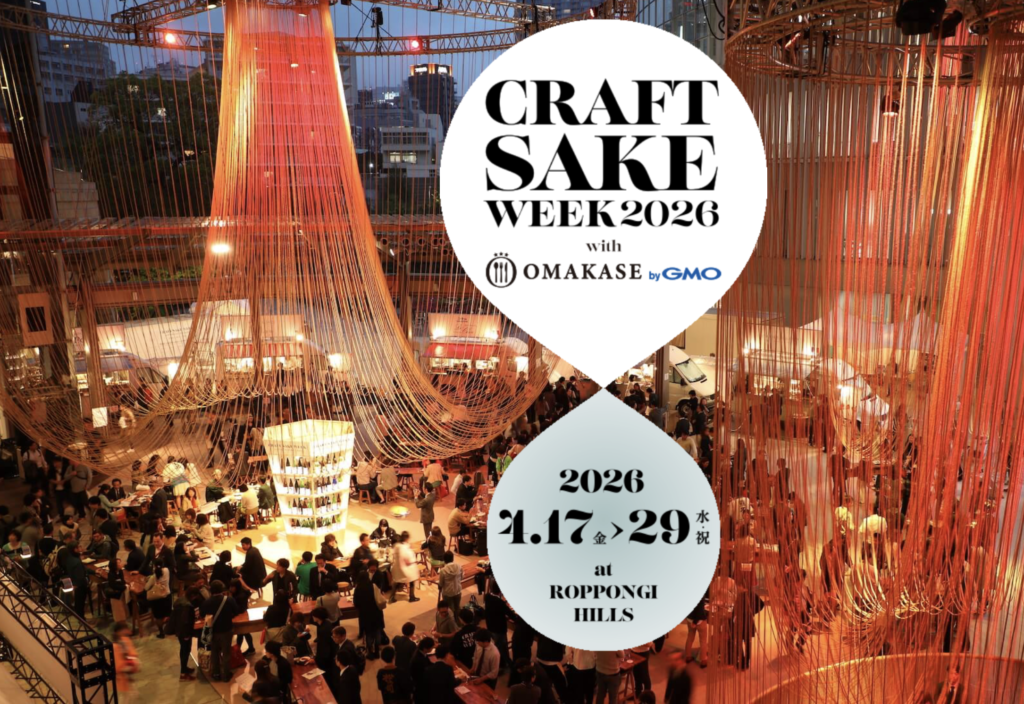
On April 17, 2026, Craft Sake Week 2026 opened at Roppongi Hills Arena in Tokyo. Over 13 days, 130 carefully selected breweries from across Japan present under daily themes, while 20 top restaurants offer exclusive menus. Since its debut in 2016, the event has welcomed more than 1.25 million visitors in total.
The organizer is JAPAN CRAFT SAKE COMPANY, founded in 2015 by former Japan national soccer team player Hidetoshi Nakata. Since 2009, Nakata has traveled to breweries in all 47 prefectures, launching this event with the goal of sharing Japanese culture with the world. Participating breweries are chosen from around 400 candidates, narrowed down through tastings by roughly 200 experts to form a lineup that reflects the current pinnacle of sake.
An Opening Theme That Signals a Shift
The theme chosen to mark the 10th anniversary opening was “Sparkling Sake Toast.” Breweries such as Nanbu Bijin, Mizubasho, and Dewatsuru gathered to showcase a wide range of sparkling sake, including those made with traditional bottle fermentation and the Pét-Nat method (a natural in-bottle fermentation process).
Sparkling sake is now one of the fastest-growing subcategories in the sake market. Yamanashi Meijo (Shichiken), a historic brewery founded in 1750, has become a global pioneer by producing eight types of sparkling sake using the same secondary fermentation method as Champagne. While it accounts for just 10% of production volume, it makes up 20% of revenue—demonstrating its high added value. In autumn 2026, the brewery plans to release a sparkling rosé made with red rice, opening a new gateway for consumers in wine cultures.
At the International Wine Challenge (IWC), sparkling sake won the Champion Sake award in 2025. In Japan, a consortium of breweries is also working toward standardization and quality guidelines for the category. “Sparkling sake” is no longer experimental—it is becoming firmly established.
Global Expansion and the Bridge Built by Bubbles
This trend coincides with the rapid expansion of sake exports. In 2025, combined exports of Japanese whisky and sake reached 95 billion yen—a 289% increase over the past decade. Sake is now distributed in 81 markets worldwide, while Japanese gin has also surged, growing 104% year-on-year to 8.2 billion yen.
Sparkling sake sits at the forefront of this export boom. In wine-centric regions like France, Italy, and the UK, a culture of sparkling beverages—Champagne and Prosecco—already exists. Into this space enters a delicate sparkling drink made from rice and koji. The form is familiar, but the substance is entirely different. This balance of “familiar yet distinct” is precisely what draws in new consumers.
Signs of this shift are already visible. In 2017, at the inaugural Kura Master in Paris, Shichida by Tenzan Brewery in Saga won the first President’s Award (top prize). Judged by France’s leading sommeliers, the deciding factor was its “compatibility with gastronomy.” The fact that French dining culture evaluates sake based on how well it pairs with food aligns directly with the path sparkling sake is taking into wine regions. It’s not just about the bubbles—sake itself is beginning to be discussed in the language of wine.
A Sparkling Connection to Bangkok’s Dining Scene
For those immersed in Bangkok’s dynamic culinary landscape, this movement feels increasingly close to home. The philosophies of breweries like Shichiken, Mizubasho, and Shichida are already enriching local dining experiences.
Among them, “SHICHIKEN Selection Alain Ducasse Sparkling Sake” stands out as a symbolic bottle. Based on kijoshu (a luxurious method using sake instead of water in brewing), it is aged in cherry wood barrels and finished with secondary fermentation in the bottle. This rare synthesis of three distinct techniques was even served at the G7 Hiroshima Summit in 2023.
Mizubasho (Nagai Brewery) is another forward-thinking producer, proposing the “Nagai Style” with four categories: Sparkling, Still, Vintage, and Dessert, and is featured on opening day.
Also worth highlighting is “eks YAKINIKU EDITION No.1,” produced by Senkin and developed by JAPAN CRAFT SAKE COMPANY. Using koji typically intended for miso, it achieves higher amino acid levels and fine Champagne-like bubbles. This is a live, cloudy sparkling sake specifically designed for pairing with yakiniku. Both Craft Sake Week and Senkin’s eks embody the evolving philosophy of “pairing-focused sparkling sake.”
A Finale Crowned by Juyondai
The final day, April 29, carries the theme “Team Juyondai,” featuring Juyondai (Takagi Brewery), Tenbu, and Toyo Bijin. Juyondai’s presence in the sake world is so significant that the event’s finale bearing its name speaks volumes in itself.
What the Bubbles Have Begun to Express
For sake, “sparkling” is more than just a new product category. It is a bridge connecting wine-centric dining cultures with Japan’s brewing traditions. It also resonates with a global consumption trend: “drink less, but choose better.”
That the 10th year of Craft Sake Week begins with sparkling sake is likely no coincidence. Through the form of bubbles, the story of rice and koji is reaching tables it never reached before. Bangkok is one of them. (Mr. Bacchus)
This article is intended solely to explore the brewing philosophy and cultural heritage of Japanese sake, specifically SHICHIKEN / Yamanashi Meijo (Sparkling Sake series), Mizubasho / Nagai Shuzo, SHICHIDA / Tenzan Shuzo, and Senkin eks, and does not aim to promote or encourage the consumption of alcohol. / บทความนี้จัดทำขึ้นเพื่อนำเสนอข้อมูลเกี่ยวกับปรัชญาการผลิตและมรดกทางวัฒนธรรมของสาเกญี่ปุ่น โดยเฉพาะ SHICHIKEN / Yamanashi Meijo (Sparkling Sake series), Mizubasho / Nagai Shuzo, SHICHIDA / Tenzan Shuzo และ Senkin eks เท่านั้น มิได้มีเจตนาเพื่อส่งเสริมหรือโฆษณาเครื่องดื่มแอลกอฮอล์ สำหรับผู้มีอายุ 20 ปีขึ้นไป โปรดดื่มอย่างรับผิดชอบ
Discover the culture behind every bottle
We share brewery stories, tasting notes and the craft of koji & fermentation — for educational and cultural purposes only.
เราถ่ายทอดเรื่องราวจากผู้ผลิต บันทึกรสชาติ และศาสตร์แห่งโคจิและการหมัก — เพื่อการศึกษาและวัฒนธรรมเท่านั้น
Follow on Instagram Facebook