Juyondai was featured in dancyu magazine
August 8, 2025
Series: “The New World of Sake Opened by Juyondai – The Work and Influence of 15th-Generation Takagi Tatsugorō”
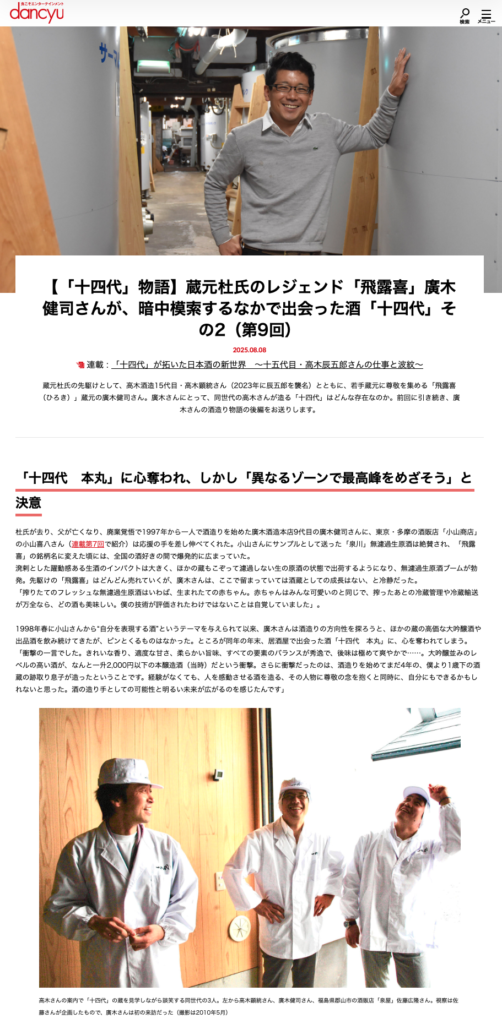
As a pioneer among brewer-owners, Kenji Hiroki, 9th-generation owner of Hiroki Brewery, is admired by young sake makers alongside Takagi Akinori, the 15th-generation head of Takagi Sake Brewery (who took the name Tatsugorō in 2023). What does “Juyondai,” crafted by his peer Takagi, mean to Hiroki? Continuing from the previous installment, here is the second half of his brewing story.
Captivated by “Juyondai Honmaru,” Yet Determined to Aim for the Peak in a Different Field
In 1997, after his master brewer left and his father passed away, Kenji Hiroki began brewing alone, prepared for the possibility of closing his family’s Hiroki Sake Brewery. Kihachi Koyama, owner of Koyama Shoten in Tama, Tokyo (introduced in Episode 7), reached out in support. The unfiltered, unpasteurized “Izumikawa” sake Hiroki sent as a sample was met with high praise, and by the time he rebranded it as “Hiroki,” it had exploded in popularity among sake lovers nationwide.
The lively, fresh impact of his namazake (unpasteurized sake) was immense, sparking a boom as other breweries rushed to release their own unfiltered, raw sakes. As a pioneer, Hiroki’s sales soared—but he remained calm, knowing that staying in that comfort zone would not lead to growth as a brewery.
“Freshly pressed, unfiltered namazake is like a newborn baby—just as all babies are adorable, any sake can taste good if it’s stored and shipped under perfect refrigeration. I knew it wasn’t really my technique that was being praised,” Hiroki recalls.
Since the spring of 1998, when Mr. Koyama challenged him to create “a sake that expresses yourself,” Hiroki had been sampling expensive daiginjo and competition sakes from other breweries, searching for a direction in brewing, but nothing struck him. Then, at the end of that same year, in an izakaya, he encountered “Juyondai Honmaru” and was utterly captivated.
“It was shocking, in the best sense of the word. A beautiful aroma, gentle sweetness, soft umami—every element perfectly balanced, and the aftertaste was refreshingly clean. The real shock was realizing this high-level sake, on par with a daiginjo, was an honjozo retailing for under 2,000 yen per 1.8-liter bottle at the time. Even more astonishing—it was made by a brewery successor one year younger than me, with only four years of brewing experience. I admired him for creating a sake that could move people despite limited experience, and at the same time, I thought, maybe I could do it too. I felt new possibilities as a brewer and saw a bright future ahead.”
The person who reached out to Hiroki, inspired by “Juyondai,” was Hirotaka Sato, owner of Izumiya, a sake retailer in Kōriyama City, Fukushima Prefecture (introduced in Episodes 5 and 6). Sato was one year younger than Hiroki and, like him, a graduate of Aoyama Gakuin University. Sato shared a close, mutually respectful partnership with Takagi Akinori, the brewer-owner of Juyondai. When Hiroki appeared on an NHK program, Sato recalled watching it together with Takagi over dinner in the living room next to the Takagi brewery.
“With wistful music playing, we saw a brewer tasting sake from a chipped tokkuri cup. I remember Takagi turning to me and saying, ‘He’s our generation, and from Fukushima too. Hirotaka, why don’t you give him some advice?'” Sato recalls.
When Sato met Hiroki, he spoke passionately about the importance of having a pasteurized, year-round “standard sake.”
“At the time, unfiltered namazake was highly praised, but I felt it was risky because its flavor varied greatly. I told him that by making a stable, pasteurized sake that could be shipped year-round as the ‘face’ of the brewery, he could build a strong brand,” says Sato.
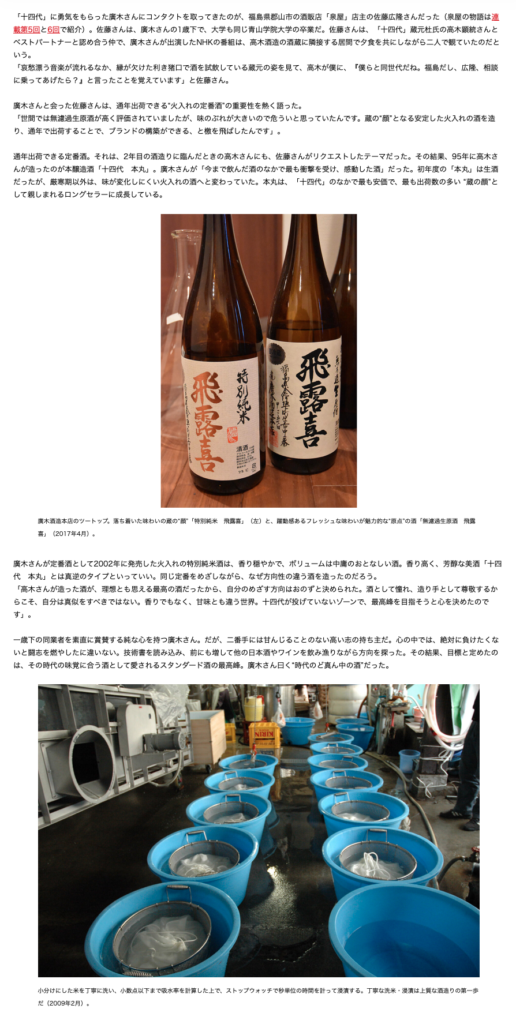
A year-round standard sake—this was also the theme Sato had given Takagi during his second brewing season. The result was the 1995 honjozo “Juyondai Honmaru,” which became, for Hiroki, “the most shocking and moving sake I’ve ever tasted.” In its first year, Honmaru was released as namazake, but outside the coldest months, it was shifted to pasteurized form for better stability. Today, Honmaru is the most affordable and widely shipped sake in the Juyondai lineup, beloved as the brewery’s signature long-seller.
The special junmai sake Hiroki released as his own standard in 2002 was calm and modest in style, with a subdued aroma and moderate body—the complete opposite of the fragrant, rich “Juyondai Honmaru.” Why did he create a sake so different while aiming for the same “standard” category?
“Because the sake Takagi made was, to me, the ideal—the ultimate. That meant my own path was naturally set. I admired his sake and respected him as a brewer, but I knew I shouldn’t copy him. I decided to aim for the pinnacle in a zone Juyondai wasn’t covering—neither aroma-driven nor sweet, but something entirely different,” Hiroki explains.
Though Hiroki openly praised a peer one year younger than himself, he was no stranger to ambition. Deep down, he must have felt a fierce determination never to be outdone. He devoured technical manuals, drank more sake and wine than ever before in search of his direction, and set his sights on creating “a standard sake that would be loved as the best fit for the taste of the era”—what he called “a sake at the very center of the times.”
Because he had debuted with the impactful unfiltered namazake, the special junmai’s modest style initially drew lukewarm reviews. “I shed tears of frustration many times, but it was simply that my skills hadn’t caught up yet. I never intended to change direction.” Through repeated focused brewing, he honed his craft, blending multiple tanks brewed with different yeasts in his own way. The once “plain” sake evolved into one with a quiet but undeniable presence. In 2012, when it took first place in the junmai category at the inaugural SAKE COMPETITION hosted by Hasegawa Saketen, Hiroki felt he had reached a technical milestone. Today, “Hiroki” Tokubetsu Junmai enjoys unwavering support from top sushi chefs and sake enthusiasts as “a refined, stable sake that never disappoints.”
In 1997, his first year brewing alone, nearly all of the 16 tanks he produced were inexpensive table sake. By 2024, production had grown to 123 tanks, half of them Tokubetsu Junmai, with unfiltered namazake limited to winter shipments. The rest were junmai ginjo and junmai daiginjo—transforming the brewery into one with a clear focus on ultra-high quality.
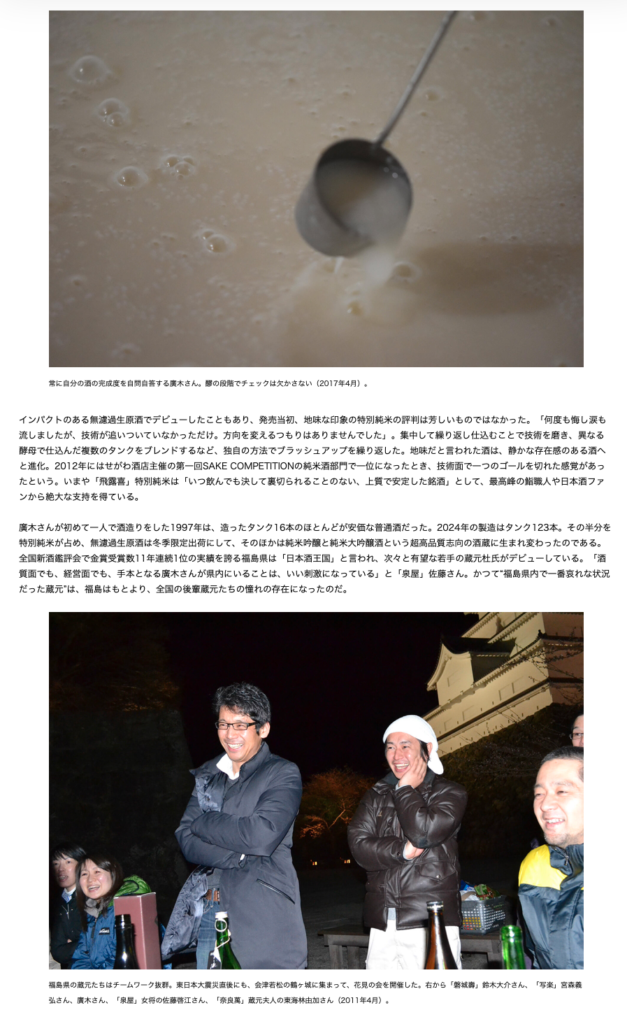
Fukushima Prefecture, with the nation’s top record of 11 consecutive years winning the most gold medals at the National New Sake Appraisal, is called “Japan’s Kingdom of Sake,” producing a steady stream of promising young brewer-owners. “Having someone like Hiroki in the prefecture—both as a role model in quality and in management—is an inspiration,” says Sato of Izumiya. The brewery once considered “the most pitiful in Fukushima” had become an admired figure not only in the prefecture but for young brewers nationwide.
“Takagi showed that sake made by a young brewery successor could have a different kind of charm than that made by professional toji. When the world was waiting for the next person after him, I was lucky to have him take notice of me. I think it was the expectation for youth and passion, and I believe I was able to live up to it. I take pride in being one of those who helped usher in the ‘era of the brewer-owner,’ and in contributing to a major turning point in sake history,” Hiroki reflects.
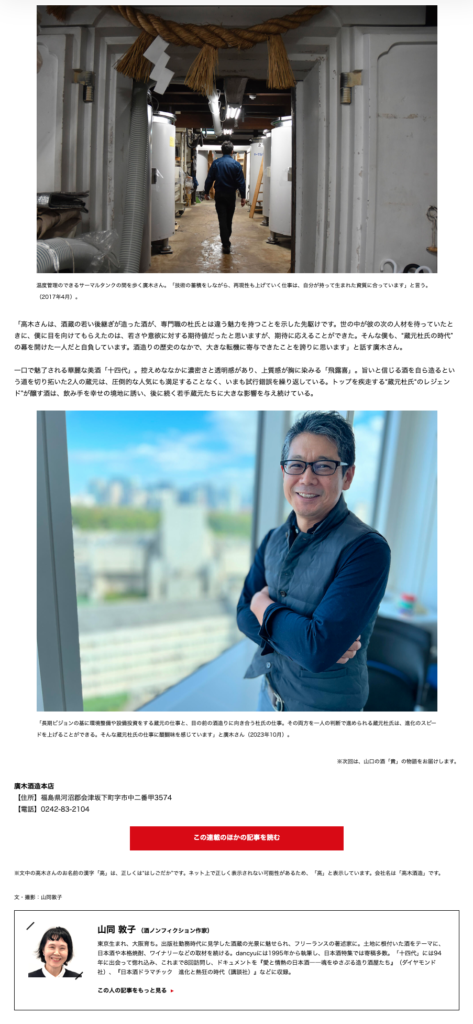
A single sip of “Juyondai” captivates with its elegance. “Hiroki,” with its understated depth and clarity, offers a refined richness that resonates in the heart. These two brewer-owners have each forged their own path to create the sake they believe in, never content even with overwhelming popularity. The legendary brewer-owners at the top of their field continue their trial and error, crafting sake that not only brings drinkers into a state of bliss but also inspires the next generation of young brewers.