
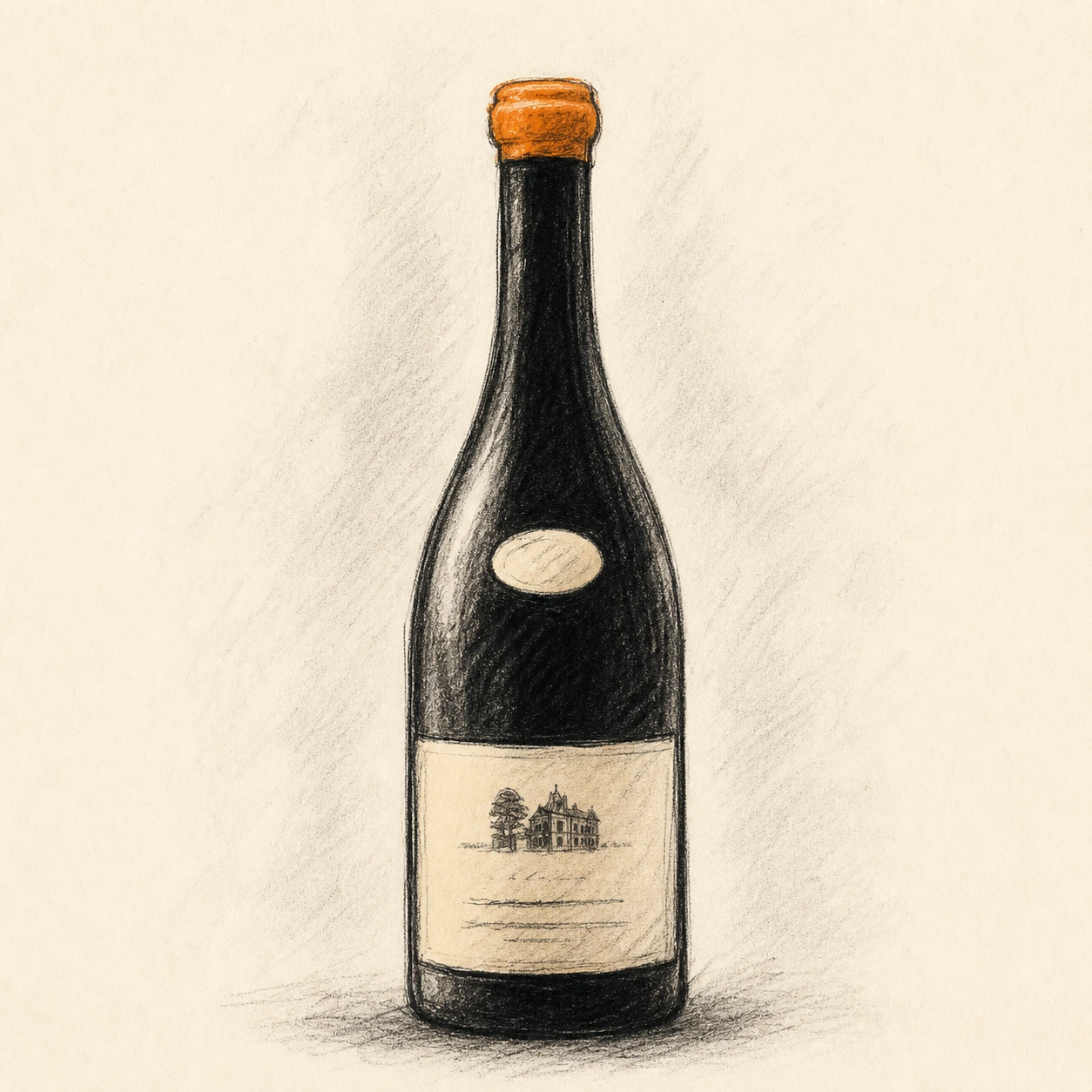
Original bottle illustration — Bacchus Global
Domaine Xavier & Agnès Amirault (Le Clos des Quarterons) — Saint-Nicolas-de-Bourgueil
DOMAINE XAVIER & AGNÈS AMIRAULT (LE CLOS DES QUARTERONS)Le Fondis
Long before Saint-Nicolas-de-Bourgueil had a name on modern maps, growers had already singled out this gravel-and-clay corner of the appellation as something special. Le Fondis breaks from the sandy norm nearby, giving Cabernet Franc a firmer backbone and a quieter, more structured voice — the kind of wine that rewards a slow evening with a pot simmering on the stove and your favorite music playing softly.
Thailand · Product information
Product information from Bacchus Global Co., Ltd., based in Bangkok, Thailand. About Bacchus Global
- Wine type
- Red wine, still, dry
- Grape
- Cabernet Franc 100% (locally called Breton)
- Appellation
- AOC Saint-Nicolas-de-Bourgueil
- Origin
- Touraine, Loire Valley, France
- Drinking window
- 2026–2034
- Recommended temperature
- 16–17°C
- Alcohol
- —
- Bottle size
- 750 ml
About the Estate
Domaine Xavier & Agnès Amirault (Le Clos des Quarterons) is a family-run estate in Saint-Nicolas-de-Bourgueil, in the Touraine district of the Loire Valley.
The estate's vineyards are divided into 53 individual parcels, each vinified separately to preserve its own character.
Taste profile
In the glass
LE FONDIS
Scale1–5
BG wine structure estimate
Comparative profile within the Bacchus Global wine range.
Saddle leather, licorice, asphalt and green peppercorn on opening, evolving with air toward blackcurrant, cherry, juniper berry, wet fallen leaves and a gravelly mineral note.
Concentrated fruit with polished tannins, taut acidity and the cool, faintly green freshness typical of Cabernet Franc, balancing power with elegance.
Before it reaches the glass
Temperature
Serve at 16–17°C.
Timing
Best enjoyed within the 2026–2034 window.
Glassware
A large Burgundy-style glass or a medium tulip glass suited to Cabernet Franc.
Question 1
Which grapes are listed in the product facts?
- Cabernet Franc 100% (locally called Breton)
- Syrah, Cabernet Sauvignon, Grenache
- Chardonnay 60%, Pinot Noir 40%
Read the answer and explanation
Correct answer: A — Cabernet Franc 100% (locally called Breton)
The linked part of this page lists Cabernet Franc 100% (locally called Breton).
Read the relevant passageQuestion 2
Which appellation is listed in the product facts?
- Pouilly-Fuissé 1er Cru
- AOC Saint-Nicolas-de-Bourgueil
- AOC Pic Saint-Loup
Read the answer and explanation
Correct answer: B — AOC Saint-Nicolas-de-Bourgueil
The linked part of this page lists AOC Saint-Nicolas-de-Bourgueil.
Read the relevant passageQuestion 3
Which origin is listed in the product facts?
- Luzech, Lot Valley, South-West France
- Jurançon, Gan, Southwest France
- Touraine, Loire Valley, France
Read the answer and explanation
Correct answer: C — Touraine, Loire Valley, France
The linked part of this page lists Touraine, Loire Valley, France.
Read the relevant passageAt the table
Food Pairing
The wine's dense acidity and polished tannins make it a natural partner for slow-cooked and umami-rich dishes across cuisines.
Japanese
- Beef cheek braised in red wine
- Wagyu thigh steak
- Sansho-pepper grilled duck
Why it worksSlow-braised and grilled preparations echo the wine's structure, while sansho pepper's citrusy heat plays against its cool, green-tinged fruit.
Thai
- Massaman beef curry (mild)
- Khao mok gai (chicken biryani rice)
- Nuea tun (Chinese-style braised beef)
Why it worksMild spice and long-simmered richness let the wine's fruit and tannin show without being overwhelmed by chili heat.
Western
- Beef cheek braised in a cocotte
- Duck confit
- Aged hard cheese
Why it worksClassic slow-cooked bistro dishes and aged cheese match the wine's dense tannin and structured acidity.
From cellar to bottle
Winemaking
Grapes are hand-harvested, fully destemmed and sorted in two passes before undergoing integral vinification in 500-litre oak barrels, fermented with native yeasts only and no additives, including sulfur. Maceration runs three to five weeks, with the barrels rotated several times a week during the first fortnight.
Product detail
After blending press juice with free-run wine, the blend ages 18–24 months in the same barrel and is bottled unfiltered.
Origin & Terroir
Le Fondis sits apart from the sandier soils typical of the appellation, contributing a firmer structural backbone to the wine.
Official producer website→Certifications
Demeter · Demeter

Ecocert · Ecocert
Demeter, Ecocert & Vin Méthode Nature
Domaine Xavier & Agnès Amirault farms under Demeter (biodynamic) and Ecocert (organic) certification, and Le Fondis follows the Vin Méthode Nature charter for natural winemaking.
Recognition
B-21 Wine
Rated 91–93 points by wine merchant B-21 for the 2020 Le Fondis.
Trade information
Contact Bacchus Global for product documentation, availability and trade enquiries.

