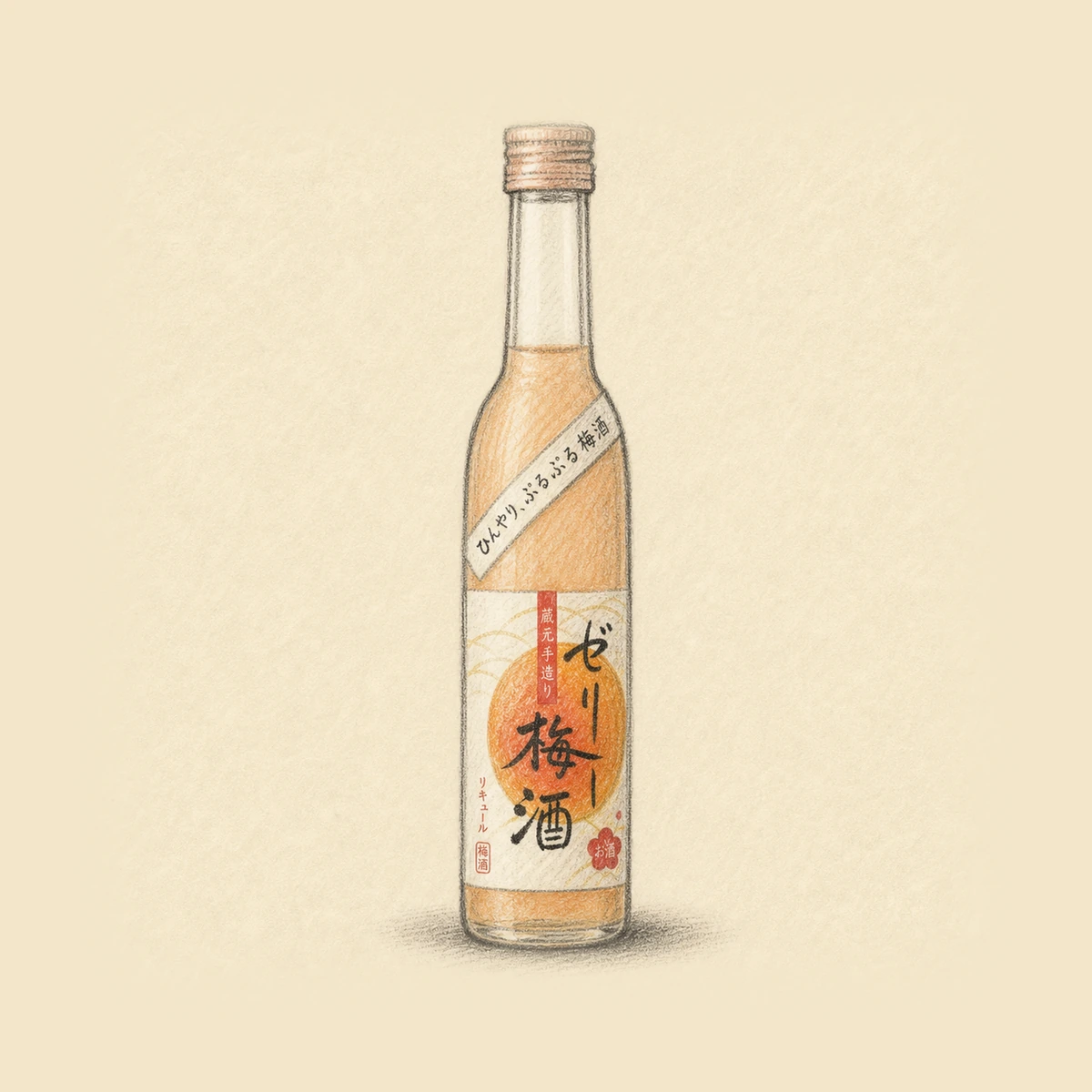
JELLY UMESHU
Umeshu made from ripe large ume and honkaku rice shochu is set into a jelly that loosens when shaken, turning one motion into a soft, pourable texture.
Thailand · Product information
Product information from Bacchus Global Co., Ltd., based in Bangkok, Thailand. About Bacchus Global
Shake-to-serve jelly umeshu
Turning umeshu into a jelly that loosens when shaken
Ripe large ume is infused in honkaku rice shochu, then set into a jelly that becomes pourable after the unopened bottle is shaken.
Infusing ripe ume in rice shochu
The aromatic spirit supports a peach-like expression of fully ripe ume.
Setting, then breaking, the texture
Tip the unopened bottle downward and shake gently; the size of the jelly pieces and the flow change with the motion.
Between a drink and a dessert
This still umeshu adds a visual and tactile experience that is completed in the glass.
Peach-like ripe ume, measured sweetness and a changing texture

Ripe ume recalls peach on the nose. The flavour is lightly sweet and refreshing, while the texture can move from softly jellied to almost fluid depending on the shake.
Question 1
Which spirit is used to steep the ume?
- Honkaku rice shochu
- Red wine
- Sake alone
Read the answer and explanation
Correct answer: A — Honkaku rice shochu
Ripe ume is steeped in honkaku rice shochu.
Question 2
Where is the large ripe ume grown?
- Only in Aomori
- In Oita and Fukuoka
- In Okinawa
Read the answer and explanation
Correct answer: B — In Oita and Fukuoka
The page names large ripe ume from Oita and Fukuoka.
Question 3
What makes the finish distinctive?
- Added carbonation
- Five years in cask
- A jelly texture that loosens when shaken
Read the answer and explanation
Correct answer: C — A jelly texture that loosens when shaken
The umeshu is set as jelly and becomes pourable after shaking.
Built around a changing texture and a peach-like aroma
The food affinities of Jelly Umeshu carry no official recommendation from the producer either. They are organised around the peach-like aroma of ripe ume, a restrained sweetness, and a texture that shifts from softly jellied to almost fluid, in four directions.
Food-pairing science notes that aromas close to peach or apricot tend to connect with fruit from the same family, or with starters carrying acidity and colour. Given the lower strength and restrained sweetness, the pairing leans toward light starters and small plates rather than heavier dishes.
Ikegame Shuzo, established in Kurume in 1875
Founded in Kurume, Fukuoka, in 1875, Ikegame Shuzo draws on its sake and honkaku-shochu craft for this jelly-textured umeshu, first released in 2007.
Related stories
Contact Bacchus Global for product documentation and trade information.