

Where Thai single malt and Japanese whisky intersect
“Can whisky really be made in Asia?”
This is the very question that was once posed to Japanese whisky. In 1923, when the Yamazaki Distillery began operations, many doubted whether authentic whisky could be produced anywhere outside Scotland. About a century later, Japanese whisky has become a regular at international competitions, and as of March 2026, it has even moved toward applying for Geographical Indication (GI) status. The number of distilleries across Japan has reached roughly 100.
Now, the same question is being directed toward Thailand. And the answer is emerging with quiet confidence.
A quiet milestone on the global stage
PRAKAAN, a single malt whisky produced by Prakaan Distillery in Kamphaeng Phet Province in central Thailand, won a Category Winner title at the World Whiskies Awards (WWA) 2026, marking its second consecutive year of recognition. The WWA, organized by the UK-based Whisky Magazine, is an international competition judged through blind tastings by experts. It evaluates the liquid itself, not the reputation of its origin or brand.
The award-winning Tribura Series draws inspiration from the ancient triple-layered fortifications of Kamphaeng Phet. The tropical climate enhances ester formation, resulting in aromas reminiscent of tropical fruits and honey.
Adapting to the tropical environment
Climate is a decisive factor in whisky maturation. In Japanese whisky, the seasonal temperature swings create dynamic interactions between cask and spirit, producing a distinctive complexity. Low winter temperatures slow maturation, while summer heat accelerates extraction from the cask. This natural rhythm has given Japanese whisky its signature balance of delicacy and depth.
Prakaan, however, faces entirely different conditions. In a tropical climate with an average temperature of 32°C (90°F), chemical reactions between cask and spirit proceed far more rapidly than in Scotland. Insights from Taiwan’s Kavalan Distillery suggest that one year of maturation in the tropics can equate to four to five years in Scotland. At Prakaan, the angel’s share—the evaporation loss from casks—reaches about 13% in the first year alone, compared to Scotland’s typical 2–3% annually. This highlights just how intensely the spirit and cask interact.
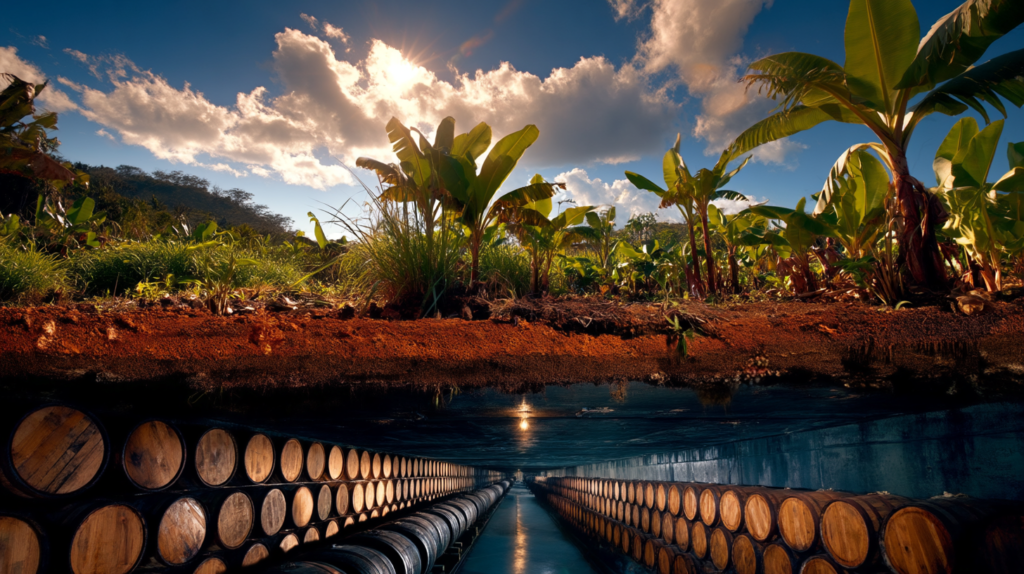
However, an accelerated pace requires careful mastery. Rapid maturation risks overwhelming the spirit with excessive cask influence, potentially disrupting its balance. To address this, the distillery developed a unique underground aging system. Maturation warehouses are built three meters below ground, with earth piled up to four meters high along the walls to stabilize temperature and humidity. The goal is to harness the vitality of the tropics while maintaining precise control. This carefully managed environment is what shapes Prakaan’s distinct character.
The name “Prakaan” means “wall” or “fortress” in Thai, referencing Kamphaeng Phet’s nickname, the “Diamond Wall.” The underground warehouse itself functions as a literal and symbolic barrier, protecting the maturing spirit from the extremes of the tropical climate.
Prioritizing maturity over numerical age
Another notable aspect is Prakaan’s maturation philosophy. Instead of stating an age on the label, the distillery relies on its blender to determine when the whisky has reached optimal maturity, bottling it at that precise moment.
Given the speed of tropical maturation, this approach is highly rational. The level of cask interaction equivalent to a 12-year Scotch can occur in less than three years in the tropics. Age, as a mere number, becomes less relevant when climate conditions differ so profoundly.
This non-age statement (NAS) philosophy is also gaining traction in the world of Japanese whisky. Amid long-term shortages of aged stocks, blending techniques that do not rely on age statements are being reevaluated. Rather than defining quality by years, the focus shifts to the completeness of the liquid itself. In this sense, Thai and Japanese producers, though driven by different circumstances, are arriving at a shared philosophy.
Perspectives from the Bangkok bar counter
For those in Bangkok’s hospitality scene serving sake, shochu, and Japanese spirits, this evolution is highly relevant. As guest interest shifts from “where it’s made” to “how it’s made,” the ability to speak across Asia’s diverse distilling cultures adds depth to conversations at the bar.
Japanese whisky draws on seasonal variation; Thai single malt manages tropical intensity through underground maturation. Both are rooted in Scottish techniques, yet shaped by their own climates into distinct identities. This narrative offers a compelling way to communicate the diversity of distilled spirits.
There are also clear institutional differences. In Japan, GI designation is helping formalize the definition of Japanese whisky. Thailand has yet to establish such a framework. However, the historical pattern, where quality gains recognition first and regulation naturally follows, echoes the evolution of GI development in sake.
The map of Asian whisky continues to evolve in fascinating ways. (Mr. Bacchus)
This article is intended solely to explore the distillation techniques and cultural heritage of PRAKAAN Distillery and the PRAKAAN brand, and does not aim to promote or encourage the consumption of alcohol. / บทความนี้จัดทำขึ้นเพื่อนำเสนอข้อมูลเกี่ยวกับเทคนิคการกลั่นและมรดกทางวัฒนธรรมของ PRAKAAN Distillery และแบรนด์ PRAKAAN เท่านั้น มิได้มีเจตนาเพื่อส่งเสริมหรือโฆษณาเครื่องดื่มแอลกอฮอล์ สำหรับผู้มีอายุ 20 ปีขึ้นไป โปรดดื่มอย่างรับผิดชอบ