

There’s one element we don’t talk about much, yet it’s crucial to the making of Champagne: the Champagne cellars.
When you walk through Champagne, there is what you see: its hillsides, its villages, its vineyards caressed by the wind and its winemakers who work there… But what we don’t see and yet is essential is what is happening underground.
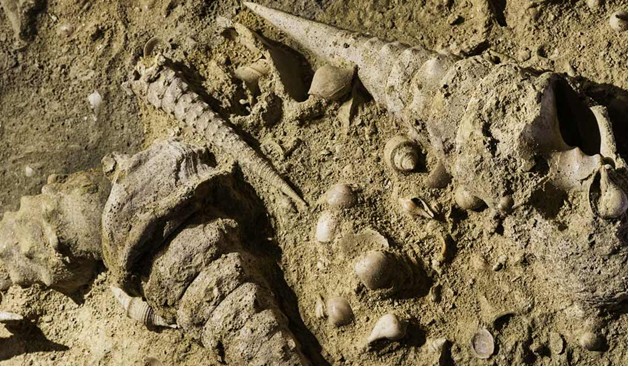
Let’s take a trip back in time to 90 million years ago. At that time, the oceans covered everything. Sediments (shells & rocky deposits) carried by the oceans are deposited on the bottom of what will become Champagne. They piled up to a thickness of 200 meters!
This limestone subsoil has many peculiarities that make it ideal for growing vines.
Since it is a fragmented material, it favours soil drainage. This offers very favorable conditions for the vine, which will always have the foot dry. It also helps to ripen the grapes.
Second feature, this limestone is made up of fragments of shells and marine micro-organisms, making it highly porous. This high porosity makes it a real water tank: it can hold between 300 to 400 liters per m3. This ensures that the vines have sufficient water supply, even in the driest summers.
Third particularity, it contributes, by its nature, to the production of champagne by providing the moderate, constant temperature in the cellars that are dug into it, which is necessary for the conservation of first fermentation wines and for the slow formation foam, an essential factor in quality. Nowhere in the world are the cellars as good as in Champagne.
From a level of 7 metres below the ground, the temperature is 10 to 12°, summer and winter, with a humidity of 90 to 100, with no condensation, as the limestone absorbs excess humidity.
The most famous are “Les Crayères”, which are the ancient stone quarries of the Romans, when, 2000 years ago, they built Durocortorum, – the name of the city Reims during the Roman era. There are around 250 of them.
(Dr. FX)