Drink
The Limits of “Carbon Neutral”
Wine Regions and the Philosophy of Regenerative Agriculture
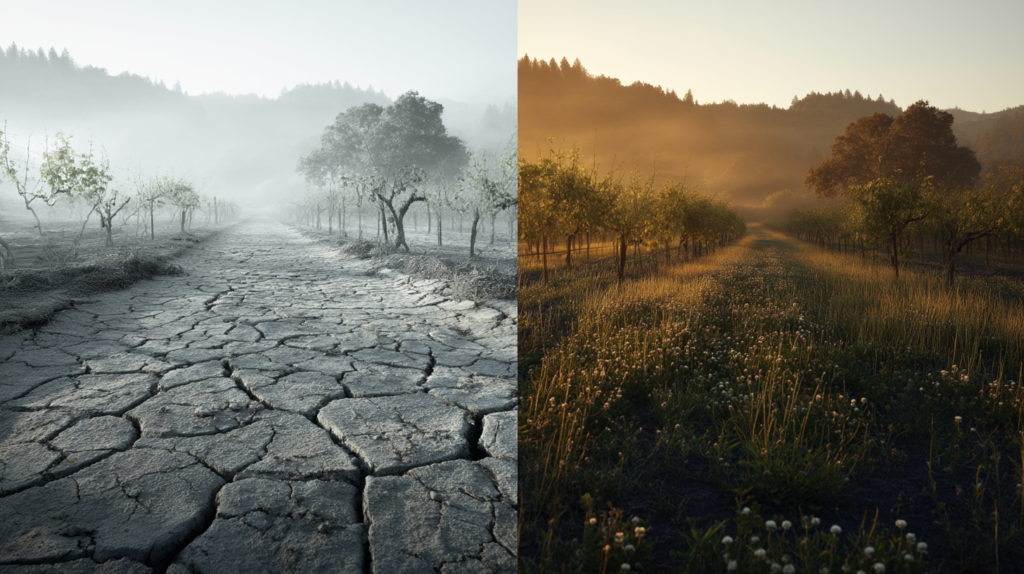
The Limits of “Carbon Neutral”, Wine Regions and the Philosophy of Regenerative Agriculture
As 2026 begins, a distinct phrase is quietly emerging on the labels of progressive wineries across Europe and North America. Alongside established certifications such as “Organic” and “Biodynamic,” the words “Regeneratively Grown” are now taking their place. Why has this term surfaced now? Fundamentally, it reflects a pressing realization: merely mitigating environmental impact is no longer sufficient.
“Carbon neutral” refers to achieving a net-zero balance of CO₂ emissions and absorption. It functions much like breaking even on a ledger|it prevents further debt, but does nothing to clear the historical deficit. The reality is that excessive CO₂ has already accumulated in our atmosphere. This is where the concept of “carbon negative” takes root. By fixing more CO₂ in the soil than is emitted, this approach actively reduces atmospheric carbon. It represents a profound paradigm shift, transforming wineries from passive victims of climate change into active participants in the solution.
A 2024 study published in the academic journal Nature Reviews Earth & Environment served as a sobering milestone for the industry. It predicted that if temperatures continue their current trajectory, grape cultivation could become unviable in as much as 70% of today’s established wine-producing regions. Even in historic appellations like Bordeaux, Tuscany, and the Napa Valley, structural shifts are already a reality: harvests arrive earlier each year, and grape sugar levels are climbing to unprecedented highs.
From “Reducing Harm” to “Reviving the Soil”
This is where regenerative agriculture finds its purpose. It is a holistic concept that encompasses organic farming|which abstains from synthetic pesticides and fertilizers|and biodynamics, which schedules farming work in line with the phases of the moon. At its core lies a fundamental inquiry: “Is the soil alive?”
In conventional agriculture, the heavy reliance on chemical inputs and the repeated tilling of the earth have severely depleted organic matter. Regenerative viticulture takes a restorative approach. Producers cultivate cover crops like clover and rye between vine rows, utilizing their root systems to anchor and protect the soil. They are adopting “no-till” methodologies to leave the earth undisturbed, fostering a subterranean environment where microorganisms can flourish, while returning vital nutrients through organic compost. Producers who have committed to these practices report remarkable transformations|soil once hardened like concrete has become porous and resilient, welcoming the return of earthworms and essential biodiversity.
In early 2026, the British trade publication The Drinks Business highlighted emerging debates within the industry regarding this movement. While some advocate for strict, formalized certification systems, others argue that because terroir and soil conditions differ so vastly across regions, uniform standards will not suffice. There is also a legitimate concern that chasing certification could become an end in itself, overshadowing the primary objective of genuine soil restoration. Yet, the very existence of this discourse proves that the movement has grown far too significant to ignore.
A Philosophy Shared by Koji and Soil: Creating Space for Microorganisms
While this may read as a purely viticultural discourse, it echoes a philosophy deeply familiar to those rooted in fermentation culture.
Countless invisible microorganisms inhabit the soil beneath our feet. Bacteria and fungi weave intricate networks, circulating nutrients and fixing carbon. The ultimate goal of regenerative agriculture is not for humans to micromanage these processes, but rather to curate an environment where microscopic ecosystems can thrive autonomously.
This mindset mirrors the relationship we share with koji. We do not “manufacture” koji mold; rather, it is a living organism that naturally takes root in grains like rice or soybeans. Sake, shochu, miso, and soy sauce are all realized through the quiet labor of koji. The foundational principle|cultivating an environment where microorganisms can act freely, and then stepping back to let nature take its course|seamlessly connects the worlds of traditional brewing and modern regenerative agriculture.
Within Bangkok’s premium wine market, interest in organic and natural wines has been growing year by year. Regenerative viticulture sits on this continuum, but its significance goes beyond consumer perceptions attached to terms such as “additive-free.” The focus here is the production philosophy behind how growers approach soil, biodiversity, and long-term environmental responsibility.
When the phrase “Regeneratively Grown” graces a label, it signifies far more than a new marketing credential. It is a fundamental reassessment of our relationship with the land. That shift in thinking is quietly beginning to change the values behind wine. (Mr. Bacchus)
This article is intended solely to explore the sustainable farming philosophies and cultural heritage of the contemporary wine world, and does not aim to promote or encourage the consumption of alcohol. / บทความนี้จัดทำขึ้นเพื่อนำเสนอข้อมูลเกี่ยวกับปรัชญาการเกษตรแบบยั่งยืนและมรดกทางวัฒนธรรมของโลกไวน์ร่วมสมัยเท่านั้น มิได้มีเจตนาเพื่อส่งเสริมหรือโฆษณาเครื่องดื่มแอลกอฮอล์ สำหรับผู้มีอายุ 20 ปีขึ้นไป โปรดดื่มอย่างรับผิดชอบ
Discover the culture behind every bottle
We share brewery stories, tasting notes and the craft of koji & fermentation | for educational and cultural purposes only.
เราถ่ายทอดเรื่องราวจากผู้ผลิต บันทึกรสชาติ และศาสตร์แห่งโคจิและการหมัก | เพื่อการศึกษาและวัฒนธรรมเท่านั้น
Follow on Instagram FacebookRelated Articles
“From the Soil Up” / “The 1924 Lectures and the Bangkok Wine List” / “Ah! Organic? Biodynamic? Nature? What are the differences?” / “Beyond the Niche”