Drink
Letting Sound Shape Shochu
A Small Distillery on Amami Oshima Takes on an Experiment
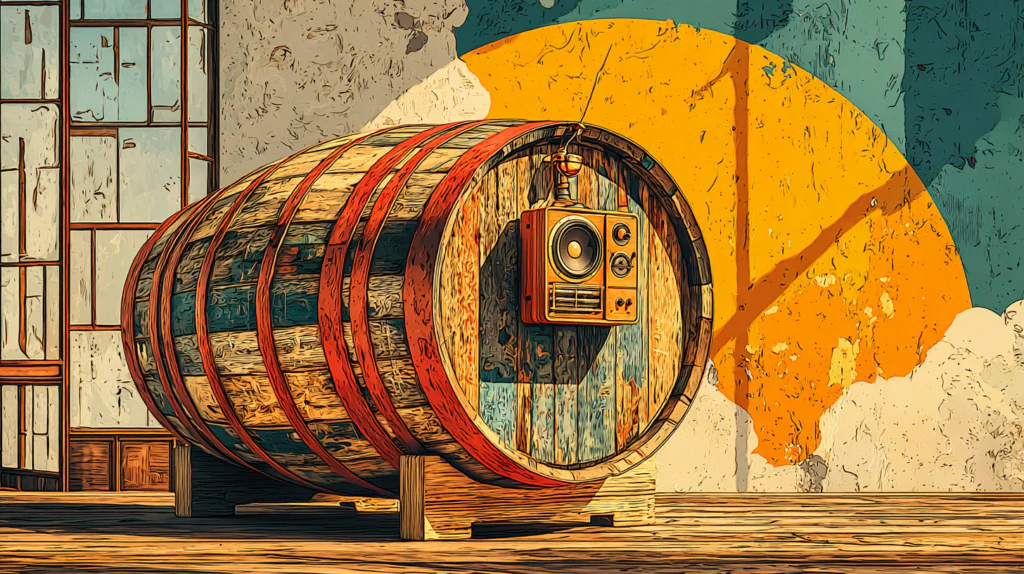
Attach speakers to a barrel. Then let the shochu rest for eight hours a day while music resonates through the cellar.
This is the unconventional aging process being carried out by Nishihira Distillery on Amami Oshima, an island in Kagoshima Prefecture in southern Japan. The project is called the “Nishihira Sonic Aging Project.”
House, reggae, hip-hop, Latin, rock, and traditional island folk songs known as shimauta | six genres in total. According to the distillery, shochu made from the same base spirit and produced in the same way develops noticeably different characteristics depending on the music it “listens” to.
A Small Distillery on a Small Island
The Amami Islands, where Amami Oshima is located, are the only region in Japan legally permitted to produce brown sugar shochu. Rooted in the island’s sugarcane culture, it is a distilling tradition found nowhere else.
Nishihira Distillery is a small, family-run operation that has spent 99 years crafting shochu on Amami Oshima. The company is now approaching its centennial.
Leading the distillery is fourth-generation owner Serena Nishihira. Faced with the question of how to carry the island’s long-standing shochu-making tradition into the next generation, she arrived at an unexpected idea: raising shochu through sound.
Can Music Change Flavor?
The distillery presents the influence of these vibrations on maturation as a hypothesis under investigation. Different genres create different vibrations, which travel through the barrels and into the liquid inside. Those vibrations, she believes, may alter how the shochu interacts with the wood, ultimately affecting its flavor and color.
In a 2024 interview, Nishihira reported darker color and a rounder character in the barrels exposed to rock and reggae.
She described the shimauta barrels as lighter in color and younger in character. These were observations during the experiment, not proof that a particular genre accelerates maturation.
This is less a scientifically proven process than an ongoing hypothesis. Still, the very idea that identical spirits might evolve differently through sound alone is enough to spark curiosity.
Small Enough to Experiment
Large distilleries face large-scale constraints. The more volume a producer handles, the harder it becomes to take risks.
A small island distillery, on the other hand, can try something as unconventional as “letting barrels listen to music” almost immediately.
Preserving tradition while freely reinterpreting it may sound contradictory, but Nishihira Distillery manages to do both at once. Built on a foundation shaped by nearly a century of history, the fourth generation continues to ask new questions without hesitation.
That openness may be something only a small distillery can achieve.
Toward the Next Century
Shochu aged with music may sound like a novelty, but underneath the experiment lies a simple and sincere desire: to help more people discover the unique spirits of Amami.
Shochu shaped by the island’s climate and culture now mingles with the rhythms of reggae and shimauta. Memories of the land and the sounds of the present come together inside a single barrel.
As it approaches its 100th anniversary, this small distillery is opening the door to its next century through an unexpected medium: sound. (Mr. Bacchus)
This article is intended solely to explore the distillation techniques and cultural heritage of Nishihira Shuzo and its sonic aging project, and does not aim to promote or encourage the consumption of alcohol. / บทความนี้จัดทำขึ้นเพื่อนำเสนอข้อมูลเกี่ยวกับเทคนิคการกลั่นและมรดกทางวัฒนธรรมของ Nishihira Shuzo และโครงการบ่มด้วยเสียงเท่านั้น มิได้มีเจตนาเพื่อส่งเสริมหรือโฆษณาเครื่องดื่มแอลกอฮอล์ สำหรับผู้มีอายุ 20 ปีขึ้นไป โปรดดื่มอย่างรับผิดชอบ
Discover the culture behind every bottle
We share brewery stories, tasting notes and the craft of koji & fermentation | for educational and cultural purposes only.
เราถ่ายทอดเรื่องราวจากผู้ผลิต บันทึกรสชาติ และศาสตร์แห่งโคจิและการหมัก | เพื่อการศึกษาและวัฒนธรรมเท่านั้น
Follow on Instagram FacebookRelated Articles
“The Invisible Spirit” / “The True Vernacular of the Land” / “A Parallel Spirit” / “Sushi and the Choice of Shochu” / “The Truth Behind “It Can Only Be Made in Amami””