Drink
A Masterpiece from a Legend Who Cannot Drink
Noguchi Naohiko Sake Institute “Organic Rice Junmai Ginjo Unfiltered Unpasteurized Genshu 2019”
Naohiko Noguchi is widely revered in Japan as the “god of sake brewing.” Born in 1932 in Ishikawa Prefecture as the third generation of a family of tōji (master brewers), he entered the sake world at 16 and became the tōji of Kikuhime at just 27 years old. As one of the legendary “Four Guardians” of the Noto tōji tradition, he has won gold medals at the Annual Japan Sake Awards 27 times, including 12 consecutive victories. He was recognized as a Contemporary Master Craftsman in 2006, awarded the Medal with Yellow Ribbon in 2008, and received the Commissioner for Cultural Affairs Award in 2023.
Unusually for a master brewer, Noguchi cannot tolerate alcohol; even a single serving is enough to intoxicate him. Recognizing this early on, he has never relied solely on his own palate. Instead, he has traveled tirelessly to restaurants, listening closely to patrons and continuously refining his understanding of taste through the voices of those who enjoy his sake.
The Culmination of a Legendary Tōji’s Career
In 2017, after a brief retirement, Noguchi opened a new brewery in Komatsu, Ishikawa, bearing his own name: Noguchi Naohiko Sake Institute. Conceived as a laboratory for passing on technique, philosophy, and the very spirit of sake brewing to the next generation, it stands as the culmination of a lifetime devoted to fermentation.
One of the bottles that announced the new brewery’s arrival to the world was the “Organic Rice Junmai Ginjo Unfiltered Unpasteurized Genshu 2019.”
Craftsmanship Defined by Three Demanding Elements
This sake is defined by three exceptionally demanding approaches to brewing.
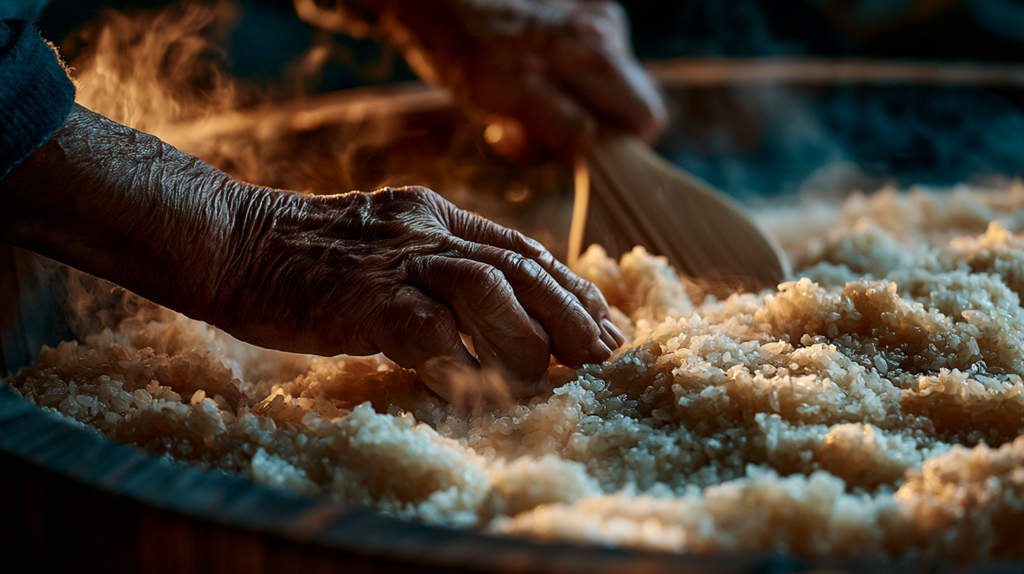
First, the rice. It utilizes JAS-certified organic Gohyakumangoku rice grown locally in Komatsu. Even today, breweries cultivating and utilizing certified organic rice for premium sake remain extremely rare in Japan.
Second, the production method. It is a muroka nama genshu—unfiltered, unpasteurized, and undiluted. The absence of heat pasteurization, filtration, and added water ensures that the brewer’s intent reaches the bottle in its absolute purest form.
Third, the aging process. The sake undergoes roughly three years of unpasteurized aging at near-freezing temperatures. Because namazake (unpasteurized sake) can deteriorate within days at room temperature, yeast activity must be controlled with extraordinary precision. Without elite-level fermentation management, commercial-scale aging of this nature would be nearly impossible.
The rice polishing ratio is 60%. Rather than polishing down to daiginjo levels of 50% or below, the brewery intentionally preserves the rice’s natural umami and depth. The alcohol content reaches 19%, giving the undiluted genshu a powerful structure and concentration. Finally, the bottle is sealed with a Czech-made Vinolok glass closure and wrapped in a UV-protective sleeve—a quiet testament to the brewery’s obsession with protecting the delicacy of unpasteurized sake through every stage of production.
A Sake That Transforms with Temperature
After three years of ice-temperature maturation, the sake retains a vivid freshness when served cold, evoking notes of green apple and Japanese citrus. As the temperature gently rises, richer layers begin to emerge—custard cream, mellow umami, and a deeply rounded texture born purely from maturation. It is an extraordinarily gastronomic sake that dramatically shifts its character depending on the serving temperature.
Arriving at Bangkok’s Tables
Because this is an unpasteurized nama sake, strict cold-chain transportation is essential to preserve its delicate profile all the way from Ishikawa to Thailand. This rigorous requirement means it can only be handled by a select few establishments capable of maintaining such uncompromising standards.
A bottle created by “the god of sake brewing,” combining organic rice with three years of ice-temperature namazakeaging—one of the most technically demanding approaches in modern sake production. Quietly, its story is now beginning to be told across the counters of Bangkok’s fine dining scene. (Mr. Bacchus)
This article is intended solely to explore the brewing philosophy and craft of Noguchi Naohiko and the Noguchi Naohiko Sake Institute, including the Junmai Ginjo Non-filter Nama-Genshu 2019 using JAS-certified organic Gohyakumangoku rice and three years of sub-zero nama-jukusei aging, and is not intended to promote or encourage the consumption of alcohol. / บทความนี้จัดทำขึ้นเพื่อนำเสนอข้อมูลเกี่ยวกับปรัชญาการผลิตและงานฝีมือของ Noguchi Naohiko และ Noguchi Naohiko Sake Institute รวมถึงสาเก Junmai Ginjo Non-filter Nama-Genshu 2019 ที่ใช้ข้าว Gohyakumangoku ออร์แกนิกที่ได้รับการรับรอง JAS และการบ่ม Nama-Jukusei ที่อุณหภูมิต่ำกว่าศูนย์เป็นเวลา 3 ปี เท่านั้น มิได้มีเจตนาเพื่อส่งเสริมหรือโฆษณาเครื่องดื่มแอลกอฮอล์ สำหรับผู้มีอายุ 20 ปีขึ้นไป โปรดดื่มอย่างรับผิดชอบ
Related Product(s)
NOGUCHI NAOHIKO Yume Zukuri / NOGUCHI NAOHIKO Junmai Non-filter Nama-Genshu 2024 / NOGUCHI NAOHIKO Junmai-Ginjo Non-filter Nama-Genshu Gohyakumangoku 2019 / NOGUCHI NAOHIKO Junmai-Daiginjo Yamadanishiki 2019 / NOGUCHI NAOHIKO 01 2019
Discover the culture behind every bottle
We share brewery stories, tasting notes and the craft of koji & fermentation — for educational and cultural purposes only.
เราถ่ายทอดเรื่องราวจากผู้ผลิต บันทึกรสชาติ และศาสตร์แห่งโคจิและการหมัก — เพื่อการศึกษาและวัฒนธรรมเท่านั้น
Follow on Instagram Facebook