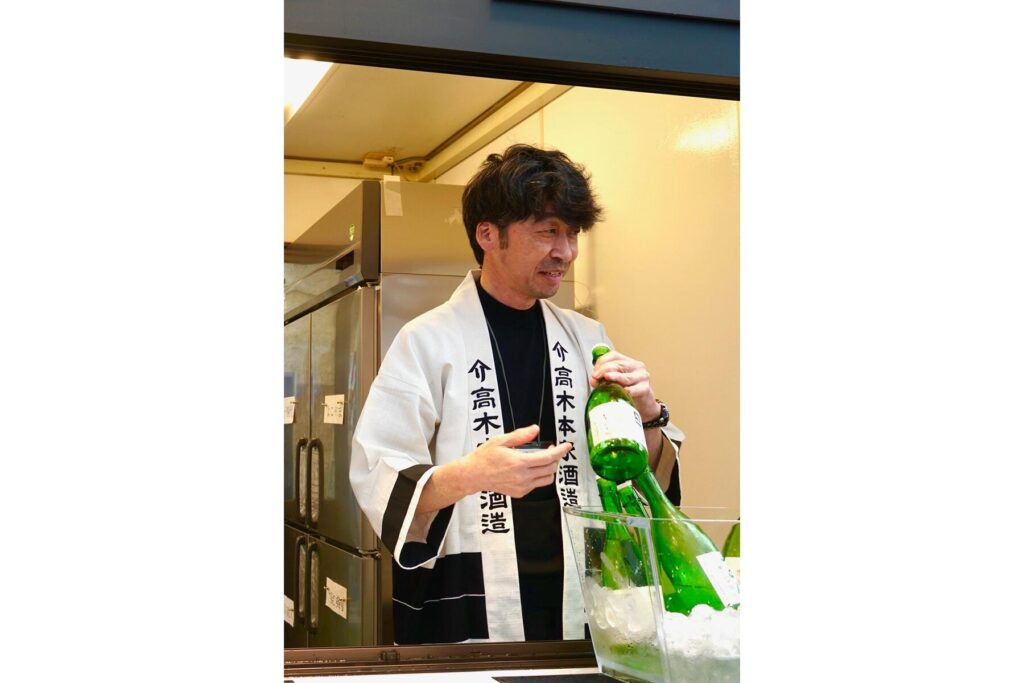
JUYONDAI (Takagi Shuzo) was featured in DANCHU!
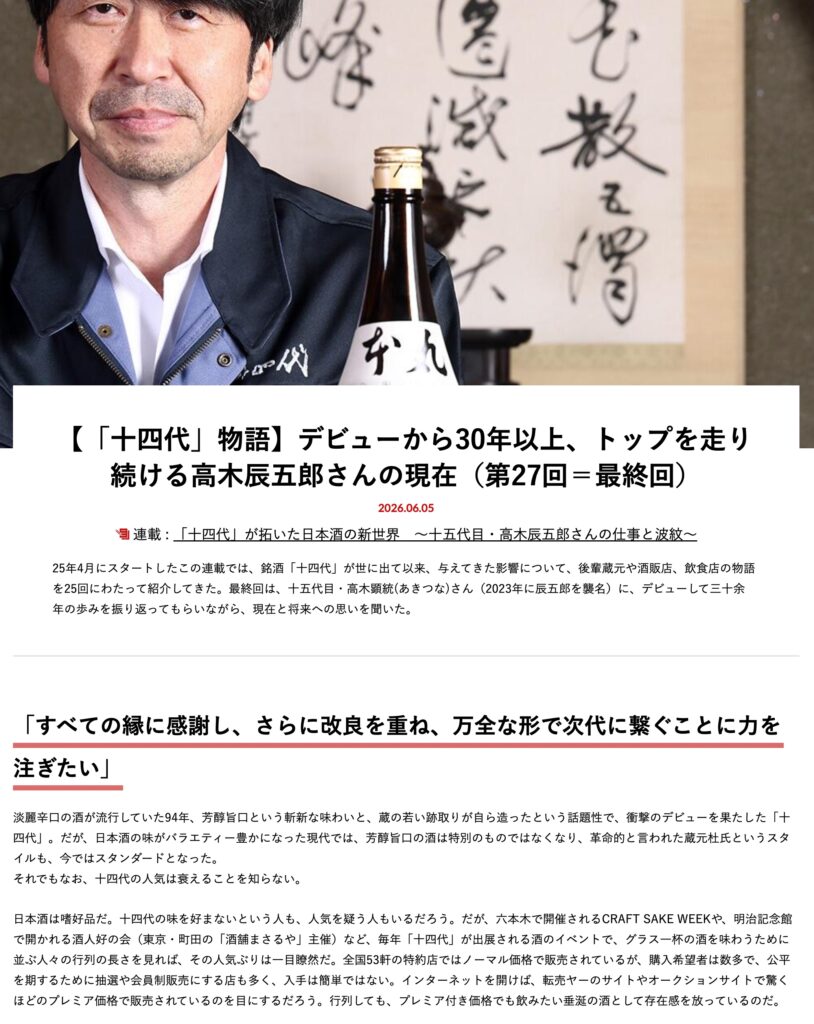
In 1994, when Tanrei Karakuchi (light and dry) sake was at the height of its popularity, “Juyondai” made a shocking debut. It captured immediate attention with its innovative Hojun Umakuchi (rich and flavorful) taste profile, combined with the buzz surrounding a young brewery heir crafting the sake himself. However, in today’s modern era where the flavors of Japanese sake have become richly varied, Hojun Umakuchi sake is no longer considered unusual. Furthermore, the style of a “Kuramoto-Toji” (a brewery owner who also serves as the master brewer), once hailed as revolutionary, has now become the industry standard.
Yet, despite these changes, the popularity of Juyondai shows no signs of waning.
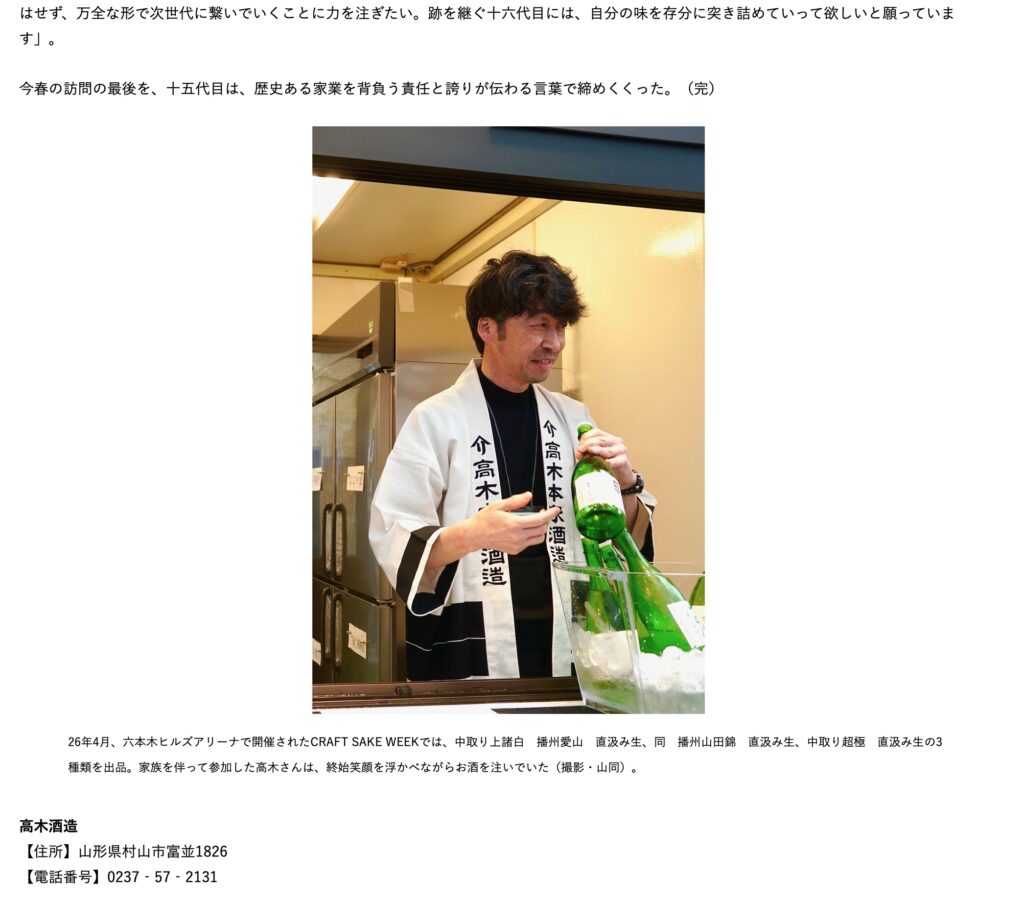
Sake is a luxury item of personal preference. There are undoubtedly those who may not favor the taste of Juyondai, as well as those who might question its immense popularity. However, its overwhelming status becomes instantly undeniable when observing the long lines of people waiting just to enjoy a single glass at annual sake events where Juyondai is showcased—such as CRAFT SAKE WEEK held in Roppongi, or the Saketoko no Kai (hosted by Shuho Masaruya in Machida, Tokyo) held at the Meiji Kinenkan.
While the sake is sold at standard retail prices across its 53 designated specialty shops nationwide, the number of hopeful buyers is vast. To ensure fairness, many stores operate via lotteries or membership-only sales, making it exceptionally difficult to obtain. If you look online, you will frequently see bottles listed at astonishingly high premium prices on reseller websites and auction platforms. It continues to command a powerful presence as a highly coveted sake that people are eager to drink, whether it means standing in long lines or paying a premium price.
This immense presence applies equally to the brewery owner, Mr. Takagi.
“I feel that Mr. Takagi radiates a truly special aura. At gatherings where brewery owners assemble, when Mr. Takagi walks through, everyone instantly steps aside to clear a path. It was just like the legend of Moses parting the sea,” recalls Takamichi Ishihara, the Kuramoto-Toji of “Ouroku” (Shimane Prefecture), with an expression of deep respect.
More than three decades since its debut, how has Juyondai managed to continuously run at the very front of the pack?
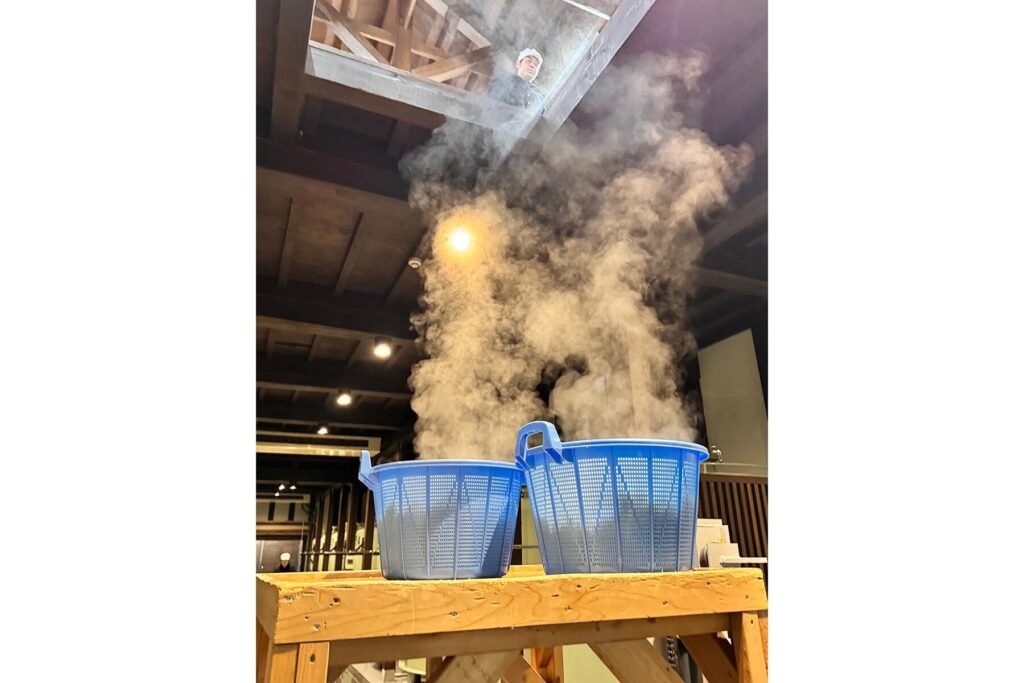
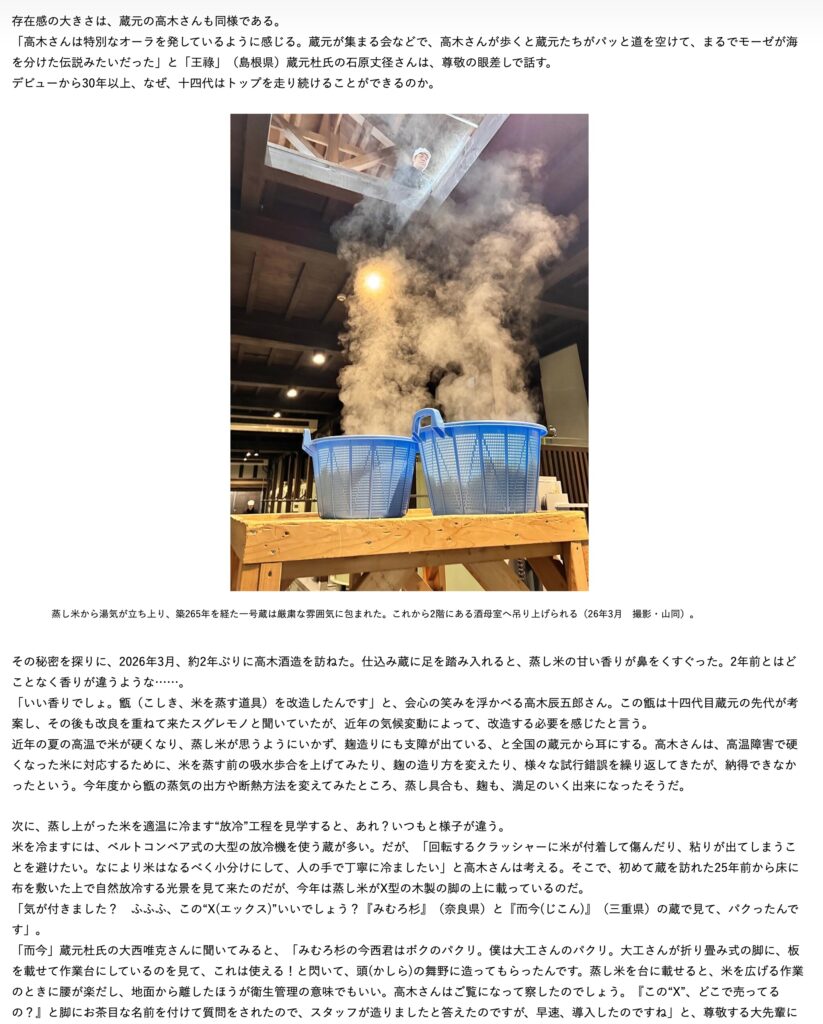
To uncover this secret, I visited Takagi Shuzo in March 2026, about two years after my last visit. Stepping into the brewing house, the sweet aroma of steamed rice gently greeted my senses. Yet, the fragrance felt somehow different from two years ago…
“Beautiful aroma, isn’t it? We modified our koshiki (the traditional wooden vessel used for steaming rice),” said Tatsugoro Takagi, with a thoroughly satisfied smile. I had heard that this particular koshiki was an exceptional piece of equipment originally devised by the 14th-generation head and continually refined over the years. However, Takagi explained that recent climate changes had made further modifications necessary.
Brewers across the country have reported that the high summer temperatures in recent years have caused rice grains to become harder, disrupting the steaming process and subsequently affecting the koji production. In response to these heat-damaged, hard rice grains, Takagi had repeatedly gone through various trials and errors—such as increasing the water absorption ratio before steaming and altering the koji-making techniques—yet none had yielded fully satisfying results. This brewing season, however, after changing the steam distribution and insulation methods of the koshiki, both the steaming quality and the koji achieved a highly satisfactory finish.
Next, I observed the “horei” (cooling) process, where the steamed rice is brought down to the ideal temperature, only to notice another change in the scenery.
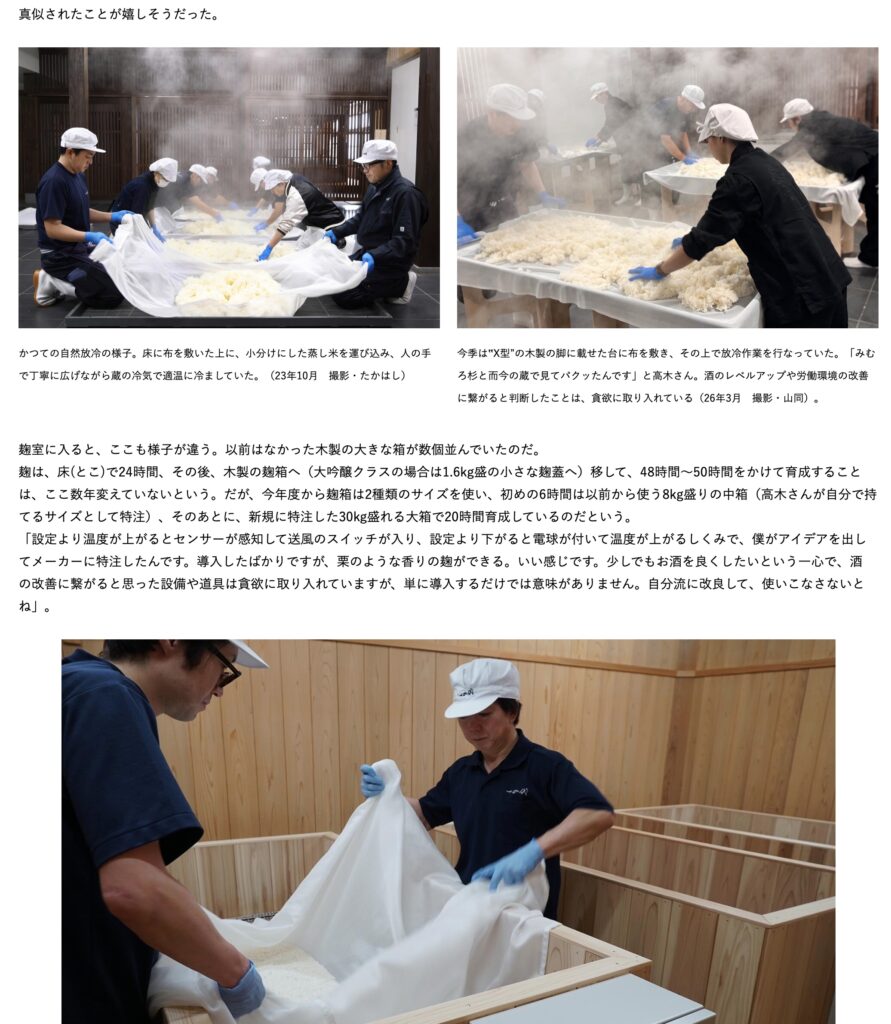
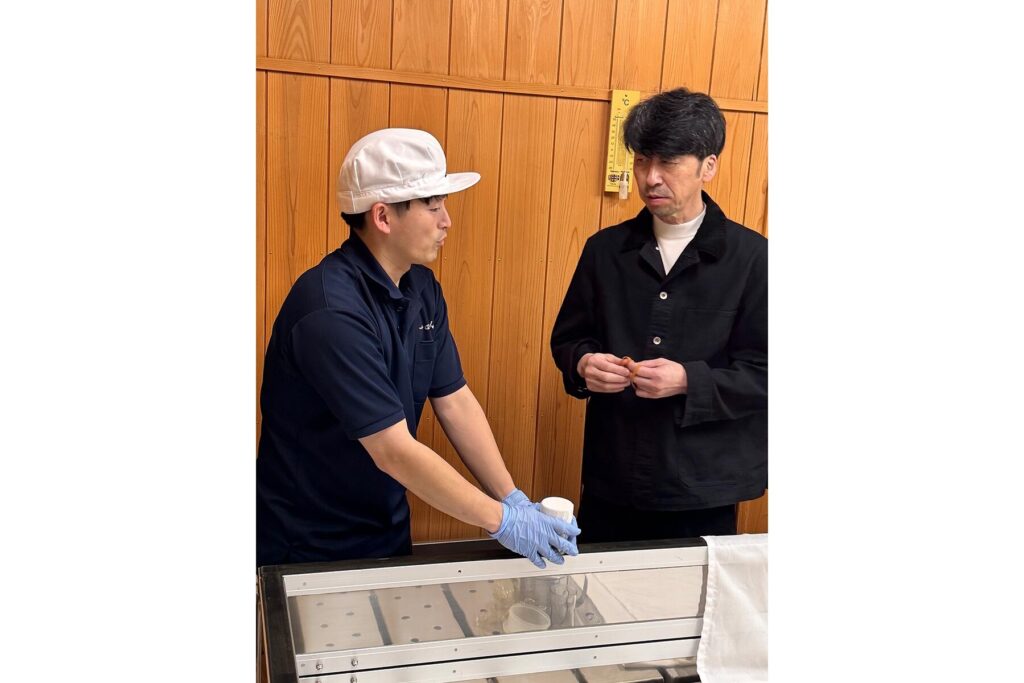
While many breweries utilize large, belt-conveyor-type cooling machines to cool their rice, Takagi holds a different philosophy: “I want to avoid the rice sticking to rotating crushers, which can damage the grains or create unwanted stickiness. Above all, I believe rice should be divided into small portions and carefully cooled by human hands.” Consequently, ever since my first visit to the brewery 25 years ago, I had always witnessed the natural cooling process being done directly on cloths spread across the floor. This year, however, the steamed rice was placed on tables supported by X-shaped wooden legs.
“You noticed? Fufufu, this ‘X’ is brilliant, isn’t it? I saw it at the ‘Mimurosugi’ (Nara Prefecture) and ‘Jikon’ (Mie Prefecture) breweries, and I copied it.”
When I asked Tadachika Onishi, the Kuramoto-Toji of “Jikon,” he shared the backstory with a look of delight: “Imanishi-kun from Mimurosugi actually copied me, and I copied a carpenter. I saw a carpenter using a folding stand with a board on top as a workbench and had a flash of inspiration: ‘This could work!’ So, I had our brewery leader, Maino, build one. Placing the steamed rice on a raised stand makes the work much easier on the lower back when spreading the rice, and keeping it off the ground is also far better for hygiene management. Mr. Takagi must have instantly grasped the value of it upon seeing it. He playfully asked me, ‘Where do they sell this “X”?’ giving the stand a charming name. When I told him our staff made it themselves, he went ahead and implemented it right away.” Onishi seemed genuinely happy to have been emulated by the senior master he so deeply respects.
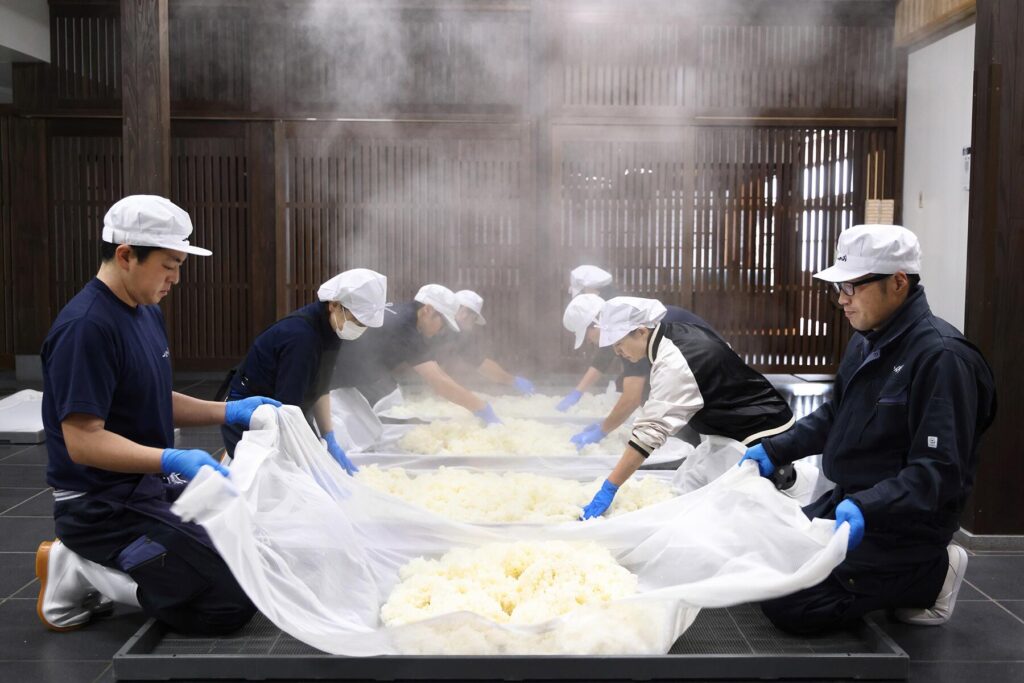
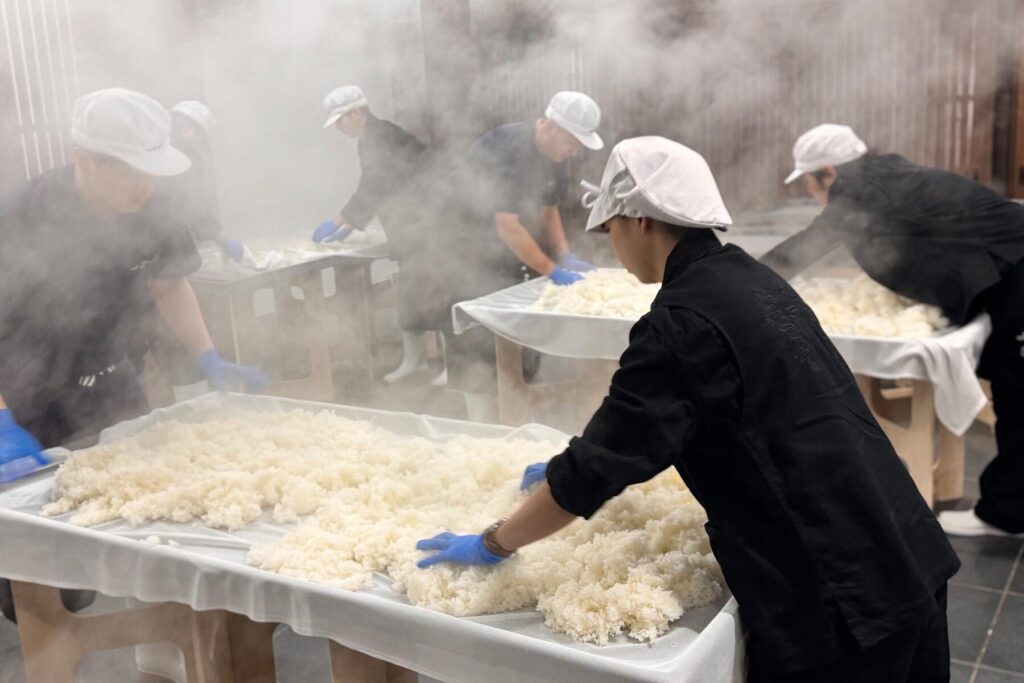
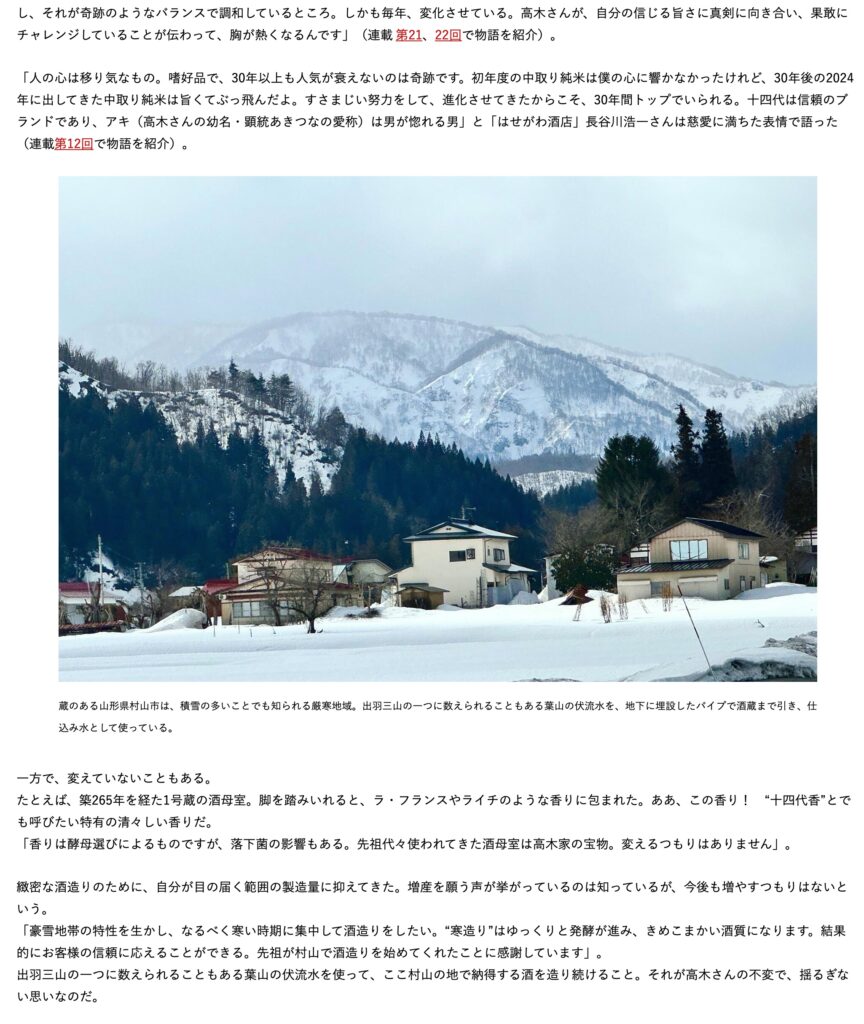
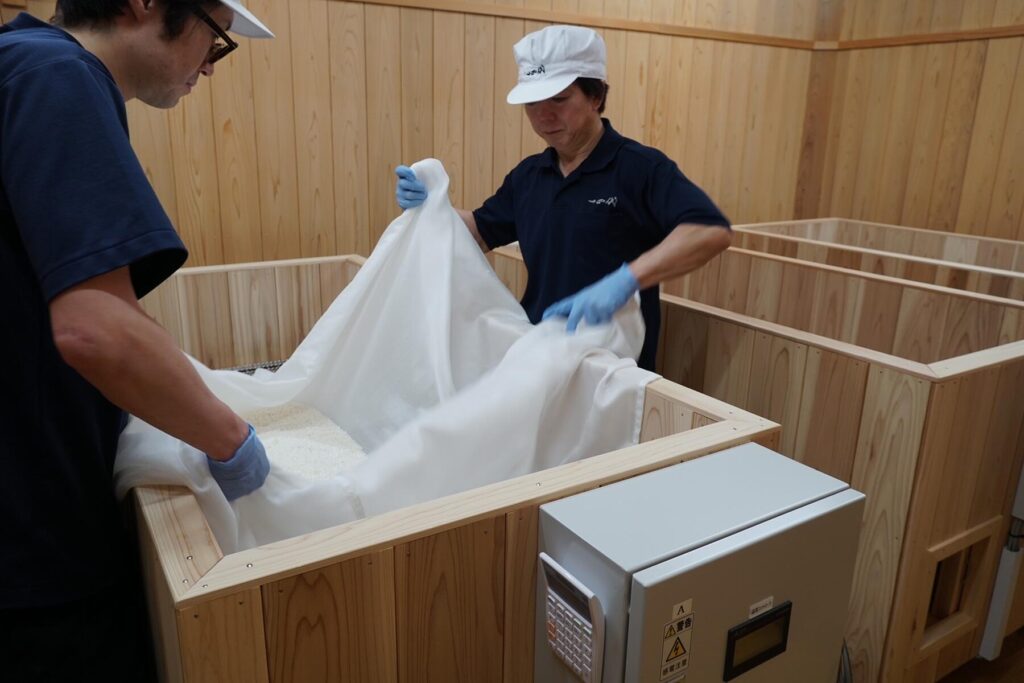
Entering the koji-muro (koji inoculation room), I noticed the scenery here had changed as well. Several large wooden boxes that had not been there before were lined up.
I was told that the fundamental timing for propagating the koji has remained unchanged for the past several years: it spends 24 hours on the toko (a large raised bed) before being transferred to wooden koji boxes (or into small koji-butatrays holding 1.6 kg for Daiginjo-class sake) to mature over a span of 48 to 50 hours. However, starting this brewing season, they have begun utilizing two different sizes of koji boxes. For the first 6 hours, the rice is placed in the previously used medium-sized boxes that hold 8 kg (custom-ordered to a size Mr. Takagi can lift by himself). After that, it is transferred to newly custom-ordered large boxes that can hold 30 kg, where it matures for the remaining 20 hours.
“It’s a system where sensors detect when the temperature rises above the set level to turn on the ventilation, and when it drops below the setting, electric bulbs turn on to raise the temperature. I came up with the idea and custom-ordered it from the manufacturer,” Tatsugoro Takagi explained. “We’ve only just introduced it, but it produces koji with a beautiful, chestnut-like aroma. It’s working quite well. Driven solely by the desire to make our sake even slightly better, I greedily adopt any equipment or tools that I believe will lead to improvement. However, simply introducing them is meaningless. You have to modify them in your own style and truly master how to use them.”
It is not only the equipment that is updated every year.
Take the rice, for example. In its second year after debuting, “Honmaru” (originally a Honjozo style) sent shockwaves through the industry with its incredible cost-performance, priced at under 2,000 yen per 1.8-liter bottle. At the time, it was brewed using Miyamaniki rice. However, through continuous experimentation with various sake rice varieties each year, Mr. Takagi concluded that Yamada Nishiki for the koji-mai (rice used for making koji) and Aiyama for the kake-mai (rice added to the mash) yielded the absolute best results. Consequently, he upgraded the ingredients to these expensive varieties, which are typically reserved for ultra-premium Daiginjo sake. Beyond the rice, every single element—including yeast selection, water absorption, steaming, koji production, moromi mash management, down to the smallest tools and even the staff uniforms—is reevaluated every year. Unbound by preconceived notions, he has consistently made bold and decisive changes.
“I never think, ‘This year went well, so this is good enough.’ I always believe there is a higher level to be reached. The peak is always what I aim for. I simply hate to lose,” says Mr. Takagi. No matter how immense his popularity becomes, he never retreats into a defensive posture; he continuously stays on the offensive.
The brewing season for this period spanned from the hatsu-arai (the very first rice washing) on September 15, 2025, to the kaizo (the completion of all brewing for the season) on April 25, 2026, totaling a production of 130 tanks. Yet, the end of the brewing season does not mean “time off.” Instead, it marks the period for planning capital investments for the upcoming season, analyzing the brewing results, and focusing on employee welfare.
“Once brewing begins, you just run at full speed according to the plan. But during the summer months when we aren’t brewing, there is so much to contemplate. It is a period filled with many anxieties. Yet, I absolutely love finding ways to innovate, so it is also a time of pure bliss. I want to spend 24 hours a day, 365 days a year, thinking about nothing but sake brewing.”
Tetsuya Doi, the Kuramoto-Toji of “Hoken,” makes it a point to taste Juyondai whenever the opportunity arises to monitor its evolution. He shares: “Sake with a sweet profile tends to lose its structure and become flabby, but Juyondai maintains a magnificent balance. Its level of perfection makes you want to bow down in reverence, and what’s more, you can truly feel that it is changing and evolving year after year. Even though Mr. Takagi is a superstar, he is still aiming even higher.” Doi notes that drinking Juyondai serves as a powerful wake-up call for his own brewing.
Yuichi Tanaka of “Nifudazake,” who was inspired to enter the world of sake brewing after experiencing a profound sense of awe upon drinking “Juyondai” Junmai Ginjo Omachi, expresses a similar sentiment: “Whenever I taste it thinking I might have moved a fraction closer to Juyondai, I am utterly crushed to realize it remains a presence far, far beyond my reach. The greatness of Juyondai lies in how a multitude of diverse flavors exist in complex layers, yet harmonize in a miraculous balance. Moreover, it changes every year. Seeing how seriously Mr. Takagi confronts his own vision of deliciousness and how courageously he takes on challenges truly warms my heart.”
“Human hearts are fickle. For a luxury item to maintain undiminished popularity for over 30 years is nothing short of a miracle. To be honest, the ‘Nakadori Junmai’ from the inaugural year didn’t resonate with me, but the ‘Nakadori Junmai’ he produced 30 years later in 2024 was so delicious it blew me away. It is precisely because he has put in staggering effort and continuously evolved the sake that he has been able to stay at the top for 30 years. Juyondai is a brand built on absolute trust, and Aki (Mr. Takagi’s childhood nickname, short for Akituna) is a man that other men truly admire,” says Koichi Hasegawa of “Hasegawa Saketen,” with an expression filled with deep affection.
On the other hand, there are things that remain completely unchanged.
One example is the shubo-shitsu (yeast starter room) inside the No. 1 Brewery, which has stood for 265 years. Stepping inside, one is instantly enveloped in an aroma reminiscent of La France pears and lychees. Ah, this very fragrance! It is that uniquely refreshing aroma that one cannot help but call the “Juyondai fragrance.”
“While the aroma is a result of our yeast selection, it is also influenced by the resident microflora of the brewery,” Mr. Takagi explained. “This yeast starter room, utilized by my ancestors for generations, is a treasure of the Takagi family. I have no intention of changing it.”
To maintain the meticulous precision of his sake brewing, he has intentionally restricted production volume to a scale he can personally oversee. Though he is well aware of the widespread demand for increased production, he has no plans to expand in the future.
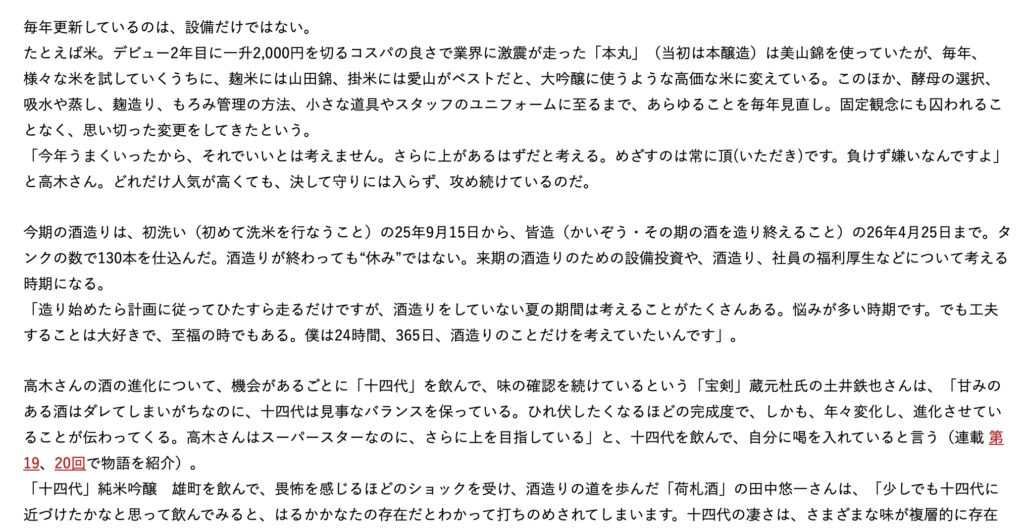
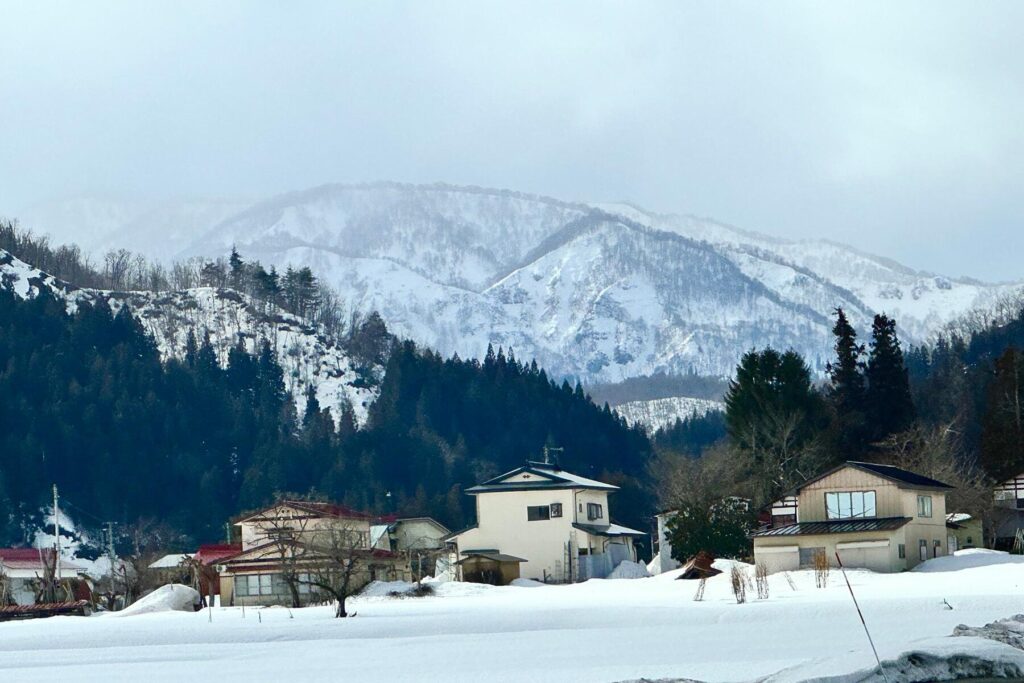
“Taking advantage of the characteristics of this heavy snowfall region, I want to concentrate our sake brewing as much as possible during the coldest months. This traditional kan-zukuri (winter brewing) allows fermentation to progress slowly, resulting in a sake quality with a remarkably fine texture. Ultimately, this is how we can honor the trust of our customers. I am deeply grateful to my ancestors for choosing Murayama to begin brewing sake.”
To continue crafting sake that brings personal satisfaction here in the land of Murayama, using the pristine underflow water of Mount Hayama—often counted among the Three Mountains of Dewa. That is Mr. Takagi’s immutable and unwavering conviction.
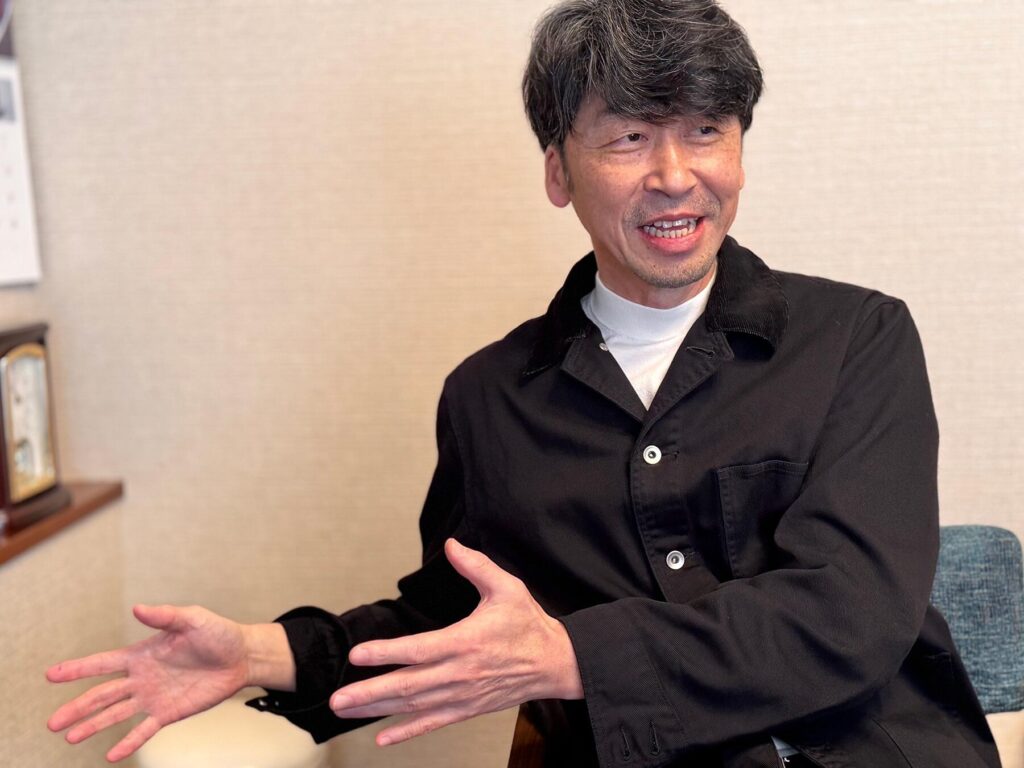
The conceptual image of the sake flavor he aims to achieve has also remained unchanged since his debut.
In 1993, when light and dry Tanrei Karakuchi sake dominated the trends, Mr. Takagi’s goal was to express through sake the sweet aroma of steamed rice that used to waft through the brewery during his childhood, as well as the natural sweetness and umami felt when chewing rice. He states that this core desire remains immutable even today.
“While keeping the fundamental principle of expressing the umami of rice unchanged, I am continuously taking on bold challenges. However, because we are dealing with living microorganisms, things rarely go exactly as planned. I have made countless mistakes, but each time I fail, I ponder, reflect, and make adjustments. Year after year, it is a repetition of that exact process.”
One wonders what kind of sake Mr. Takagi refers to as a “failed batch.”
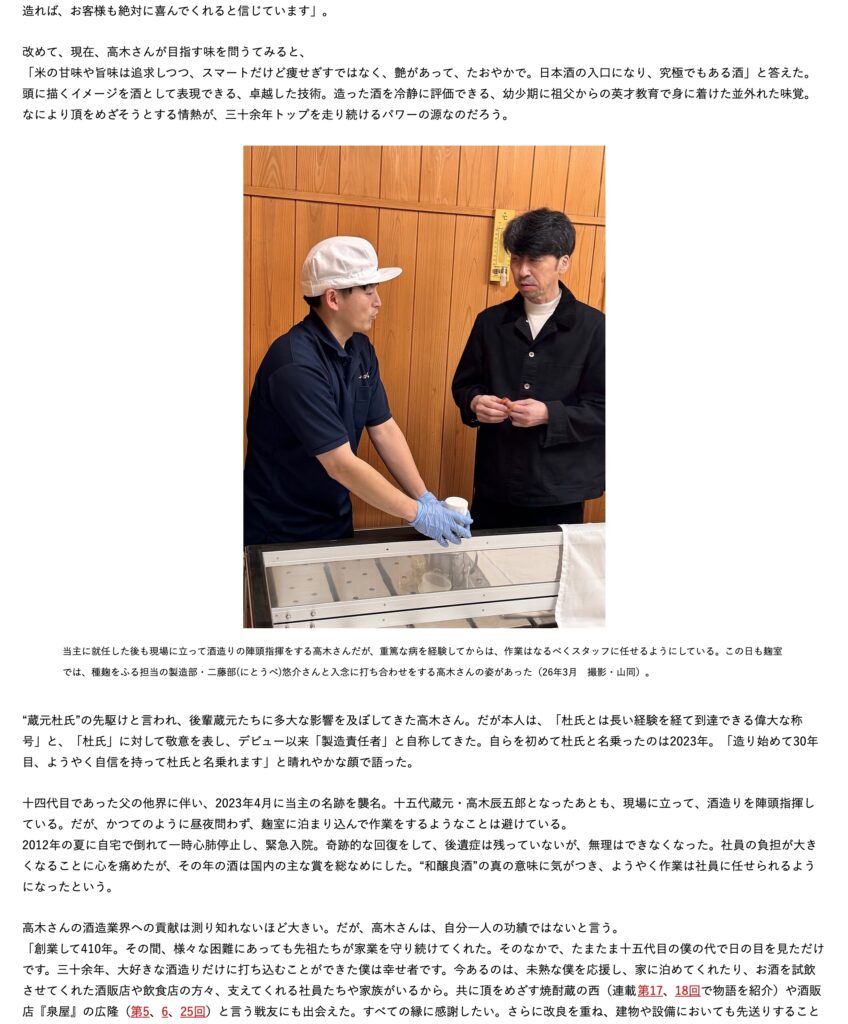
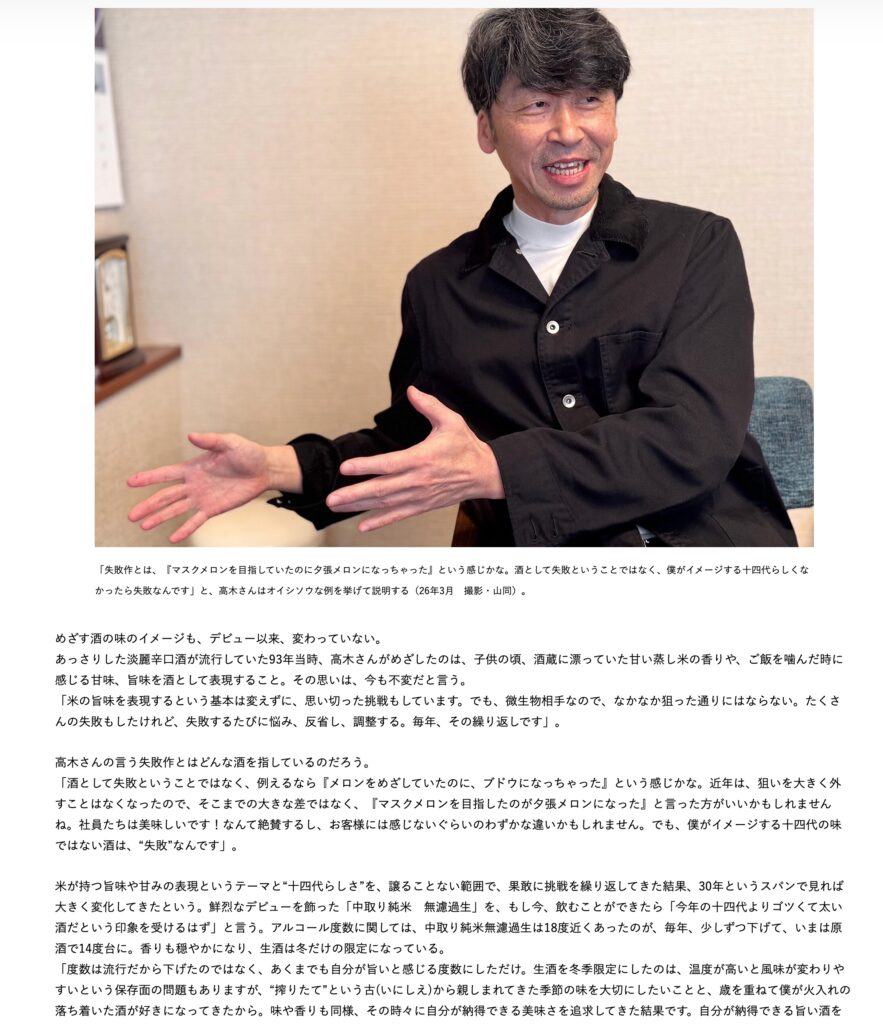
“It doesn’t mean a failure as a drink, but to use an analogy, it’s like ‘aiming for a melon but ending up with grapes instead.’ In recent years, we no longer miss our target by such a wide margin, so the difference isn’t that drastic. It might be more accurate to say, ‘I aimed for a musk melon, but it turned into a Yubari melon instead.’ My staff will rave about it, saying it’s delicious, and it may be a subtle variance that customers wouldn’t even notice. However, any sake that does not align with the exact image of Juyondai’s flavor in my mind is a ‘failure.'”
By courageously and repeatedly taking on challenges within an uncompromising framework defined by the theme of expressing the rice’s inherent umami and sweetness along with its “Juyondai identity,” the sake has evolved significantly over a span of 30 years. He notes that if one were to drink the “Nakadori Junmai Muroka Nama” that marked his brilliant debut today, “you would likely get the impression that it is a rougher, bolder sake compared to this year’s Juyondai.” Regarding the alcohol content, while the original debut sake stood at nearly 18%, it has been lowered little by little each year, and now stands in the 14% range even as a genshu (undiluted sake). The aroma has also become more serene, and the namazake (unpasteurized sake) has been limited exclusively to the winter season.
“I didn’t lower the alcohol content because it was a trend, but strictly because that was the percentage where I personally felt it tasted the most delicious. Restricting the namazake to the winter season partly comes down to preservation concerns, as higher temperatures can easily alter its flavor profile. However, it also stems from my desire to cherish the traditional, seasonally appreciated taste of ‘freshly pressed’ sake, combined with the fact that as I have aged, I have grown to prefer the settled quality of pasteurized sake. The same applies to the flavor and aroma—it is all the result of pursuing a deliciousness that leaves me fully satisfied at that specific moment in time. I believe that if I craft a sake that truly satisfies myself, our customers will absolutely rejoice in it as well.”
When asked once more about the flavor profile he currently aspires to achieve, he replied:
“While continuously pursuing the sweetness and umami of the rice, it should be elegant and sleek, yet never thin; it must possess a radiant gloss and a graceful suppleness. A sake that serves as the perfect gateway to Japanese sake, while simultaneously representing its ultimate pinnacle.”
An exceptional technique capable of translating a mental blueprint directly into a fluid masterpiece. An extraordinary palate, nurtured since childhood through rigorous education from his grandfather, allowing him to calmly evaluate the sake he brews. Above all, his burning passion to always reach for the absolute peak is the ultimate source of power that has kept him running at the very front for over thirty years.
Hailed as a pioneer of the Kuramoto-Toji (brewery owner-master brewer) style, Mr. Takagi has exerted an immense influence on younger generations of brewers. Yet, holding the title of “Toji” in the highest regard as a magnificent designation that can only be attained through long years of experience, he consistently referred to himself simply as the “Head of Production” ever since his debut. It was not until 2023 that he first claimed the title of Toji for himself. “Entering my 30th year of brewing, I can finally call myself a Toji with confidence,” he shared with a radiant and clear expression.
Following the passing of his father, who was the 14th-generation head, he succeeded to the family’s historic name in April 2023, becoming the 15th-generation brewery owner, Tatsugoro Takagi. Even after inheriting this mantle, he continues to stand on the front lines, personally commanding the sake brewing process. However, he now avoids his past practice of staying overnight in the koji-muro (koji room) to work relentlessly day and night.
In the summer of 2012, he collapsed at home, suffered temporary cardiac arrest, and was rushed to emergency hospitalization. He made a miraculous recovery with no lasting aftereffects, but he could no longer push his body past its limits. Though it pained his heart to place a heavier burden on his employees, the sake produced that year swept nearly all major domestic awards. It was then that he realized the true meaning of Wajo Ryoshu—the philosophy that harmony among people breeds fine sake—and he finally felt able to delegate the hands-on brewing tasks to his staff.
Mr. Takagi’s contributions to the sake industry are immeasurably vast. Yet, he insists that this success is not his achievement alone.
“Our brewery has stood for 410 years. Throughout that time, facing various hardships, my ancestors continuously protected the family business. Within that long history, it just so happened to be during my time as the 15th generation that we saw the light of day. Being able to devote myself entirely to the sake brewing I love so much for over thirty years makes me an incredibly fortunate man. Where I stand today is entirely thanks to the sake retailers and restaurant owners who supported an inexperienced version of me, welcomed me into their homes, and tasted my sake, as well as the employees and family members who sustain me. I was also blessed to meet true comrades-in-arms who aim for the same peak: Nishi from the shochu distillery, and Hirotaka from the sake retail shop ‘Izumiya.’ I want to express my deepest gratitude for every single one of these connections. Moving forward, I want to focus my efforts on implementing further refinements, leaving no investments in our buildings or equipment deferred, and passing everything down to the next generation in absolute, perfect condition. It is my sincere hope that the 16th generation, who will succeed me, will thoroughly and freely pursue their own vision of flavor.”
The 15th-generation head concluded this spring visit with words that profoundly conveyed the immense responsibility and pride of carrying a historic family legacy on his shoulders.