

A Three-Dimensional Pairing Born from “Almost Zero Residual Sugar”
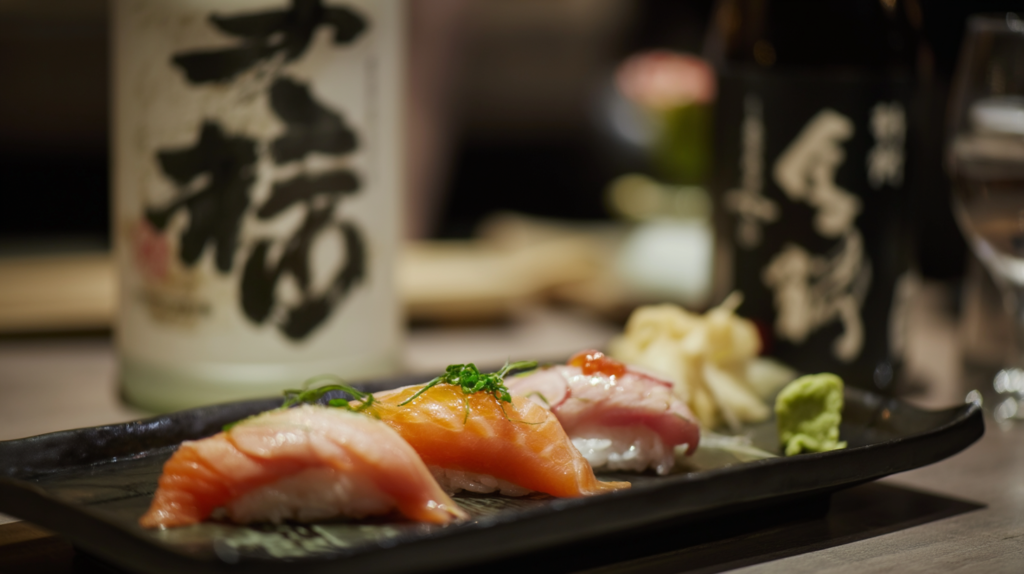
When envisioning a pairing for sushi, thoughts naturally drift toward sake. Yet in Miyazaki, a region revered as the kingdom of shochu, artisans offer an alternative perspective: shochu belongs at the sushi counter.
At a storied sushi establishment, a curation of shochu pairings presented by these Miyazaki distillers revealed the profound, often overlooked potential of this distilled spirit as a companion to fine dining.
The Striking Clarity of “Almost Zero Residual Sugar”
Crafted through the fermentation of rice, barley, or sweet potatoes followed by meticulous distillation, shochu leaves behind virtually all residual sugars. Unlike sake or wine, it possesses a structural dryness that allows its intrinsic aromas to step forward, unburdened by sweetness.
Distillers note that this near-total absence of residual sugar is precisely what makes shochu an exceptional partner for sushi. Without a blanket of sweetness, it respects the delicate umami of the neta (toppings). The aroma subtly mirrors the dish, while the clean finish sharpens the contours of each flavor profile.
A Shared Chemistry: Soy Sauce and Shochu
A deeper, more fascinating connection lies in the Maillard reaction.
This chemical interplay between amino acids and reducing sugars during heating or aging yields deeply savory, roasted aromas. It is the very process that grants high-quality soy sauce its rich bouquet. Remarkably, certain shochus mirror these roasted notes, a result of thoughtful ingredient processing and patient maturation.
Consequently, the soy sauce gracing the sushi and the shochu in the glass share an olfactory vocabulary. When they meet on the palate, they do not compete; instead, they harmonize. Altering the serving temperature or adjusting the dilution can illuminate this shared nuance even further.
Redefining the Craft: Miyazaki’s Modern Distilleries
This versatility is driven by the quiet evolution unfolding within Miyazaki’s historic distilleries.
Pioneers such as Kuroki Honten and its Osuzuyama Distillery, Yanagita Distillery, and Watanabe Distillery are crafting contemporary expressions that range from vibrant, fruity profiles to crisp, diaphanous textures. They are gently dismantling the archaic notion that all shochu tastes the same. By varying artisanal ingredients, distillation techniques, and maturation vessels, each house brings forth a distinct philosophy, infinitely expanding the horizons of food pairing.
An Evolving Dialogue at Bangkok’s Sushi Counters
Bangkok has established itself as one of the world’s most sophisticated and competitive destinations for fine sushi. Alongside curated wine and sake lists, shochu is quietly positioning itself as an intellectual alternative for pairing.
A spirit that elevates gastronomy through pure aroma rather than residual sugar. As global discerning palates cast a fresh eye on Japanese craft spirits, the reappraisal of shochu at the sushi counter is poised to deepen—fluidly weaving its way into Bangkok’s luxury dining narrative. (Mr. Bacchus)
This article is intended solely to explore the culinary science and cultural context of pairing shochu with sushi, and does not aim to promote or encourage the consumption of alcohol. / บทความนี้จัดทำขึ้นเพื่อนำเสนอข้อมูลเกี่ยวกับวิทยาศาสตร์การจับคู่อาหารและบริบททางวัฒนธรรมของการจับคู่โชจูกับซูชิเท่านั้น มิได้มีเจตนาเพื่อส่งเสริมหรือโฆษณาเครื่องดื่มแอลกอฮอล์ สำหรับผู้มีอายุ 20 ปีขึ้นไป โปรดดื่มอย่างรับผิดชอบ