

A 100-Year Journey from Japan’s Music Cafés to Bangkok

In April 2026, France 24 published an article titled “Listening bars blossom as the hottest new nightlife trend.” From New York and London to Paris and Bangkok, these rapidly multiplying venues across major global cities share a common DNA: vacuum tube amplifiers, large-format speakers, walls lined with analog records, united by a singular purpose: to listen to music. Their origin traces back nearly a century, to Tokyo.
The Invention of the Music Café
In 1926, Meikyoku Kissa Lion opened its doors in Dogenzaka, Tokyo. Jazz records, brought ashore from American passenger ships docking in Yokohama, were played through handmade tube amplifiers. Customers would order a single cup of coffee and simply listen. Thus was born a new kind of space: the “music café.” If Western bars were designed as places to talk, music cafés were designed as places to listen. The proprietor wasn’t a DJ, but a curator. By the 1960s, there were hundreds of such cafés in Tokyo and Osaka alone, each with its own distinct collection and acoustic philosophy. But with the rise of karaoke and discos in the 1980s, the music café began to fade, becoming what many considered a relic of the Showa era.
A Reversal a Century in the Making
Yet in the 2020s, this philosophy began spreading globally in an unexpected form. An analysis by Smithsonian Magazine put it plainly: “Gen Z is leaving nightclubs and turning toward Japanese-style listening bars.” A generation accustomed to streaming thousands of songs each month on platforms like Spotify and YouTube is rediscovering the rarity of a different experience: listening to a specific record, in a specific space, guided by the intent of a curator. They silence their smartphone notifications and focus on the sound of a needle tracing vinyl grooves. In that moment, digital natives are finding something they didn’t know they were missing. According to The Japan News, more than 50 venues inspired by Japan’s jazz cafés have opened across six continents. The term “listening bar” is simply an English reinterpretation of the philosophy behind “ongaku kissa.” Following sushi, ramen, and sake, Japan is now exporting a more intangible cultural form: the culture of space itself.
Where Listening Meets Tasting in Bangkok
Bangkok, too, has embraced this movement in tangible ways. In Nang Loeng, Yayyyyy Record Bar; on the 30th floor of the Rosewood Bangkok, Lennon’s with its collection of over 6,000 records; and in Thonglor, Freaking Out the Neighborhood. In each of these venues, the principle is the same: music takes the lead, and alcohol plays a supporting role. Naturally, voices soften, and guests tend to linger longer. In San Francisco, Kissakeko is known for pairing vinyl records with sake, while rejecting streaming altogether. Choosing a carefully brewed sake over mass-produced uniformity mirrors the act of listening to a hand-selected record played on a turntable. Structurally, the two experiences echo one another. Following the tightening of alcohol advertising regulations in Bangkok in November 2025, the importance of creating experiences that can only be had in person has grown significantly. Music cafés have embodied this very philosophy for a century. At the counter of KOUJI ALCHEMIST by Salon du Japonisant sits the legendary studio monitor JBL 4345, long regarded as a benchmark in recording studios worldwide. Built around a substantial 38cm woofer, its intricate four-way architecture captures every acoustic nuance, delivering a sound that is both commanding and delicate. Engaging with its sound feels akin to exploring the layered complexity of Japan’s fermented beverages. In Bangkok’s nightscape, the country that invented the music café sees its traditions of sound and sake quietly intersect. To listen, and to taste: both begin with the simple act of slowing down. (Mr. Bacchus)
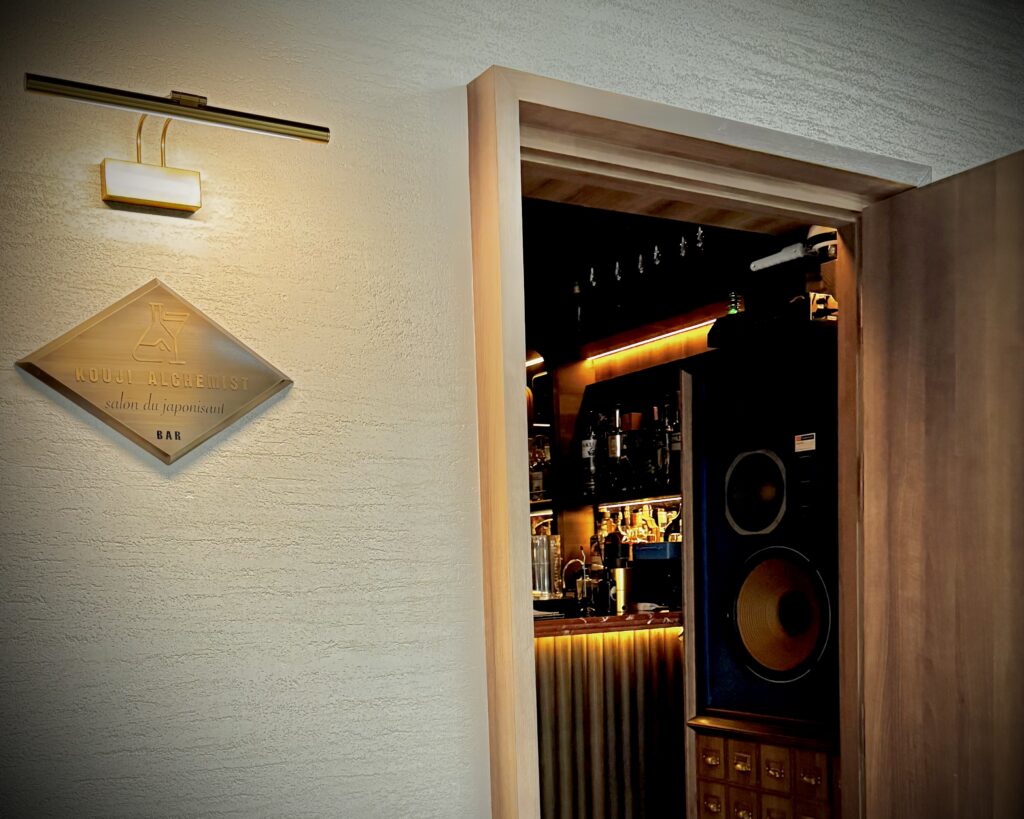
KOUJI ALCHEMIST by salon du japonisant is a premium spirits bar and experiential space in Bangkok’s Sukhumvit district, opened in February 2026. Centered on Japan’s koji fermentation culture, it offers Japanese sake, shochu, and craft spirits alongside koji-inspired cocktails and non-alcoholic beverages. Operated by Bacchus Global Co., Ltd., a Bangkok-based importer specializing in Japanese sake, shochu, and spirits, all products are delivered through a consistent -7°C cold chain from the brewery to Bangkok.
This article is intended solely to explore the cultural heritage and history of Japanese 音楽喫茶 (music cafés) and the global listening bar movement, and does not aim to promote or encourage the consumption of alcohol.
Discover the culture behind every bottle
We share brewery stories, tasting notes and the craft of koji & fermentation — for educational and cultural purposes only.
เราถ่ายทอดเรื่องราวจากผู้ผลิต บันทึกรสชาติ และศาสตร์แห่งโคจิและการหมัก — เพื่อการศึกษาและวัฒนธรรมเท่านั้น
Follow on Instagram Facebook