Tatsugoro Takagi on the Legacy and Future of Juyondai
JUYONDAI was featured in Esquire magazine
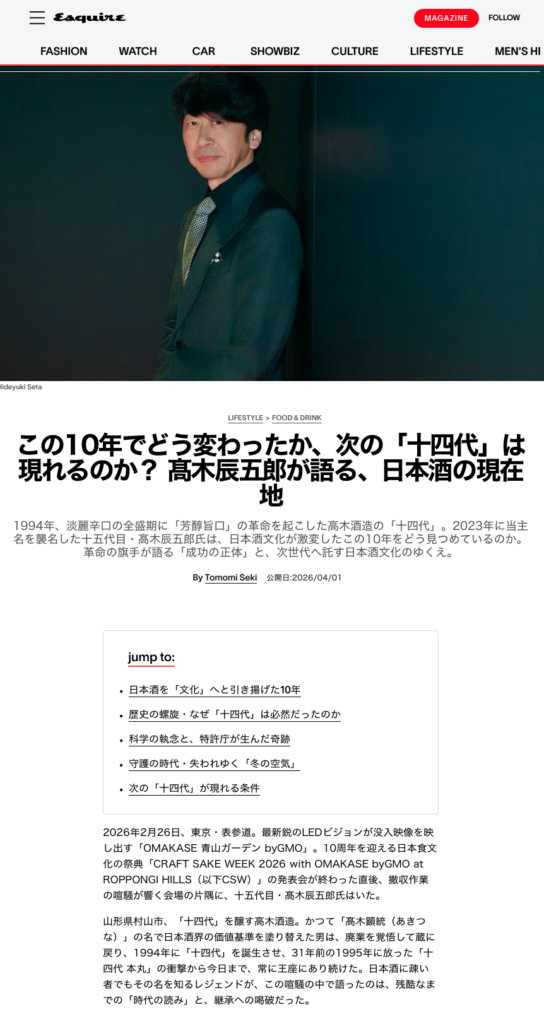
In 1994, at the height of the dry, light “tanrei karakuchi” trend, Takagi Shuzo’s “Juyondai” sparked a revolution with its rich, umami-driven style. Now in 2023, having succeeded to the family name as the 15th-generation head, Tatsugoro Takagi reflects on how dramatically sake culture has evolved over the past decade. The man behind the revolution speaks about the true nature of success and what lies ahead for the next generation of sake.
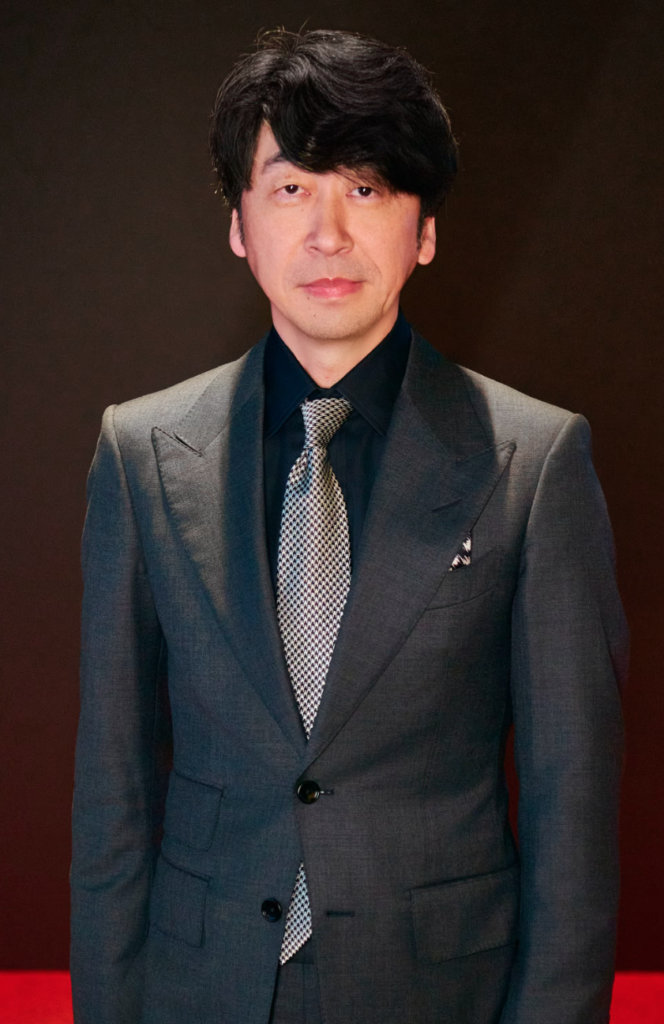
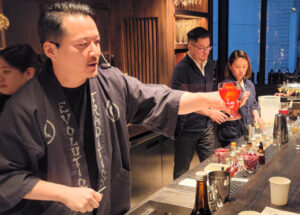
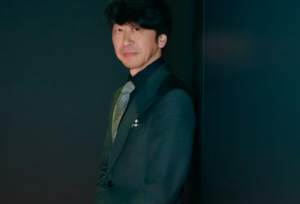
February 26, 2026, Omotesando, Tokyo. At OMAKASE Aoyama Garden by GMO, where cutting-edge LED visuals create an immersive experience, the press event for “CRAFT SAKE WEEK 2026 with OMAKASE by GMO at Roppongi Hills” (CSW), a Japanese food culture festival celebrating its 10th anniversary, had just ended. Amid the noise of teardown, Takagi stood quietly off to the side.
Takagi Shuzo, based in Murayama City, Yamagata, is the brewery behind “Juyondai.” Once known as Akitsuna Takagi, the man who redefined the standards of sake returned to the brewery prepared to shut it down, but instead created “Juyondai” in 1994. Since the shockwave of “Juyondai Honmaru” in 1995, he has remained at the top for over three decades. Even those unfamiliar with sake know the name. What he shared in that chaotic setting was an astute reading of the times and a profound perspective on succession.
The Decade That Elevated Sake into a Global Culture
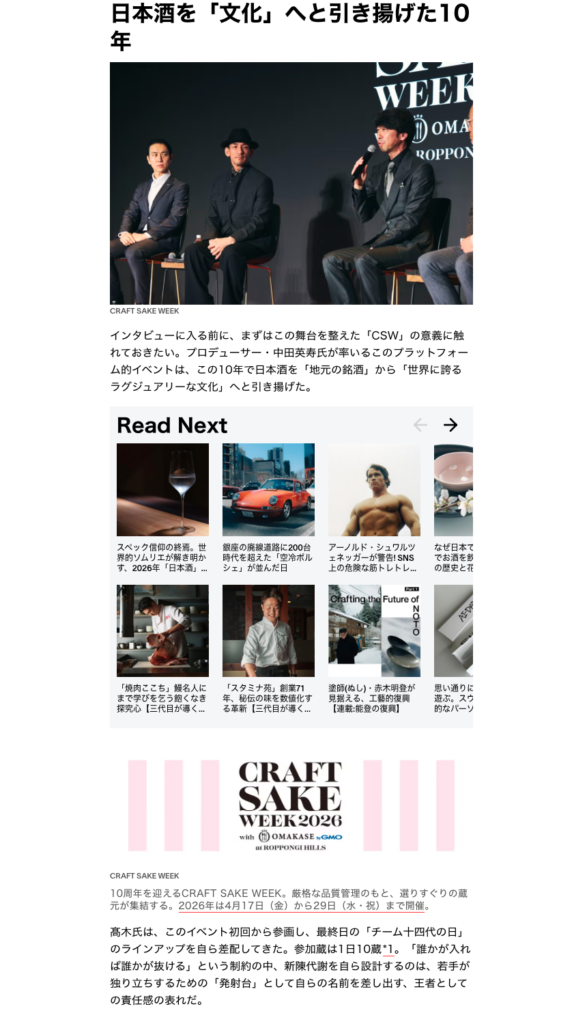
Before diving into the interview, it is important to understand the significance of CSW. Produced by Hidetoshi Nakata, the event has, over the past decade, elevated sake from a local specialty to a luxury cultural product recognized worldwide.Takagi has been involved since the very first edition, personally curating the lineup for the final day, “Team Juyondai Day.” With only ten breweries allowed per day and a strict rule that one must leave if another joins, he deliberately engineers turnover, offering his own platform as a launchpad for younger brewers. It is a gesture that reflects the responsibility of someone at the top.
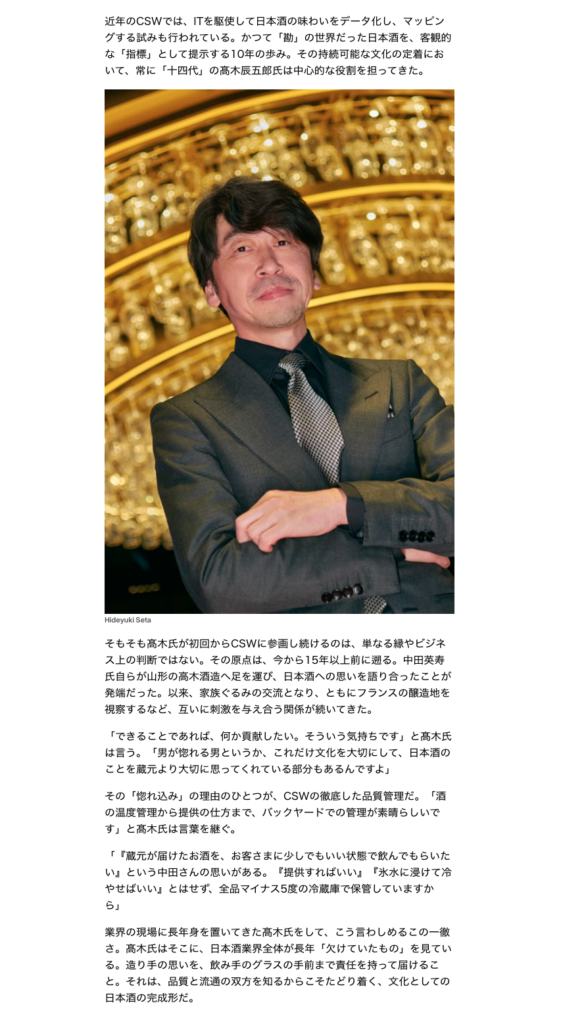
In recent years, CSW has also used technology to map and visualize sake flavors, transforming what was once governed by intuition into something measurable and objective. Throughout this evolution toward a sustainable cultural framework, Takagi has remained a central figure.
His involvement, however, goes beyond business or convenience. It dates back over 15 years, when Nakata himself visited Takagi Shuzo in Yamagata and shared his vision for sake. Since then, their relationship has grown into a family-level bond, even traveling together to wine regions in France, continually inspiring one another.
“If there is anything I can do, I want to contribute,” Takagi says. “He is an individual who commands deep respect. He values culture so deeply, sometimes even more than the brewers themselves.”
One reason for that admiration is CSW’s uncompromising quality control.
“From temperature management to how the sake is served, the behind-the-scenes operation is outstanding,” Takagi explains. “There is a clear intention: to deliver the sake from the brewer to the customer in the best possible condition. It is not just about serving it or chilling it in ice water. Everything is stored at minus five degrees.”
For someone who has spent decades in the industry to praise it this highly, it reveals what has long been missing: taking full responsibility for delivering the brewer’s intent all the way to the glass. That is what defines sake as a true cultural product.
The Spiral of History: Why Juyondai Was Inevitable
Looking back over the past 30 years, Takagi’s revolution appears almost inevitable.
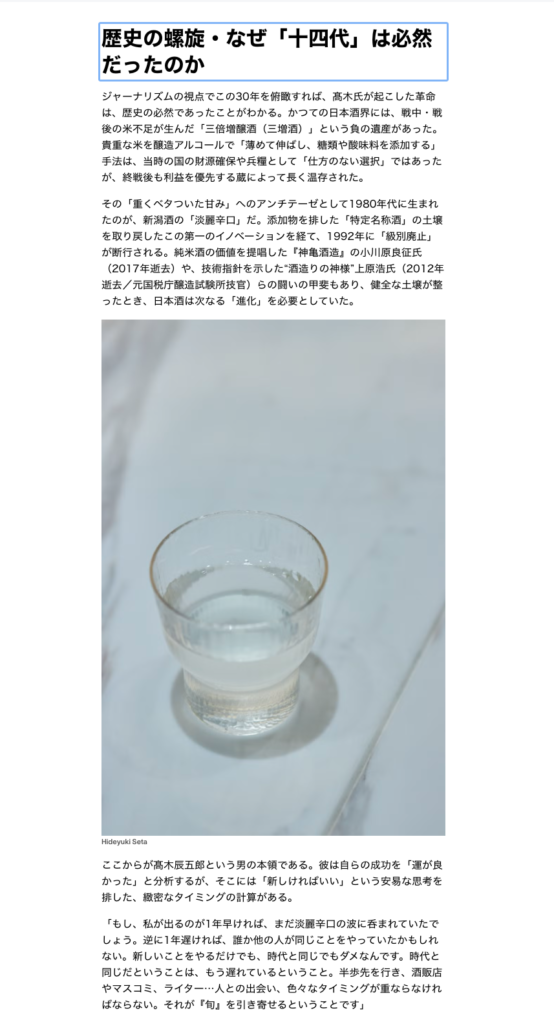
The sake industry once carried the legacy of “sanbaizoshu,” a wartime method of stretching scarce rice by diluting it with brewing alcohol and adding sugars and acids. Though unavoidable at the time, it persisted postwar as profit-driven producers continued the practice.
The “tanrei karakuchi” style of Niigata in the 1980s emerged as a response: clean, dry, and additive-free. This marked the first major innovation, restoring the foundation of quality sake. Then in 1992, the grading system was abolished, further paving the way for change.
It was at this moment that sake needed its next evolution, and Takagi delivered it. He describes his success as “luck,” but in reality, it was precise timing.
“If I had come out one year earlier, I would have been swallowed by the dry trend. One year later, someone else might have done the same thing. It is not enough to be new, and you cannot be the same as the times either. Being the same means you are already behind. You need to be half a step ahead, and everything from retailers and media to relationships has to align. That is what creates the right moment.”
“Juyondai” did not reject the past; it revived the rich umami that once existed before the war, while adding a new dimension of fruity aromatics through scientific exploration.
Interestingly, Takagi’s father, the 14th-generation head, had a deep fascination with distilled spirits like tequila and even imported a Charentais pot still from France to produce rice shochu. His intellectual curiosity about aroma intersected with his son’s scientific approach, giving birth to this “second innovation.”
An Obsession with Science and a Trademark Miracle
Behind Takagi’s concept of timing lies rigorous logic. Both he and his father studied brewing at Tokyo University of Agriculture, forming a two-generation academic foundation for “Juyondai.”
At the center was his mentor, Professor Ken Hosaka, who invested his own money to teach students what real flavor meant. Even after graduation, he stayed at the brewery, working alongside Takagi to design the sake. Techniques now considered standard, like second-by-second water absorption control and fermentation methods that enhance fruity aromas, were born from this hands-on research.
There is also a curious story behind the name “Juyondai.” Originally registered by his father for aged sake, it was part of a series including “13th,” “14th,” and “15th.” Normally, numbers alone are not accepted as trademarks, but for some reason, only “14th” passed.
Takagi boldly repurposed the name for fresh sake and launched “Honmaru” at an unprecedentedly accessible price point for its quality.
“Why only 14 passed, I still do not know. Maybe they read it differently. But without that name, it would not have been etched into history.”
The brand was brought to prominence by passionate retailers such as Suzuden in Yotsuya, Koyama Shoten in Tama, and Izumiya in Koriyama. Even today, Takagi maintains relationships with places like Akaoni in Sangenjaya and GORI in Shinjuku, which supported him in obscurity, never wavering. That consistency is what protects a brand in an era of information overload.
The Era of Guardianship and the Loss of Winter Air
Toward the end of the interview, when asked what has been lost in the past decade, Takagi answered candidly:
“With refrigeration, we can now produce fresh sake year-round, which is wonderful. But if I had to name something, it would be the beauty of winter brewing. The crisp, clean air, free of dust, dry, and pure, creates a clarity you cannot replicate. When a brewer says, ‘It’s good for something made in summer,’ it means they understand that winter brewing is still the ideal.”
He also expressed concern about seasonal marketing distortions, such as hiyaoroshi (sake traditionally aged until autumn) being released earlier to avoid overlap with new sake.
At the core of his philosophy is the act of looking back.
“I think the industry has started to forget that. Our predecessors made a thousand mistakes and passed that knowledge on to us. Each brewery needs to revisit its own history. There is something in the past that still tastes better, you just do not notice it if you are only focused on the present.”
The more you move forward, the more you must look back. That paradox defines his role as a guardian.
“Always face forward, but look back half a step ahead. If you are aligned with the times, you are already late.”
Will There Be Another Juyondai?
“What matters most is not expanding the brewery; it is passing the baton at the perfect time to the next generation. My role now is to create an environment where my son can succeed.”
There is no hesitation in his words as the 15th-generation head.
“I no longer hold personal dreams,” he reflects, not out of despair. Having reached the pinnacle he once admired, he has moved beyond personal ambition toward a public mission: preserving the backbone of sake culture for future generations.
When asked whether another “Juyondai” will emerge, he answered:
“This is a golden age. Breweries like Aramasa, Jikon, Hiroki, Nabeshima, and Toyo Bijin, everyone is making great sake. But great taste alone is not enough to stand out. Beyond technique, you need alignment with the times and a chain of passion.”
As the sounds of teardown echoed through the venue, Tatsugoro Takagi quietly walked away.
The 30 years of revolution are over. The next decade of guardianship has already begun. What he sees ahead is not the noise of trends, but a quieter, more disciplined future where sake endures as a true cultural force.