

220 Years of the Heitzmann Family in Ammerschwihr
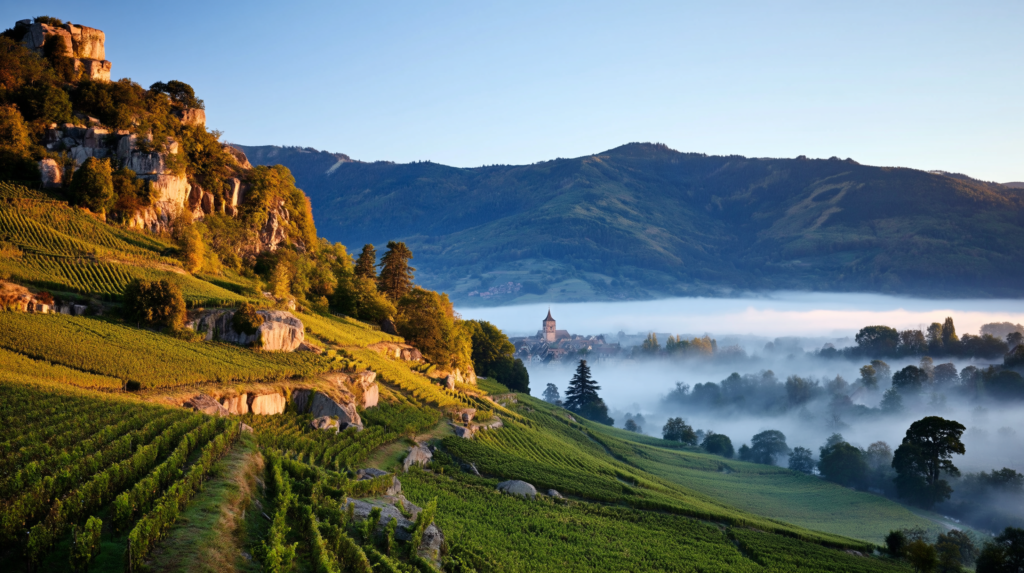
One of the Village’s Oldest Winegrowing Families In Alsace, in northeastern France near the German border, the Vosges Mountains block rain clouds from the west, creating one of the driest and sunniest climates in the country. In the small village of Ammerschwihr, the Heitzmann family has been quietly growing grapes since 1804. The vineyard has been passed down through seven generations, and today the estate is guided by Laurence Heitzmann. Across roughly 12 hectares, the family cultivates nine grape varieties, including Riesling and Gewürztraminer. They also hold precious parcels in two of Alsace’s 51 Grand Crus: Kaefferkopf and Schlossberg. With only 51 Grand Cru sites in all of Alsace, it is a rare distinction for a family-run domaine to steward land in two of them.
Stewardship of the Land: Embracing a Neighbor’s Heritage A significant moment of transition occurred in 2017. Domaine Clément Klur in the neighboring village of Katzenthal was facing a succession challenge. Klur was highly regarded as a pioneer of biodynamic farming—an organic approach guided by celestial cycles and natural rhythms—but there was no one to carry on the work. Its roughly five hectares of steep-slope vineyards required dedicated care to maintain their vitality. The Heitzmann family chose to integrate the estate. Having practiced biodynamic farming since 2008 and earned Demeter certification, the international standard for biodynamics, in 2016, they saw it as a natural responsibility to take over the vineyards of a neighbor who shared their deep respect for the land. The acquisition expanded their holdings to about 17 hectares and entrusted them with an additional Grand Cru site, Wineck-Schlossberg.
Cultivating Harmony: Forest Herbs and the Lunar Calendar The Heitzmann family uses neither synthetic pesticides nor herbicides in the vineyard. They manage the rows alternately, allowing one row to grow wild while cultivating the next. To maintain the health of the vines, they rely not only on Bordeaux mixture—a traditional blend of copper sulfate and lime—but also on herbal decoctions carefully prepared from nettle, willow, dandelion, and horsetail gathered from the surrounding forest. Their vineyard work follows a calendar attuned to lunar cycles, and fruit trees are planted around the vines to attract beneficial insects and birds. The philosophy is to nurture the vineyard as a complete, self-sustaining ecosystem, maintaining a natural balance without chemical intervention. All harvesting is done entirely by hand. On the steep slopes, this is partly a practical necessity, but it also serves as the ultimate form of quality control, ensuring that only the healthiest fruit is selected for pressing.
The Wisdom of Old Vines The Riesling Vieilles Vignes is crafted from vines between 35 and 70 years old, rooted in plots just outside the Grand Crus. Compared with younger vines, these older plants send their roots much deeper into the earth, drawing complex nourishment from Alsace’s intricate layers of granite, gneiss, and clay-limestone soils. Fermentation unfolds naturally using only indigenous yeasts, and the wine is patiently aged in traditional Alsatian large oak casks known as foudres. The winemaking philosophy is strictly minimalist: to reflect in the bottle, as faithfully as possible, the precise conditions of the vineyard and the vintage. In the glass, the wine presents a pale yellow hue with subtle green highlights. The delicate aromas of citrus and white flowers gradually unfold into the distinct mineral nuances characteristic of traditional Alsatian Riesling. Dry and elegantly structured on the palate, it reveals a profound depth derived from elements drawn up through multiple ancient soil layers. While the domaine has been consistently recognized by the French wine guide Guide Hachette des Vins for over two decades, it has remained relatively under the radar of major international critics—a reflection of the quiet, artisanal nature of a family-run estate dedicated to personal relationships with its patrons rather than commercial acclaim.
In Bangkok’s refined culinary landscape, artisanal Alsace wines are still encountered less frequently than those from Burgundy or Bordeaux. However, as appreciation for sustainable and biodynamic philosophies continues to mature, more hospitality professionals are resonating with this mindful approach to viticulture. The taut minerality born from granite soils presents intriguing possibilities alongside Thai cuisine, particularly dishes intricately layered with fresh herbs and spices.
For 220 years, the Heitzmann family has nurtured the same village soil, embraced a neighbor’s heritage, and continued to craft wine guided by forest herbs and the lunar calendar. The true value cultivated by their labor lies not in scale or volume, but in the profound, enduring depth of their relationship with the land. (Mr. Bacchus)
This article is intended solely to explore the winemaking artistry and cultural heritage of Domaine Léon Heitzmann and the Riesling Vieilles Vignes brand, and does not aim to promote or encourage the consumption of alcohol. / บทความนี้จัดทำขึ้นเพื่อนำเสนอข้อมูลเกี่ยวกับศิลปะการทำไวน์และมรดกทางวัฒนธรรมของ Domaine Léon Heitzmann และแบรนด์ Riesling Vieilles Vignes เท่านั้น มิได้มีเจตนาเพื่อส่งเสริมหรือโฆษณาเครื่องดื่มแอลกอฮอล์ สำหรับผู้มีอายุ 20 ปีขึ้นไป โปรดดื่มอย่างรับผิดชอบ